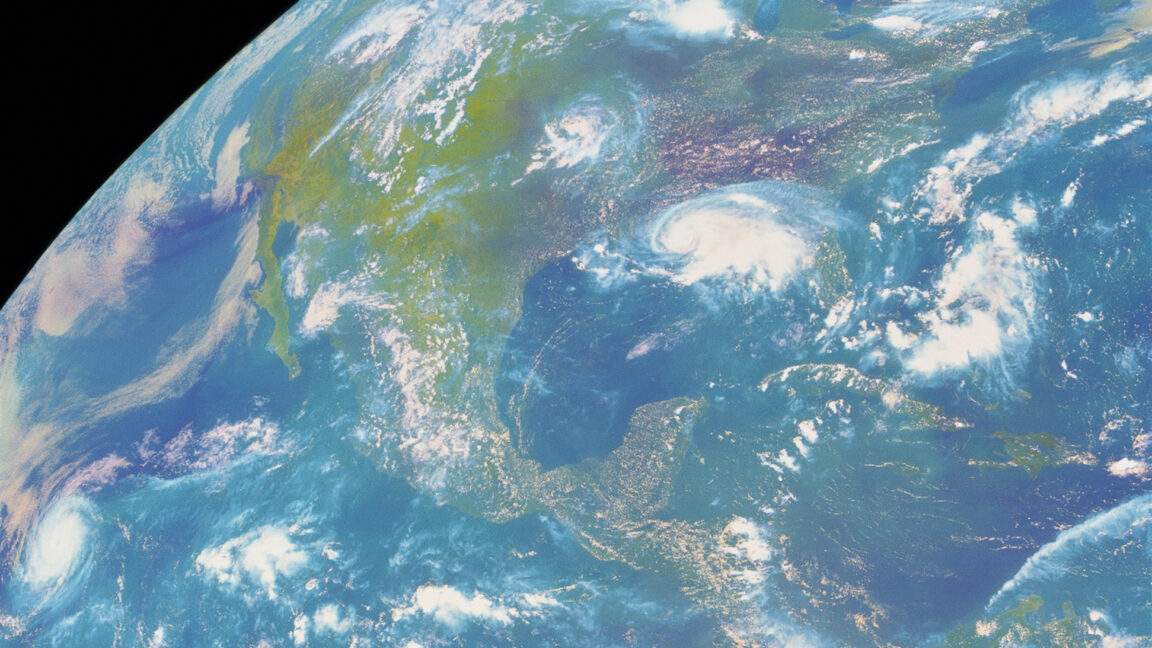
Update to Google’s AI weather model improves forecast accuracy
WeatherNext 3 adds raw satellite inputs and hourly runs, cutting reanalysis lag—and posting measurable gains over WeatherNext 2 and ECMWF’s AI model, with a few odd artifacts.
The file
Sourced AI briefs in publish order — newest first. Citeable originals live on the homepage under From Signal Desk.

WeatherNext 3 adds raw satellite inputs and hourly runs, cutting reanalysis lag—and posting measurable gains over WeatherNext 2 and ECMWF’s AI model, with a few odd artifacts.

NYU’s Tristan Buckmaster says OpenAI raced a rare Navier–Stokes attack path after learning of his team’s progress—then floated credit pressure and career threats when he went public.

Former FTC lawyers are expanding a class action arguing Anthropic’s Max “5x” and “20x” marketing hid five-hour sessions and weekly caps that shrink real capacity.

MIT’s EQuS lab wired GPT-5.6 Sol through Codex into real dilution-fridge control software, turning overnight qubit calibration into an agent job rather than a graduate-student vigil.

OpenAI’s Navier–Stokes announcement landed inside a credit fight: NYU’s Tristan Buckmaster says the lab raced after learning of his and Anthropic’s Levent Alpöge’s related Euler work.

Google Cloud’s Accenture Gemini Enterprise Business Group buys consulting feet on the ground—up to 1,000 trained FDEs—because model share alone is not converting hyperscale CapEx into sticky enterprise ROI.

Chrome 153 lands on a two-week cadence—halving the old four-week train—as Google treats AI-boosted vuln discovery and AI-boosted attacks as reasons to shrink the N-day gap.

DeepMind turns AlphaGenome into a precomputed catalog of roughly nine billion single-letter DNA variants, aiming to make mutation triage a lookup rather than a bespoke model run.

OpenAI CFO Sarah Friar argues that GPT-6 Astra, a billion-user consumer base, and in-house inference silicon form a compounding loop of capability, demand, and cheaper serving.

NVIDIA opens two official Rust paths to native PTX kernels—SIMT via cuda-oxide and Tile via cutile-rs—betting the AI systems stack will keep migrating to Rust.

Former DeepMind researcher Danijar Hafner’s stealth robotics startup bets model-based reinforcement learning can carry game-trained planners into unfamiliar physical spaces.

OpenAI says an internal multi-agent system—stronger than GPT-6 Astra—produced a Lean-checked singularity proof for Navier–Stokes statements C and D, and it will not claim the Millennium Prize.