Fly Language Model (FLM) Wires the Full Fruit Fly Connectome Into a Frozen 1.2B LLM, and Its Own Controls Show the Wiring Does Not Help
Sep 12, 2026, 11:51 AM · MarkTechPost
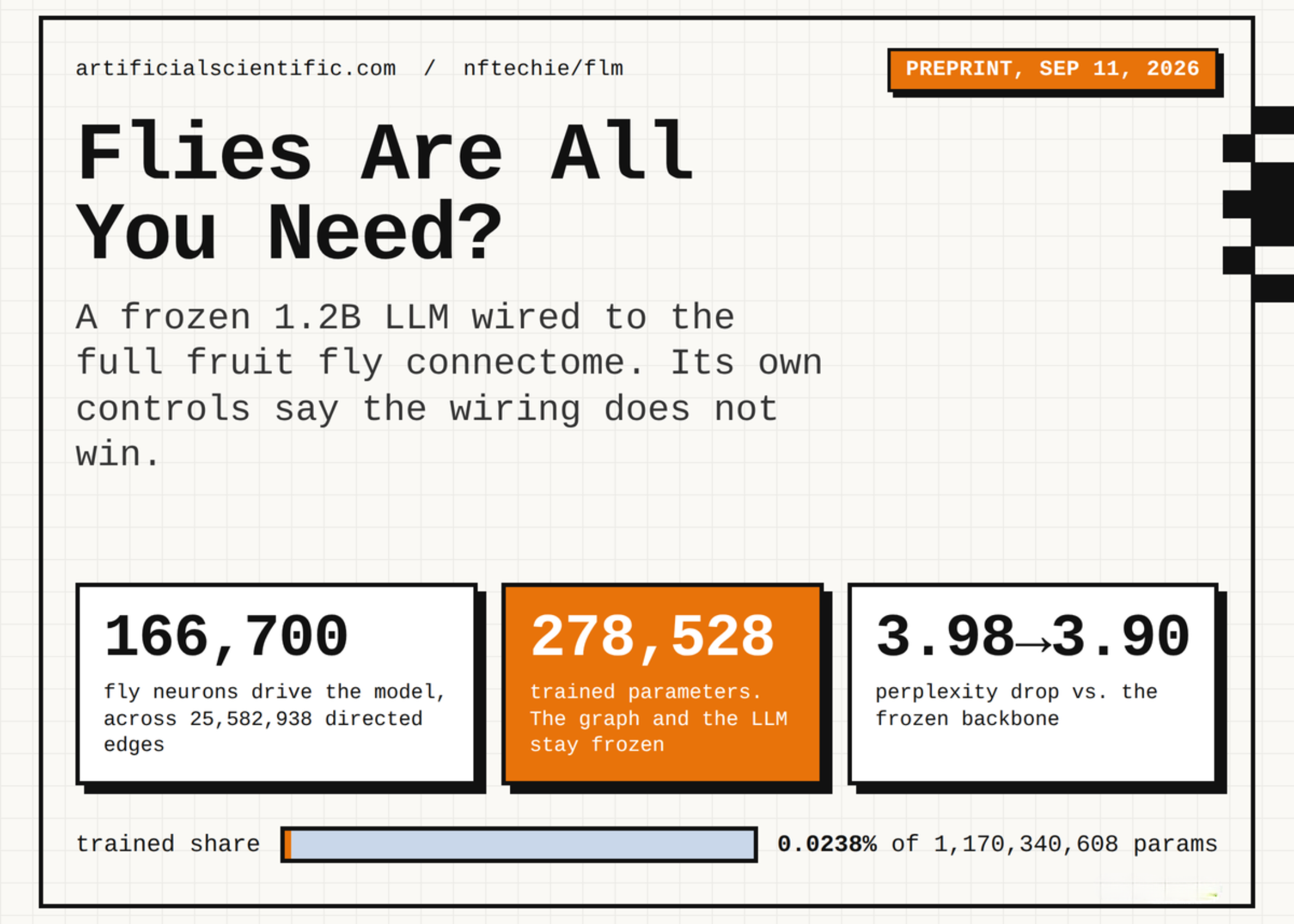
A public “Fly Language Model” wires the full fruit-fly connectome into a frozen 1.2B LLM—and its own controls show the fly graph doesn’t beat a no-graph readout.
Why it matters
Neuroscience-meets-LLM demos love a headline. FLM couples the complete retained MaleCNS v1.0 fruit fly connectome—166,700 nodes, tens of millions of directed edges—to a frozen LiquidAI LFM2.5-1.2B-Instruct backbone, training only a tiny readout.
The honest part is rarer than the headline: a parameter-matched control without the fly graph performs slightly better. The graph participates; it does not win.
From the desk
We’re covering this because negative controls are news.
The architecture is a reservoir bolted onto a language model. Token embeddings project down to 128 channels, drive the anatomical graph with a tanh recurrence, pool, and add a bounded residual to the frozen backbone’s logits. Only about 278,528 readout parameters train—roughly 0.0238% of the backbone. On a held-out SmolTalk slice, the fly readout improves backbone NLL by 0.0222 nats/token, but a direct-input control with no graph beats it in all three seeds by a small margin whose bootstrap interval doesn’t support a fly-specific gain.
Two other checks keep us honest. Zeroing the graph removes the residual exactly—so the wiring is really in the loop. Relabeling nodes without refitting collapses back toward baseline—so the readout learned an interface alignment, not a proof that fly topology beats random wiring. The recurrence contracts state differences by at most 0.6 per token; after a couple dozen tokens the bound is tiny. You don’t buy long memory by pouring in 166,700 cells. Context still comes from the backbone.
We’re for weird, careful experiments that publish their own defeat conditions. Useful AI research looks like this more than like connectome mystique. The downside if the framing spreads carelessly is another round of “brain-inspired” marketing that outruns the ablation tables. Credit to the report for disclaiming “first connectome LM” claims and for MIT-licensed local code—even while study artifacts remain private enough that full independent reproduction isn’t there yet.
I’m watching whether follow-ups can find any graph prior that beats the no-graph control—or whether the field quietly learns the reservoir wasn’t the point.
Context
MarkTechPost summarizes the nftechie/flm repo (MIT, Python 3.12, local MPS/CUDA/CPU, no API key) and cites an earlier ngxson/fly-hf prototype on a smaller MaleCNS subset. FLM’s distinction is full retained-graph scale plus a frozen backbone that keeps language competence attributable.
Who feels it
- Neuro-AI researchers
- A public full-connectome reservoir baseline with controls that fail to show topology gains—useful as a caution and a scaffold.
- Science communicators
- The accurate story is “wiring participates, controls win,” not “fly brain makes an LLM.”
- Open-source tinkerers
- Local MIT code invites replication; private study artifacts still limit full verification.
What to watch
- Independent replications with released evaluation artifacts.
- Any follow-up where a connectome prior beats matched no-graph controls.
- Whether “GPF / Fly Language Model” branding spreads faster than the ablation results.