Google announces new experimental "CC" AI agent for families
Sep 17, 2026, 1:24 PM · Ars Technica
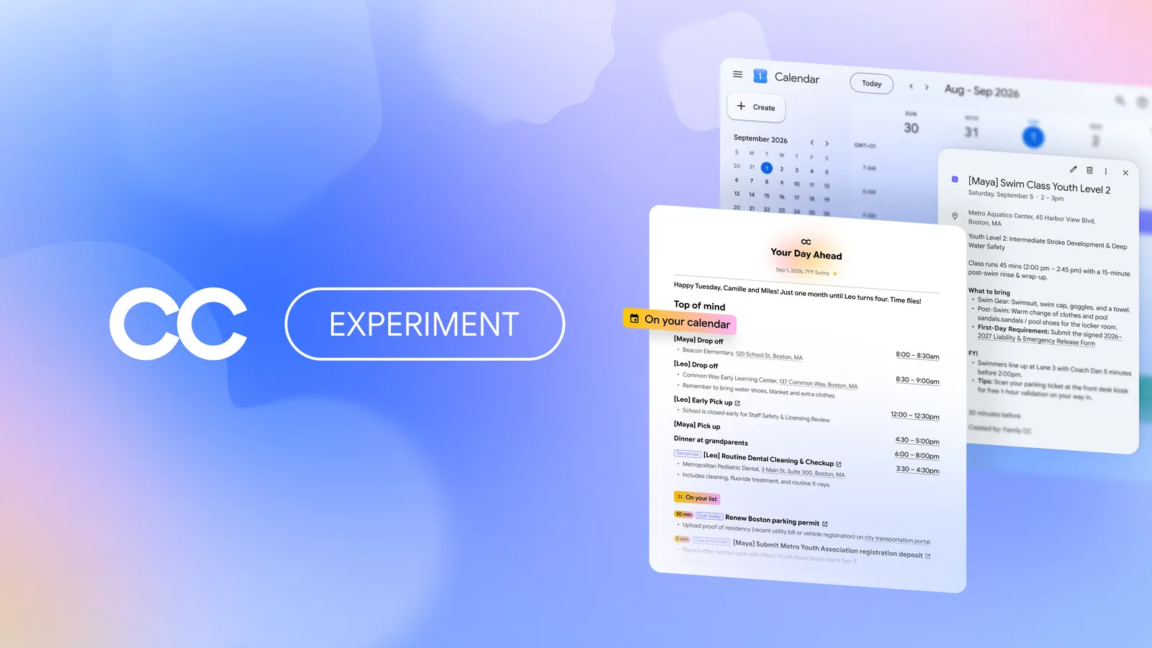
Google Labs’ CC becomes a shared family agent for up to six adults—own Google account, selective email/Drive sharing, morning Day Ahead briefs, PDF chores—on Gemini 3.8 Flash, waitlisted and not for kids’ accounts.
Why it matters
Google’s edge isn’t always the top leaderboard model; it’s the data already living in Gmail, Calendar, Drive, and Chat. CC tries to turn that into a household coordinator instead of a solo Daily Brief.
Each CC instance gets its own account. Family members opt in what the agent sees—always-share school addresses, Chat forwards, a watched Drive folder. It drafts permission slips and calendar items but won’t email outsiders without confirmation.
Useful for chaotic households. Risky if consent, memory, and kid-adjacent data stay fuzzy even when accounts are 18+ only.
From the desk
We’re rooting for agents that eat admin work—and watching the privacy seams.
CC evolves the 2025 experiment that became Gemini’s Daily Brief into a six-person shared brain on an isolated cloud instance via Antigravity and Gemini 3.8 Flash. No Pro model since early year; this isn’t gated to paid subscriptions. Early Daily Brief users upgrade automatically; newcomers waitlist. Personal Gmail, 18+, so parents manage the household rather than kids chatting the bot—legal baggage Google is clearly dodging for a Labs trial.
Useful AI looks like this when it works: fewer missed school emails, shared day plans, forms mostly filled. The downside if “explicitly shared” drifts into always-on family surveillance, or if memory of habits outlives someone’s wish to leave the group. Confirmation before external send is the right default. I’m watching waitlist conversion metrics and whether Google publishes clear exit/deletion rules for shared CC memory.
Context
Ars Technica, September 17, 2026. Google Labs experiment; powered by Gemini 3.8 Flash on isolated instances.
Who feels it
- Families in the Google ecosystem
- A shared agent could cut coordination overhead—if consent and sharing controls stay crisp.
- Privacy advocates
- Household agents concentrating email and Drive context create a new high-value target and consent problem.
- Competitors
- Pressure to match multi-user home agents without Google’s data gravity.
What to watch
- Waitlist opening and any paid-tier gating later.
- Published retention and leave-the-family-group data rules.
- Whether CC expands beyond 18+ personal Gmail constraints.
Companies: Google