Things That Go Beep in the Night: Agentic AI Joins the Search for Extraterrestrial Signals
Oct 30, 2026, 8:00 AM · NVIDIA Blog
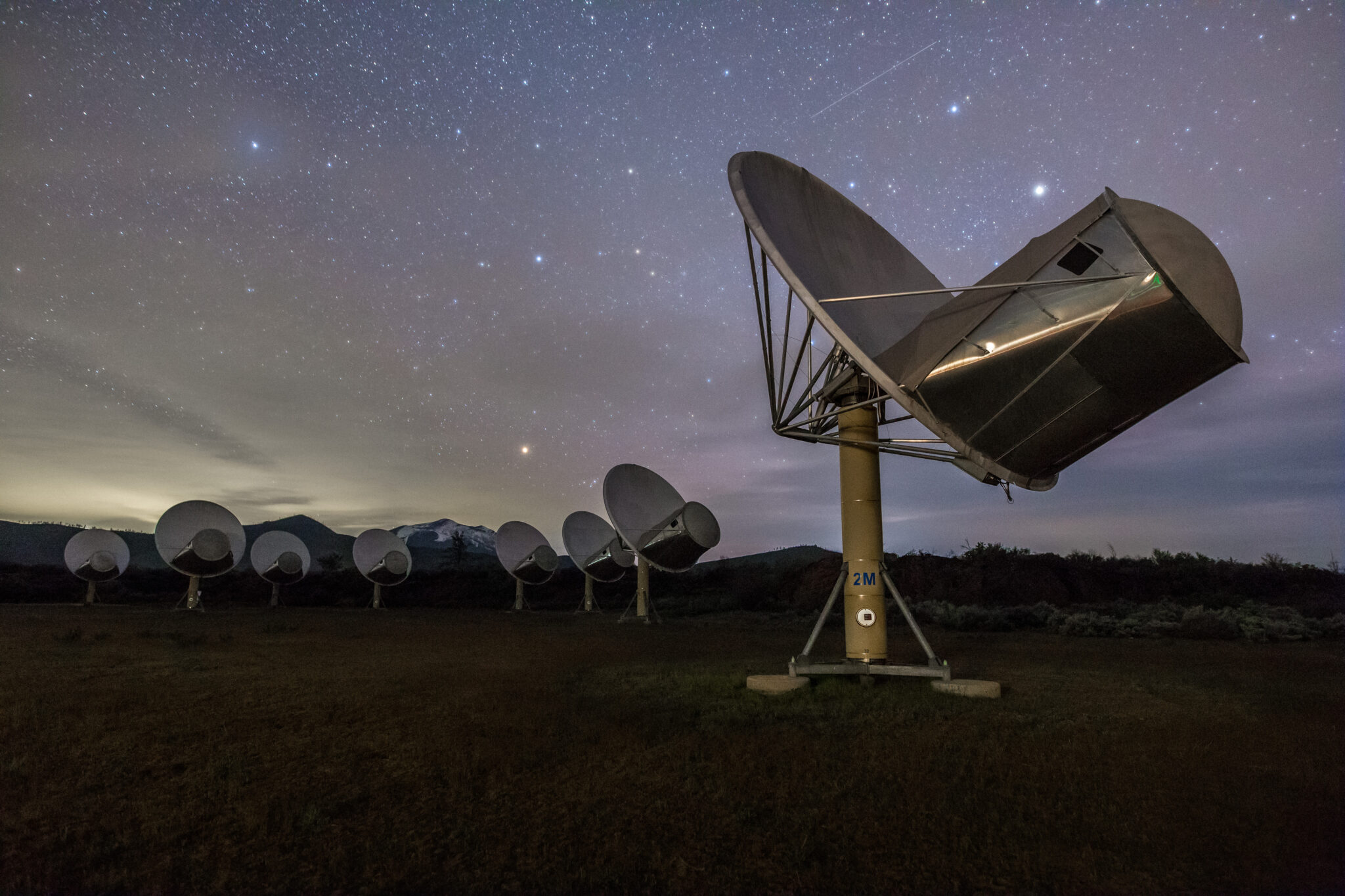
Strip away the Halloween framing and this is a genuinely good use of agents: letting scientists steer a radio telescope and process terabits of data in real time, right at the instrument.
Why it matters
Breakthrough Listen and the SETI Institute are bringing agentic AI into daily operations at the Allen Telescope Array in Northern California. According to NVIDIA, agents there can steer the instrument, calibrate it, catch and correct data errors, and run AI models on the incoming stream, all from a natural language request.
The practical problem is volume. Radio telescopes produce more data than anyone can store and sift later, so the search has to happen as the data arrives. NVIDIA says the system handles 2.4 terabits per second on RTX PRO 6000 Blackwell GPUs, with inference on premises beside the telescope, and that the pipeline has already made the first real-time AI detection of a pulsar, in the Crab Nebula.
From the desk
We're going to be openly enthusiastic about this one. Science is where agents can do the most good with the least collateral risk. Nobody's job is being automated out from under them here, and no private data is being scraped. The trade is simple: researchers spend less time babysitting hardware and pipelines, and more time on the question they actually care about. NVIDIA says agents compress work that would take humans weeks or years into hours. That's a vendor's phrasing, and we'd like to see the researchers' own accounting, but the direction is believable.
The stack is worth understanding. A Holoscan library called DAQIRI pulls sensor data straight into GPU memory so it's processed in flight instead of filling disks. CyberEther, a SETI Institute framework, does the signal math on CUDA libraries. And Nexus, a web-based orchestrator, acts as the agent harness, giving agents one source of truth for instrument state and compute, and letting researchers check packet loss, read live spectrograms, and even rewrite processing blocks by prompting.
That last capability is where I'd raise a hand. An agent that can rewrite signal-processing blocks on the fly is powerful, and it's also a way to quietly change what the instrument is able to see. In a field where the whole game is distinguishing a real anomaly from an artifact, provenance matters enormously. If a candidate signal ever turns up, the first question will be what the pipeline looked like at that moment and who, or what, changed it. Logging every agent action alongside the data isn't optional here; it's the scientific record.
The pulsar detection is the right kind of milestone. A pulsar is a known, verifiable target, so it proves the pipeline works without asking anyone to take an extraordinary claim on faith. We'd treat the more speculative framing, that the search increasingly involves human-built AI listening for alien-built AI, as a thought experiment from the researchers rather than a finding.
Where this leads is the most interesting part. The team is evaluating open models including Nemotron for cases where data locality and turnaround matter most, including observatories that might someday run offline on the far side of the moon. Autonomous instruments that can't phone home will need to be trusted to make judgment calls alone. Getting the guardrails and audit trails right on Earth first is exactly how that should be earned.
Context
The Allen Telescope Array is operated for SETI research, and Breakthrough Listen is a major search program led on the science side by Andrew Siemion of the SETI Institute. A pulsar is a rapidly spinning stellar remnant that emits regular pulses, making it a common test target for signal-detection systems.
Who feels it
- Scientists
- Natural-language control over instruments and pipelines could free researchers from much of the operational grind of radio astronomy.
- Observatories
- On-premises inference at terabit rates shows real-time analysis is feasible without shipping raw data off site.
- AI developers
- Scientific instruments are a demanding proving ground for agents where every action must be reproducible.
What to watch
- Peer-reviewed or researcher-published details on the real-time pulsar detection
- How Nexus logs and versions agent-driven changes to signal-processing blocks
- Results from evaluating open models like Nemotron for offline, on-site operation
- Whether other observatories adopt the same agent harness approach