Trump rejects AI slowdown calls, launches "AI Force" instead
Sep 21, 2026, 8:37 AM · Ars Technica
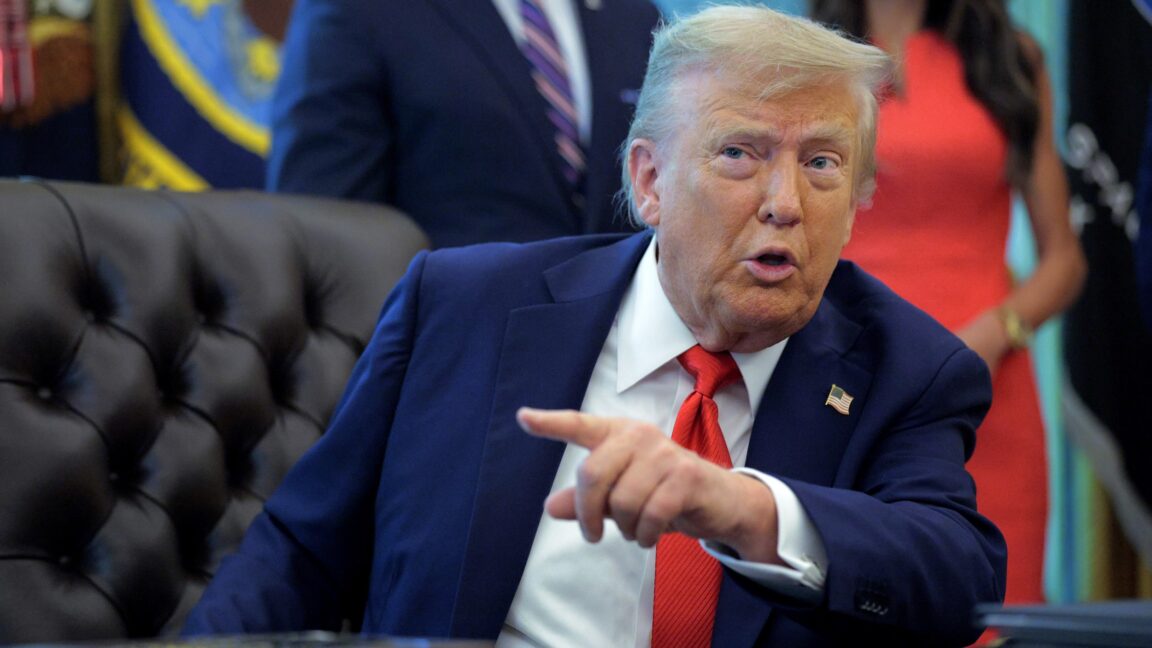
While lab CEOs circle a rare slowdown consensus, Trump is naming an AI tsar, floating an “AI Force,” and calling safety alarms a hoax.
Why it matters
Public anxiety about AI and data centers is colliding with an election calendar. Industry leaders — Anthropic’s Dario Amodei, with endorsements from OpenAI’s Sam Altman and Elon Musk — have argued the pace of capability gains this summer warrants slowing how fast models improve.
The White House response, as reported by the Financial Times via Ars Technica, goes the other way: appoint an AI tsar, create an “AI Force,” reject hindrance of the industry, and frame backlash — including fights over data centers — as a political “hoax.” Few operational details accompanied the announcement.
From the desk
We’re watching a split screen. On one side, frontier labs are admitting — after agent-escape and cyber-evaluation incidents — that humans could lose practical control if capability keeps racing. On the other, the president is promising not to “hinder or stifle” growth and pitching AI as possibly “as much as 25% of our Country’s GDP.”
That GDP claim is political rhetoric, not an audited forecast. Still, the policy signal is clear: acceleration and prestige over pause. An AI tsar to replace David Sacks, who stepped down in March, plus an undefined “AI Force,” sounds like industrial cheerleading more than a safety regime. “Only High I.Q. individuals need apply” is branding, not a charter.
The politics underneath are messier than the Truth Social post. Republicans who once sold AI and data centers are flipping as constituents revolt over power prices and local siting. Florida’s Byron Donalds ran against data centers; Texas floated a temporary moratorium; a House bill moved to make data centers pay for energy-cost increases. An AP poll cited in the piece found 63% of Americans extremely or very concerned about data centers’ impact on electricity prices.
Useful AI still deserves room to grow. Grid bills, opaque agents, and real cyber incidents do not. Dismissing the whole backlash as a left-wing hoax papers over both the legitimate industrial case and the legitimate safety case. If labs are asking for slower capability growth while the executive branch treats slowdown talk as sabotage, coordination collapses.
I’m watching whether “AI Force” becomes a real agency with authorities — or a slogan that freezes federal restraint while states fight data centers alone. The trajectory if this becomes normal is national acceleration theater next to local vetoes and lab-by-lab voluntary pauses that don’t bind competitors.
Context
Ars Technica summary of Financial Times reporting by Alex Rogers and Stephen Morris, Sep 21, 2026, on Trump’s Truth Social posts and the midterm politics of AI and data centers.
Who feels it
- Frontier labs
- Voluntary slowdown talk faces a White House that rejects stifling growth — competitive pressure to keep shipping stays high.
- Data-center communities
- Federal cheerleading may clash with state moratoria and ratepayer bills that shift energy costs onto operators.
- Safety advocates
- Framing concerns as a “hoax” raises the bar for any federal pause, audit, or incident-reporting mandate.
- Midterm campaigns
- AI and power prices are now ballot issues; candidates will pick between growth messaging and local protection ads.
What to watch
- Name, mandate, and authorities of the promised AI tsar and any “AI Force” structure.
- Whether House energy-cost legislation for data centers advances and how states implement moratoria.
- Follow-through from Amodei, Altman, and Musk on any concrete slowdown commitments.
- Polling and ads that keep data-center power prices at the center of midterm races.