Yandex Introduces Sona: A Single Generative Recommender That Replaces Entire Recommendation Cascade
Oct 5, 2026, 1:10 AM · MarkTechPost
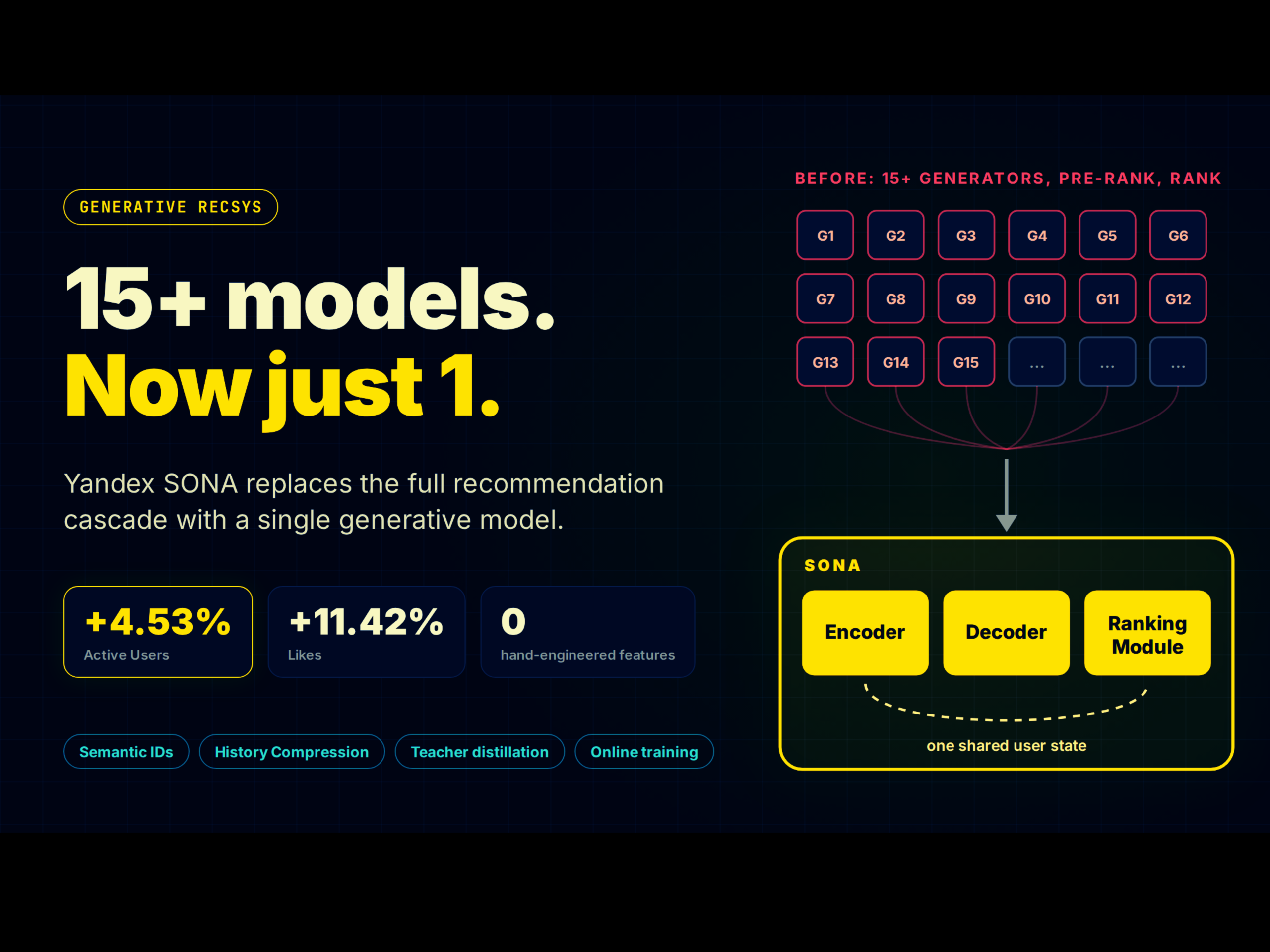
Yandex collapsed a music recommender’s whole cascade — 15-plus generators, a pre-ranker and a ranker — into one transformer, and live users listened more. The engineering is impressive; the engagement lever is the story.
Why it matters
According to MarkTechPost’s write-up of Yandex’s Sona technical report, the company replaced a classic multi-stage recommendation system on its smart speakers with a single generative model. In a seven-day online A/B test on 15% of randomly selected users per split, Sona stood in for more than 15 candidate generators, the pre-ranking stage and the ranking stage.
The reported results were statistically significant: active users up 4.53%, total listening time up 6.30%, likes up 11.42% and “repeat” commands up 17.99%. The active-user lift is 2.35 times what Yandex’s earlier Argus transformer delivered on the same surface.
Most recommenders that run the internet are stacks of separately trained models fed by hundreds of hand-built features. A credible production result showing one model can replace the stack — with no hand-engineered features at all — is a meaningful signal for how recommendation systems will be built next.
From the desk
We think this is one of the more important quiet results of the year for anyone who builds ranking systems. Cascades exist because no single model could do it all cheaply. Each stage optimizes its own goal, and the final ranker only sees what earlier stages let through. Sona reads a listener’s history once, generates candidates as Semantic IDs, and scores them against the same representation. Fewer moving parts, one objective, less feature plumbing. If that pattern holds elsewhere, it shrinks a lot of brittle infrastructure.
The clever piece is training. A 0.6B-parameter teacher ranker scores the candidates the model itself generates during training, and the served ranking module learns to match those scores — then the teacher is removed at serving time. Weights refresh every 10 minutes. That is a practical recipe, not a lab toy.
Now the caveats. There’s no public code or weights, and the write-up is clear this isn’t on full traffic. Comparisons with Kuaishou’s OneRec and Meta’s HSTU come from different platforms and metrics, so nobody should line those numbers up as a leaderboard.
And I want to name what is actually being optimized. Music recommendation is a gentle case — more songs people like is mostly a win. But the same architecture, pointed at short video or news, is a more efficient machine for maximizing time spent. A single model with one objective is easier to tune and also easier to aim. If end-to-end generative recommenders become standard, the question of what they’re rewarded for matters more, not less.
Context
Sona is not the first end-to-end generative recommender: Kuaishou’s OneRec serves a single encoder-decoder model on part of its traffic, and Meta’s HSTU reframed recommendation as sequential transduction in 2024. What the report claims as distinct is the combination of full cascade replacement, no hand-engineered features and a distilled ranker validated online.
Who feels it
- Recommender & ML infra teams
- A strong production argument for consolidating cascades into one model and cutting feature-engineering overhead — though no code or weights are available to try.
- Streaming & consumer platforms
- Engagement gains this size from an architecture change will push competitors to test generative recommenders quickly.
- Users
- Better picks on smart speakers in the near term; longer term, a more powerful engagement engine wherever it’s deployed.
What to watch
- Whether Yandex rolls Sona to full traffic or other surfaces like Yandex Music apps
- Independent replications of the rollout-distillation approach in open recommender frameworks
- Similar cascade-replacement claims from short-video or news platforms, and what objectives they optimize