AI · Nov 9, 2026
OpenAI’s Control Room puts a fail-closed kill switch inside the inference engineBaseten swaps in a Gemma backbone, and the selling point is calibration
· Updated · Signal Desk newsroom
Analysis of reporting by MarkTechPost. How we work
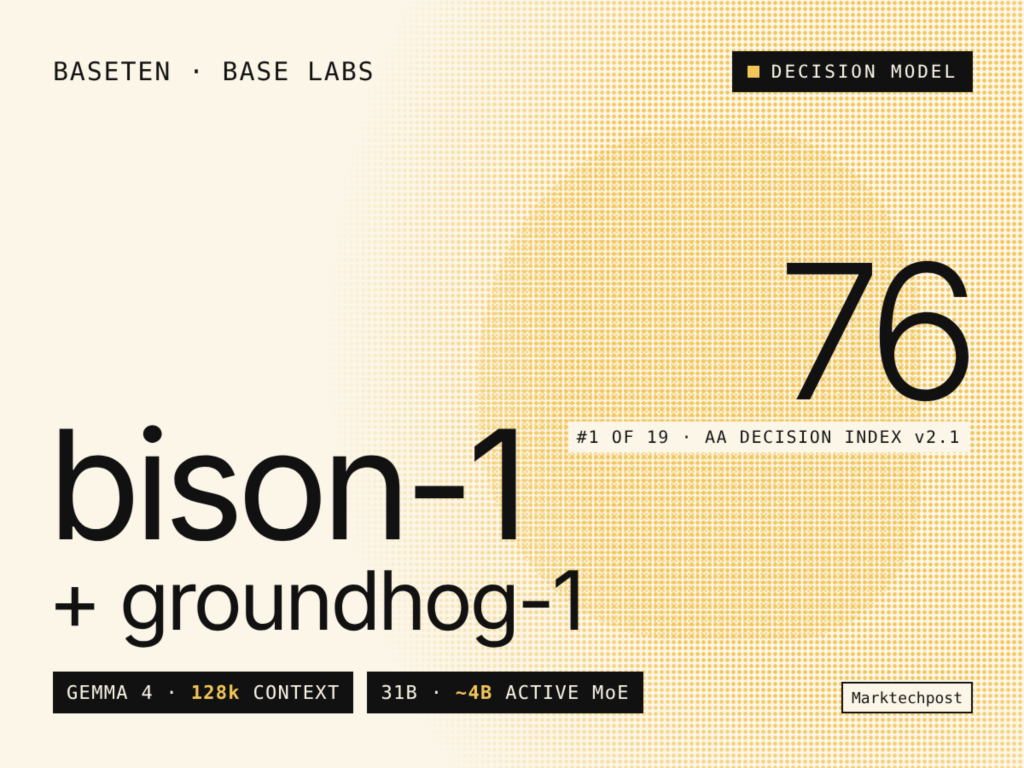
Bison-1 edges Liquid AI by a single point on the Decision Index. The more durable story is Baseten moving to a U.S. base model and pitching honest probabilities over 128k tokens at a dime per million.
Key takeaways
- Baseten released two open-weight decision models on Google’s Gemma 4: bison-1, a 31B dense model, and groundhog-1, a 26B mixture-of-experts with about 4B active parameters.
- Bison-1 scores 76 on Artificial Analysis’s Decision Index v2.1, ranked first of 19 and one point above Liquid AI’s d1.2-ultra.
- Both models expand context from 16k to 128k tokens, accept images, and refuse over-length requests instead of truncating them.
- Bison-1 costs $0.10 per million input tokens and groundhog-1 $0.035; open BF16 weights are on Hugging Face.
- Groundhog-1 has no official index score yet, and the reported numbers come from Baseten.
A crowded category gets a new leader, barely
Decision models have become one of the busiest corners of open-weight AI this fall. They do not write prose. They take a state, ask it any number of yes-or-no, multiple-choice or scored questions, and return probabilities in a single prefill pass with no output tokens. That makes them cheap tools for routing, triage, spam filtering and guardrails. Baseten is back with two new entries after launching its tiny joey-1 last month, and bison-1 now sits at the top of Artificial Analysis’s Decision Index v2.1 with a score of 76.
That lead is one point. Liquid AI’s d1.2-ultra scores 75, and Baseten’s own older mammoth-1 scores 71. A single-point margin on a composite index blending six evaluations is not a moat; it is a snapshot that the next release can overturn. MarkTechPost notes bison-1 ranks first on four of the six components, with knowledge-heavy decisions as its weak spot. Buyers should treat the ranking as a reason to test, not a reason to switch.
The backbone is the business decision
The more interesting move is what sits underneath. Baseten’s earlier lineup, mammoth-1, elephant-1 and joey-1, was built on Qwen backbones. Bison-1 post-trains Gemma 4 31B; groundhog-1 fine-tunes Gemma 4 26B-A4B. Baseten calls this its first release on an American backbone, and that phrase is doing commercial work. For regulated enterprises and public-sector buyers, model provenance has become a procurement question, and a guardrail model that inspects every message is exactly the kind of component legal teams ask about.
That shift looks sensible for Baseten’s customers, but it also says something uncomfortable about the open ecosystem: technical merit is no longer the only axis. Qwen-based models helped make this category cheap and capable. Rebasing onto Gemma is partly an engineering call and partly a hedge against politics. That hedge may become standard for any vendor selling infrastructure-grade models into U.S. companies.
Training scale is modest by frontier standards, which is part of the appeal. Baseten says bison-1 used 192 B200 GPUs and groundhog-1 used 128. That is a reminder that much of the value in this category comes from post-training a strong open base with the right labels, not from building a giant model from scratch. Whoever ships the next good open backbone effectively hands every decision-model vendor a free upgrade.
Calibration is the product
The number that matters most for real pipelines is not the index score but the Brier score of 0.14, the lowest on the index, against 0.15 for d1.2-ultra. A decision model is only useful if its 80% means roughly 80%. Baseten credits the Gemma base and more soft labels in training, meaning probability targets rather than one fixed answer, so the model learns to express uncertainty that tracks how often it is right. For a router deciding whether to escalate to an expensive model, or a moderation layer deciding whether to block, honest confidence is worth more than a point of accuracy.
The jump to 128k context matters for the same pipelines. Full policies, long conversation histories and images can fit in a single call. Baseten reports LongMemEval M scores of 84.8 for bison-1 and 77.4 for groundhog-1. One practical warning: requests beyond the trained limit are refused rather than silently truncated, so systems built around truncation will need a length check. That is the safer behavior for a guardrail, even if it creates new error handling.
Pricing mirrors Baseten’s older pair: $0.10 per million input tokens for bison-1 and $0.035 for groundhog-1. Switching from an older Baseten decision model is a one-line model-name change. Competing options such as Google’s Gemini Decisions API keep the price pressure on.
Who it affects
- Platform engineers
- A drop-in upgrade with longer context and images, but over-length requests now fail loudly.
- Trust and safety teams
- Better-calibrated probabilities make threshold-setting for moderation and jailbreak guardrails more predictable.
- Compliance buyers
- A Gemma backbone may ease provenance reviews that Qwen-based models faced.
- Self-hosters
- Open BF16 weights are available, but roughly 62 GB and 52 GB footprints and no quantized builds limit cheap local use.
What to watch
- Groundhog-1’s official Decision Index score; Baseten expects it to match mammoth-1.
- Independent verification of the Brier and long-context numbers, all currently self-reported.
- Quantized community builds that bring bison-1 onto smaller GPUs.
- Whether rivals answer with their own non-Chinese backbones and market provenance the same way.
FAQ
What is a decision model?
A model that returns calibrated probabilities for yes/no, multiple-choice or scored questions in a single pass, without generating text. It is used for routing, triage, spam detection and guardrails.
How much better is bison-1 than its rivals?
It scores 76 on Artificial Analysis’s Decision Index v2.1, one point above Liquid AI’s d1.2-ultra, and posts a Brier score of 0.14 versus 0.15. The margins are small and the figures are self-reported.
What does groundhog-1 offer?
A cheaper mixture-of-experts sibling with about 4B active parameters, priced at $0.035 per million tokens, with the same 128k context and image input. It has no official index score yet.
More on AI
AI · Nov 11, 2026
OpenAI’s $2 million for children’s AI safety research matters for one promise: publishing bad newsAI · Nov 19, 2026
Perplexity opens its in-house model switchboard to developers, refusal routing includedAI · Nov 24, 2026
A general-purpose model reaches into biology's toolbox, and sometimes grabs the right toolAI · Nov 17, 2026
OpenAI says its models now shave area off production chips, including AMD’s next flagships