Building a Streaming Robotics Learning Pipeline Using NVIDIA Cosmos3-DROID
Oct 5, 2026, 2:41 PM · MarkTechPost
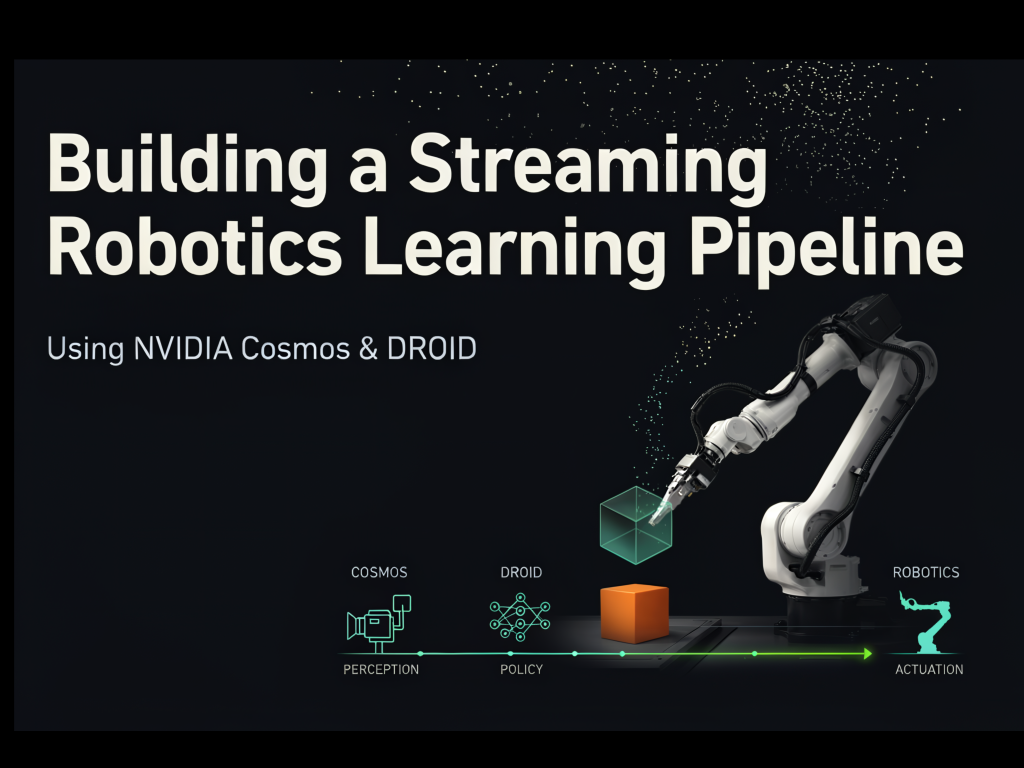
A new walkthrough shows how to train a robot policy from NVIDIA’s huge Cosmos3-DROID dataset without downloading it, a quiet but meaningful step toward making robot learning affordable outside big labs.
Why it matters
Robot learning has a data-gravity problem. The Cosmos3-DROID repository on Hugging Face runs to 707 GB, which is a lot of disk and bandwidth just to start experimenting.
This tutorial streams only what it needs: it reads dataset metadata, pulls selected Parquet row groups and columns over HTTP byte ranges, and decodes only the needed windows of AV1 video. It then trains a small behavior-cloning policy and saves it for reuse. The technique matters more than the specific model.
From the desk
We think this is the kind of unglamorous engineering that actually widens access to AI. Big robotics datasets are only open in theory if using them requires a data center’s worth of storage. Treating the dataset as something to query rather than something to copy lowers the bar for students, small labs and startups who want to try ideas on real-world robot data.
The workflow is thoughtful. It starts by mapping the LeRobotDataset v3.0 structure from its info file, tasks and episode tables, then turns individual episodes into state-and-action trajectories and inspects joint motion, gripper events, end-effector paths and action frequencies before training anything. That habit of looking at the data first is worth copying. The policy itself is ACT-style, predicting chunks of future actions from recent state history and, optionally, wrist-camera images.
We’d keep expectations in proportion, though. The evaluation is open-loop: the model’s predicted actions are compared with recorded ones using per-joint error and R-squared against a mean-action baseline. That shows the model learned something about the demonstrations. It does not show a robot can complete a task, where small errors compound once the policy’s own actions change what it sees next. The setup is also deliberately small, a few dozen episodes and a handful with vision, sized for a notebook.
There’s a dependency to name too. Streaming means relying on a hosted repository staying available and stable. That’s a reasonable trade for experimentation and a fragile one for anything production-grade.
Where this leads if it scales: more people can test robot-learning ideas cheaply, which is good, and more papers and demos may lean on open-loop numbers that overstate real-world readiness. We’d like to see more of the former and more honesty about the latter.
Context
DROID is a real-world robot manipulation dataset, and NVIDIA’s Cosmos3-DROID version is hosted on Hugging Face in the LeRobot format. The tutorial notes the workflow can be extended to more shards, failure demonstrations, additional camera views, language instructions and vision-language-action experiments.
Who feels it
- Robotics researchers and students
- Can prototype on a very large real-world dataset without local storage or a full download.
- ML engineers
- Byte-range Parquet reads and seek-based video decoding are reusable patterns for other large multimodal datasets.
- Robotics startups
- Cheaper experimentation, but open-loop metrics should not be mistaken for deployed robot performance.
What to watch
- Closed-loop evaluations, in simulation or on hardware, of policies trained this way
- More large robotics datasets adopting streaming-friendly formats like LeRobotDataset v3.0
- Whether the approach extends cleanly to language-conditioned vision-language-action training
Companies: NVIDIA