Evolve your marketing with new AI tools
Aug 10, 2026, 7:30 AM · Google AI Blog
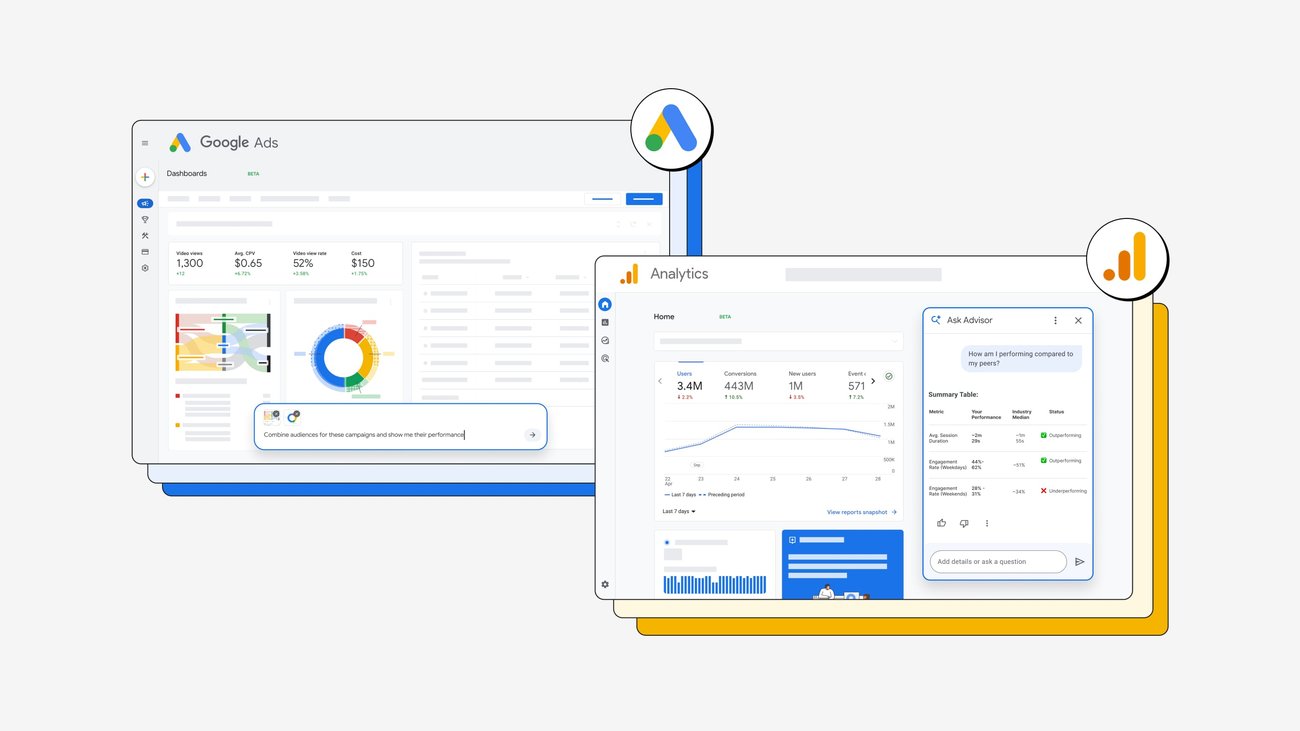
Google is moving interpretation and action closer together inside its ad stack, saving analyst time while deepening dependence on the platform being measured.
Why it matters
Google Analytics now places AI Overviews on its homepage to summarize important performance changes and can send those summaries by phone or email. Context can move directly into Ask Advisor for further analysis. Google Ads adds personalized insight cards and a prompt box for custom questions.
Prompt-created visual dashboards are available in Google Ads and planned for Analytics. Ask Advisor can also compare campaign performance with anonymized averages from similar businesses. The features are built with Gemini and currently available in beta for English-language accounts.
Google presents these additions as a shorter path from noticing a performance shift to changing campaign strategy, collapsing work that once required analysts to construct and interpret reports.
From the desk
The practical gain is not conversational reporting by itself; it is continuity between noticing a change, asking why and altering spend. Google owns the event data, advertising controls and now the interpretive interface, reducing handoffs through the decision loop.
Signal Desk's read: that convenience creates an acute conflict of perspective. The same company selling media is summarizing performance and suggesting action. Marketers should treat the assistant as a fast hypothesis generator, not an independent judge of incrementality or budget allocation.
This is a vendor-authored Google product announcement and includes a favorable customer quotation. Availability, usefulness and performance claims are vendor-reported; the source offers no error rates, controlled productivity study or detail on how peer groups are assembled.
Benchmarking could be valuable if comparison cohorts are stable and genuinely similar. Without transparency into cohort composition, an anonymized average may look authoritative while merely encouraging convergence toward platform-defined norms.
Context
Marketing platforms already centralize campaign measurement, but extracting explanations has required query skills and custom reporting. Natural-language interfaces now let non-specialists build views and request interpretations inside the same system that sells and measures ads.
The product boundary is consequently moving from analytics to semi-automated decision support. That can democratize interpretation, but it may also make Google’s definitions of relevance, peer similarity and opportunity increasingly invisible inside everyday marketing practice.
Who feels it
- Marketers
- Routine reporting may get faster, but consequential budget decisions still require independent validation.
- Agencies
- Basic dashboard work faces pressure, increasing the value of experimental design and cross-channel analysis.
- Analytics teams
- Teams need governance for prompt-created reports, peer benchmarks and recommendation review.
What to watch
- How Google defines and updates similar-business comparison groups
- Whether recommendations expose evidence, uncertainty and alternative explanations
- Expansion beyond English beta accounts and into Google Analytics dashboards
Companies: Google