Germany Wants to Lead the World in Industrial AI: How NVIDIA Will Help
Oct 19, 2026, 12:27 PM · NVIDIA Blog
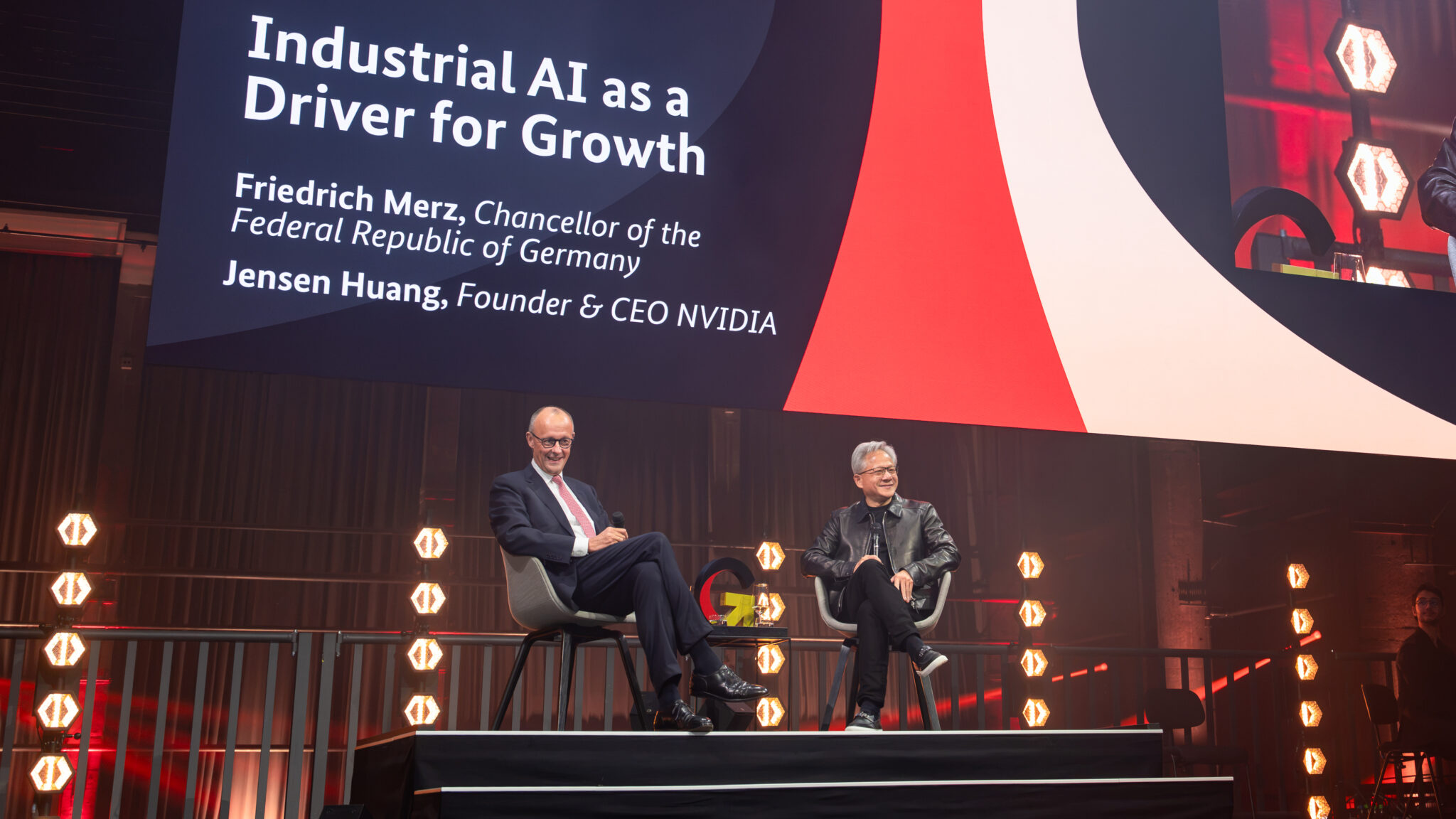
Berlin just signed on with NVIDIA to push AI into factories and the Mittelstand. It's a smart bet on Germany's real strength, and a deeper dependence on one American supplier.
Why it matters
At the Invest in Germany Summit, Chancellor Friedrich Merz and two federal ministries signed a Joint Declaration of Intent with NVIDIA to work on advanced models for physical AI, the kind that runs robots, factories and machines. It formalizes NVIDIA's role alongside Germany's Industry 4.0 Platform, with a stated government goal of bringing industrial AI into widespread use.
Jensen Huang also announced planned investments in four German startups: Agile Robots, Avelios Medical, Mirelo and Reflex Aerospace. NVIDIA frames these as part of a nearly $10 billion commitment across Europe. Same day, Siemens said it is partnering with NVIDIA on autonomous factories, claiming its virtual production ramp-up cuts engineering effort by up to 85%.
From the desk
We think Germany is aiming at the right target. It isn't going to out-chatbot the American or Chinese labs, and it doesn't need to. Its edge is decades of hard-won knowledge about how to build machines, cars and production lines. Physical AI is where that knowledge becomes an asset rather than a legacy, and pairing it with modern models is a sensible national strategy.
The most important line from the stage wasn't about chips. Merz asked Mittelstand owners to open their doors and let AI use their data. That's the real unlock, and the real risk. Small and mid-sized manufacturers hold enormous process know-how, often undocumented. Feeding it into AI systems can make them far more productive. It can also hand their most valuable intellectual property to platforms they don't control. Huang told the audience that knowledge belongs to them. We'd like to see contracts and policy that make sure it stays that way.
Now the trade-off Berlin is accepting. Europe has spent years talking about digital sovereignty. A government-level declaration with a single U.S. hardware vendor, plus that vendor taking stakes in the startups expected to carry the industrial AI wave, deepens dependence even as it accelerates adoption. Both things can be true at once. The question is whether Germany builds enough of its own capability along the way that it could switch suppliers if it ever had to.
A note on the numbers. The Siemens efficiency claims, up to 85% less engineering effort and up to 20% cost savings from agent-based planning, come from a showcase at its own Erlangen plant and are framed as maximums. They're promising, not proven at scale across ordinary factories. And a declaration of intent is not a budget. I'm watching for funded programs, timelines and named projects before calling this a turning point.
Context
This announcement comes from NVIDIA's own blog as part of its European event series. NVIDIA has previously backed German companies including n8n, Neura Robotics and Black Forest Labs. Separately, NVIDIA researchers used JUPITER, Europe's largest supercomputer at the Jülich Supercomputing Centre, to run what the company calls the largest and most detailed simulation of a fault-tolerant quantum computer to date, at 104 qubits.
Who feels it
- German manufacturers
- Political backing to adopt industrial AI, with real gains possible, but data-sharing terms will decide who captures the value of their know-how.
- European startups
- NVIDIA capital is flowing into robotics, health IT, generative audio and satellites, which brings resources and closer ties to one supplier.
- Policymakers
- Germany's sovereignty ambitions now sit alongside a formal partnership with a U.S. chip giant; how the two are reconciled will be closely watched across the EU.
- Workers
- Autonomous-factory pitches promise efficiency; how gains translate into jobs and retraining in German plants is still unaddressed.
What to watch
- Funding amounts and timelines attached to the Joint Declaration of Intent
- Terms of NVIDIA's planned stakes in Agile Robots, Avelios Medical, Mirelo and Reflex Aerospace
- Independent results from Siemens' autonomous manufacturing beyond the Erlangen showcase
- Whether European alternatives to NVIDIA hardware get comparable government backing
- Data-governance guidance for Mittelstand firms sharing industrial data with AI platforms
Companies: NVIDIA