AI · Nov 25, 2026
Nvidia's rulebook now has a CEO exception, and that is the part employees will rememberNvidia's comeback was decided by a weekend of calls from Washington, not by its own directors
· Updated · Signal Desk newsroom
Analysis of reporting by Ars Technica. How we work
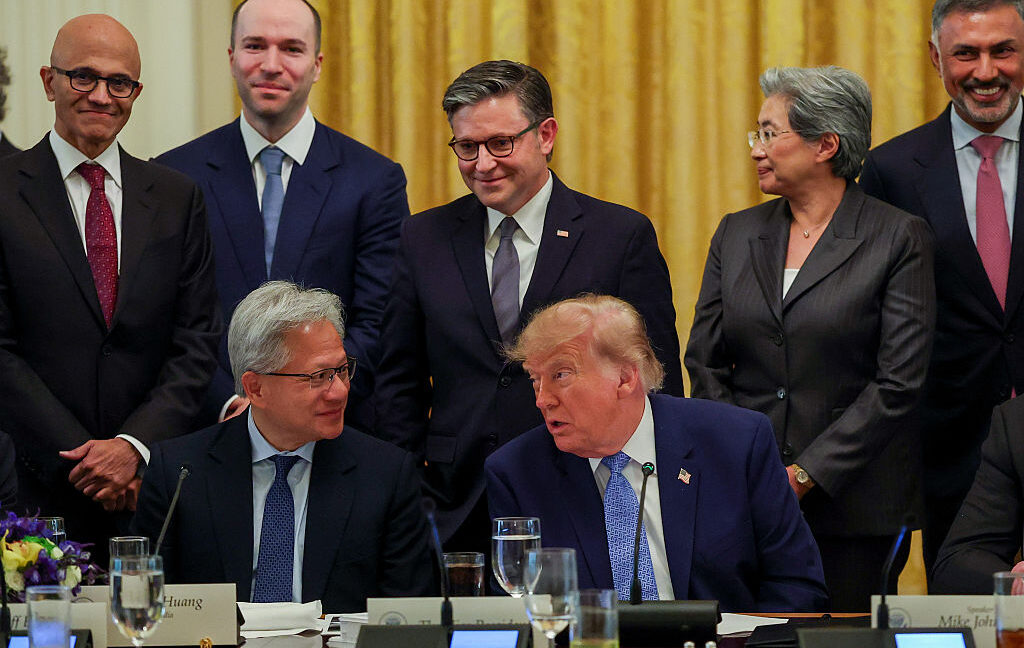
The fuller account of Jensen Huang's return shows investors, a vice president and finally the president working the board until it reversed. The precedent is about who can move a board, not whether Huang deserved the job.
Key takeaways
- The Financial Times, in reporting republished by Ars Technica, says President Trump spoke to Nvidia's board in Huang's defense over the weekend, and that intervention proved decisive.
- A small group of allies, including Travis Kalanick, Gavin Baker, Brad Gerstner, Marc Andreessen and Goldman Sachs executive John Underwood, lobbied publicly and privately for his return, according to people familiar with the events.
- One ally arranged a 45-minute call between Huang and Vice President JD Vance, in which Huang defended his positions on export controls, remote chip access and Megaspeed.
- Interim CEO Colette Kress was reportedly kept out of the talks that ended in a late Sunday board meeting, days after the board chair had publicly ruled out a return.
- Huang owns roughly 3.5 percent of Nvidia and has no supervoting shares, so the board had full formal power to say no. It said yes after outside pressure, which is the governance story.
Not a founder coup, a lobbying campaign
When Nvidia announced Huang's return on Monday, we focused on what the board's own statement did and didn't explain: the sudden comfort with his candor, the reliance on government input, and the new committees left standing. That's in our first take on the reversal. The Financial Times account, republished by Ars Technica, fills in what happened over the weekend before the vote. The picture it gives isn't a founder taking back his company. It's a lobbying campaign that went over the board's head and came back with the president's authority attached.
That difference matters because Huang had no structural way to force his way back. He has run Nvidia for 33 years but owns roughly 3.5 percent of it, and unlike founder-CEOs such as Mark Zuckerberg he has no supervoting shares that let him overrule directors. On paper, Nvidia is the textbook case of a board in control. The weekend showed what that control is worth when the people on the other side of the table include the White House.
How the pressure was built
The sequence in the FT account is quick and well organized. Within 24 hours of the November 12 resignation, Gavin Baker and Brad Gerstner published an open letter asking the board to keep every option open, including bringing Huang back. A wider circle, described as a war room or kitchen cabinet, included Travis Kalanick, Marc Andreessen and Goldman Sachs executive John Underwood. They argued in public and in private that Huang was essential to the US AI industry and therefore to the stock market and the economy. The FT says the effort had Huang's backing. Andreessen Horowitz declined to comment, and the others didn't respond.
Then the campaign moved to Washington. One ally arranged a 45-minute call between Huang and Vice President JD Vance, in which Huang defended his record on export controls, remote access to chips and his dealings with Megaspeed. Over the weekend, Trump and Vance concentrated on persuading the board that the affair with Alice Huang didn't make him a national security risk. Treasury Secretary Scott Bessent, who a week earlier had accused the company of inflating revenue through illicit China sales and called for a leadership overhaul, softened his position on Sunday. Trump then spoke to the board himself. By the FT's telling, that call is what turned the outcome.
None of it was hidden in the end. Trump talked about it openly, and an ally told the FT the vice president understood that half of US GDP now depends on Nvidia. We'd treat that line as advocacy, not analysis. But it shows how the argument was framed: Nvidia as a national asset whose leadership is a matter of state, not a company with a board that answers to shareholders.
What it says about the board
Look at what the directors did. A week earlier, chair Harvey Jones said publicly that Huang wouldn't return. Interim CEO Colette Kress spent that week steadying the company with an earnings report and promises of faster pay rises and equity grants. Then a late Sunday meeting reversed course, and according to the FT, Kress herself wasn't part of the discussions. The process was secret enough to leave out the executive running the company. Bernstein's analysts, who said they were happy to have Huang back, still called the on-and-off handling clown-like and questioned how the same board makes its other decisions.
We'd put it more plainly. A board's most important job is deciding who runs the company, and doing it on the merits, on its own timetable, with the facts its investigation has found. Here the decision was made while that internal investigation was still open, on the basis of a national security assurance from the same administration that was lobbying for the outcome. The FT also describes a board stacked with longtime Huang allies and lacking any major technology or national security figure. That's the wrong makeup for weighing a counterintelligence question against a founder who has strong political backing.
There's an argument on the other side, and it isn't weak. Shareholders lost an enormous amount of value in a few days, employees welcomed him back with elation, and the operating case for Huang was never really in doubt. If the market and the workforce both wanted him, a board that refused might have been putting its pride ahead of its duty. But the way to reach that conclusion is to finish the investigation and decide in the open. Being called by the president over a weekend isn't that.
The precedent other boards will notice
The lasting damage isn't to Nvidia's reputation this week. It's to the idea that any large AI company's board can make a hard call against a politically connected chief executive. The lesson other founders can take from this is that the route back runs through investor networks and the White House, not through the board. One person who worked with Huang in Washington told the FT that his first question should be how to get supervoting shares for next time. That's crude, but it isn't wrong about the incentive this creates.
It also changes Nvidia's relationship with the government in ways that will outlast the news cycle. A company whose CEO was restored with the president's personal help will find it harder to look neutral on export controls, China sales or federal contracts, and every future policy choice that helps Nvidia will be read in that light. The board can still rebuild some credibility through its investigation, the new compliance hire and the export-control committee. For now, though, the answer to who decides at Nvidia is less clear than it was two weeks ago.
Who it affects
- Nvidia's board
- Its independence is now the open question, and any finding from the continuing internal investigation will be read against the weekend it gave way.
- Other AI company boards
- They have a vivid example of how quickly investor networks and political allies can overturn a decision about a CEO, which raises the cost of standing firm.
- Founders without control shares
- The episode is a case study in why founders seek dual-class structures, and it may push future AI listings toward them.
- Policymakers
- A company whose CEO was restored with direct help from the White House will face sharper questions about whether export-control and China decisions favor it.
What to watch
- Whether Nvidia's board publicly explains what changed between the chair's rejection of a return and the Sunday vote.
- Any change to the board's makeup, especially the addition of directors with national security or technology backgrounds.
- Whether the continuing internal investigation reports findings, and whether they are published.
- Congressional interest in the role administration officials played in the reinstatement.
- Any move by Nvidia or Huang toward a share structure that would give him more voting control.
FAQ
Who pushed for Jensen Huang's return?
According to the Financial Times account republished by Ars Technica, a group of allies including Travis Kalanick, Gavin Baker, Brad Gerstner, Marc Andreessen and Goldman Sachs executive John Underwood, and then Vice President JD Vance and President Trump, who spoke to the board directly.
Did Huang have the voting power to force his way back?
No. He owns roughly 3.5 percent of Nvidia and has no supervoting shares, so the board had full authority to keep him out.
Was the internal investigation finished?
No. The board said it would continue even as it reinstated him, citing input from senior levels of the US government on the national security question.
Why does the political involvement matter if Huang is a good CEO?
Because it suggests the decision was made under outside pressure rather than on the board's own review, which weakens confidence in how the board handles future high-stakes calls.
Companies: NVIDIA
Also covering this
More on NVIDIA
AI · Nov 5, 2026
NVIDIA’s four open Cosmos 3 Nano models let robot and driving teams simulate worlds that reactAI · Nov 16, 2026
Rubin HPC is Nvidia’s bet that science agents will be bottlenecked by simulation, not reasoningAI · Nov 9, 2026
Nvidia’s Korean startup bets span interconnect, open models, robot hands and document AIAI · Nov 8, 2026
Nvidia’s Dynamo recipes speed four Korean open models to production, tuned for B200sAI · Nov 5, 2026
Nvidia profiles Chris Alexiuk, the YouTube teacher making the case that open AI means weights, data and recipes