AI · Oct 28, 2026
RTX Spark laptops get open speech models and a dial for background agentsNVIDIA pitches supercomputing’s next user: the research agent
· Updated · Signal Desk newsroom
Analysis of reporting by NVIDIA Blog. How we work
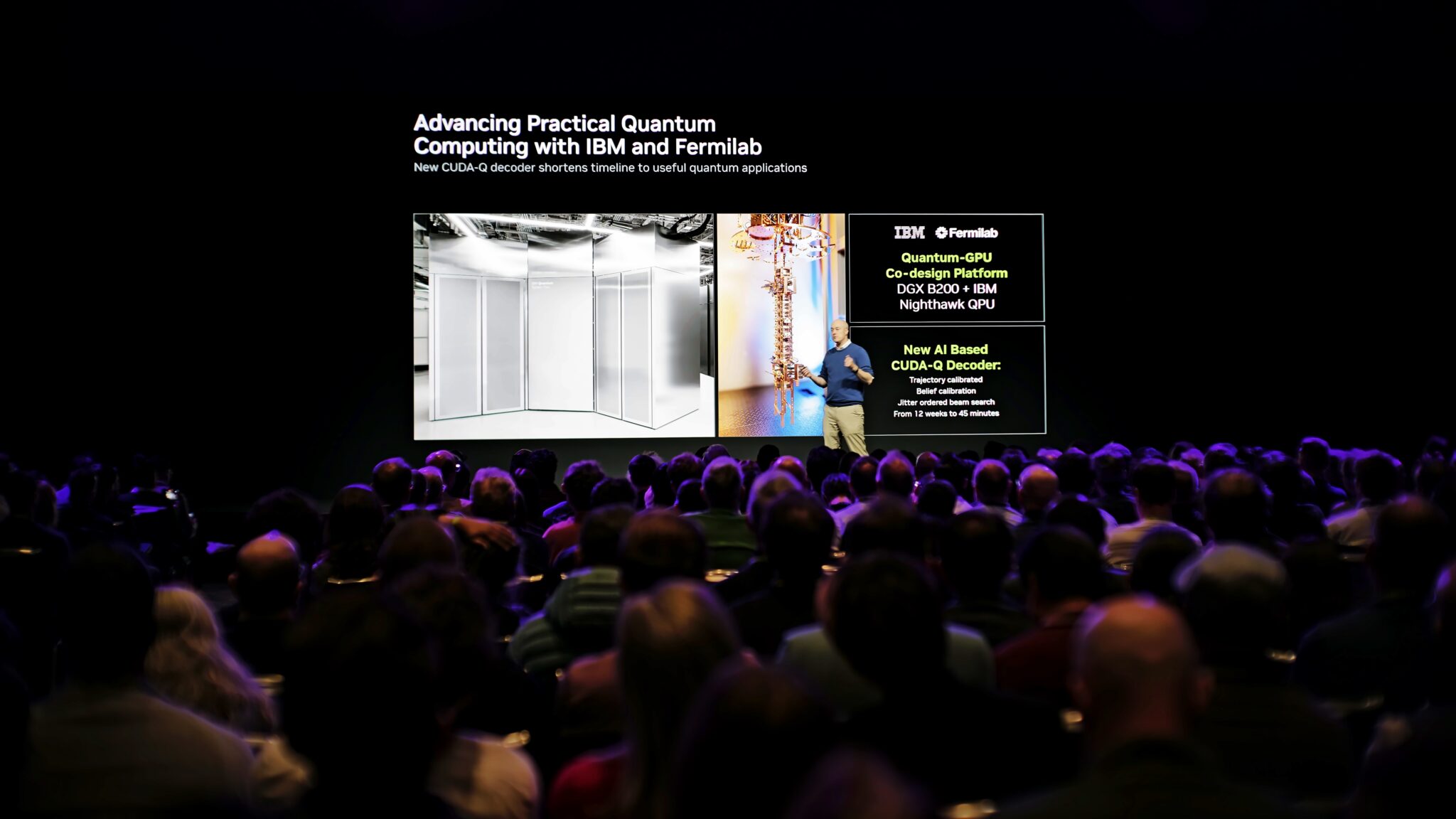
At SC26, Ian Buck paired new science hardware with open models and agents that plan experiments on researchers’ own machines. The early results are promising and anecdotal; the strategy is to make agents the reason to buy more compute.
Key takeaways
- Buck announced Nemotron for Science, the Rubin HPC GPU and an expanded Vera CPU platform at SC26 in Chicago.
- Nemotron for Science pairs the Nemotron 3.5 Super VL open model with an open chemistry dataset and post-training recipes, runnable locally.
- Examples included an Argonne agent that found two new binding sites and a KTH agent that fixed 81% of broken GROMACS test cases overnight.
- Rubin HPC, with more than 50,000 CUDA cores and FP64 to FP4 support, is expected in 2028; DKRZ picked Vera CPUs for a 2028 system.
- NVIDIA, IBM and Fermilab announced a quantum co-design platform, and a new CUDA-Q decoder cut one research computation from 12 weeks to 45 minutes.
Agents as the new interface
Ian Buck used NVIDIA’s SC26 special address to make a clear argument: simulation remains the foundation of scientific computing, but agents are now how researchers will drive it. He called them a game changer for how scientists interface with supercomputers and instruments, and opened by noting his first public CUDA talk was at SC06 twenty years ago. NVIDIA now offers more than 1,000 CUDA-X libraries, he said.
The centerpiece for agents is Nemotron for Science, which combines the open Nemotron 3.5 Super VL model with a new open chemistry dataset and post-training recipes for life sciences and chemistry. It runs on a DGX Spark, a workstation or a lab’s own cluster. “You own your data. You own the model,” Buck said, a pitch aimed squarely at labs wary of sending research data to cloud APIs. We covered the model’s debut as a single open agent brain for enterprises; this repackages it for science.
What the demos show
Buck’s examples were specific. At Argonne, an agent took one prompt, planned and tested hypotheses, chose simulations and identified two new binding sites. A KTH Royal Institute of Technology agent repaired broken GROMACS molecular dynamics setups, fixing 81% of test cases overnight on one DGX Spark. NVIDIA’s own Nsight AI Porting Agent moved a routine from the WRF weather model to GPUs for a more than 5x speedup, using about 150 million tokens. An agent at the SETI Institute’s Allen Telescope Array retuned for Doppler shift unprompted; NVIDIA’s published post still contains an unedited note about that example, a small reminder that these are keynote highlights.
These are useful signs, not validated science. “New binding sites” needs experimental confirmation, and an 81% fix rate on test cases leaves the other 19% for humans to catch. The porting example is the most honest metric in the set because it includes cost: 150 million tokens for one routine is real money and real compute, which is precisely the point from NVIDIA’s perspective.
Hardware for the agent loop
The hardware announcements explain the business logic. Buck argued agents lean on CPUs to run tool calls between model steps, and pointed to DKRZ, the German Climate Computing Center, choosing Vera CPUs for its HLRE-5 system expected in early 2028, joining Vera deployments at TACC. The Rubin HPC GPU, also due in 2028, supports FP64 through FP4, adds sparse-data acceleration and has more than 50,000 CUDA cores, about three times Hopper.
On quantum, NVIDIA, IBM and Fermilab announced a co-design platform pairing DGX B200 systems with IBM quantum computers. Buck said a JUPITER simulation showed magic state cultivation can cut operations per logical step tenfold, and that a new CUDA-Q decoder, TCBP-JOBS, cut one error-correction research computation from 12 weeks to 45 minutes. NVIDIA is positioning itself as the classical backbone of whatever quantum future arrives, which is a sensible hedge whatever the timeline.
Who it affects
- Research labs
- Local open models for science reduce data-sharing concerns, but agents add token and compute costs to budgets.
- HPC centers
- 2028 Rubin HPC and Vera systems shape procurement planning now.
- Domain scientists
- Agents that repair setups and port code could save weeks, provided outputs are verified.
- Quantum researchers
- Faster decoding and an IBM-Fermilab co-design platform tighten the link between GPUs and quantum hardware.
What to watch
- Peer-reviewed follow-up on the Argonne binding-site results.
- Uptake of Nemotron for Science outside NVIDIA partner labs.
- Rubin HPC pricing and FP64 performance details ahead of 2028.
- Whether TCBP-JOBS decoding gains hold in real-time error correction, toward the 10-microsecond latency goal.
FAQ
What is Nemotron for Science?
A package combining NVIDIA’s Nemotron 3.5 Super VL open model with an open chemistry dataset and post-training recipes for life sciences and chemistry, runnable on local hardware.
When will Rubin HPC ship?
NVIDIA says it is expected in 2028.
What was announced with IBM and Fermilab?
Plans for a quantum computing co-design platform for error-correction and applications research, pairing DGX B200 systems with IBM quantum computers.
Companies: NVIDIA
More on NVIDIA
AI · Nov 5, 2026
NVIDIA’s four open Cosmos 3 Nano models let robot and driving teams simulate worlds that reactAI · Nov 16, 2026
Rubin HPC is Nvidia’s bet that science agents will be bottlenecked by simulation, not reasoningAI · Nov 9, 2026
Nvidia’s Korean startup bets span interconnect, open models, robot hands and document AIAI · Nov 8, 2026
Nvidia’s Dynamo recipes speed four Korean open models to production, tuned for B200s