Inside NVIDIA’s IsaacTeleop: From Hand and Controller Tracking to Robot Actions with the Graph-Based Retargeting Engine
Oct 3, 2026, 5:19 PM · MarkTechPost
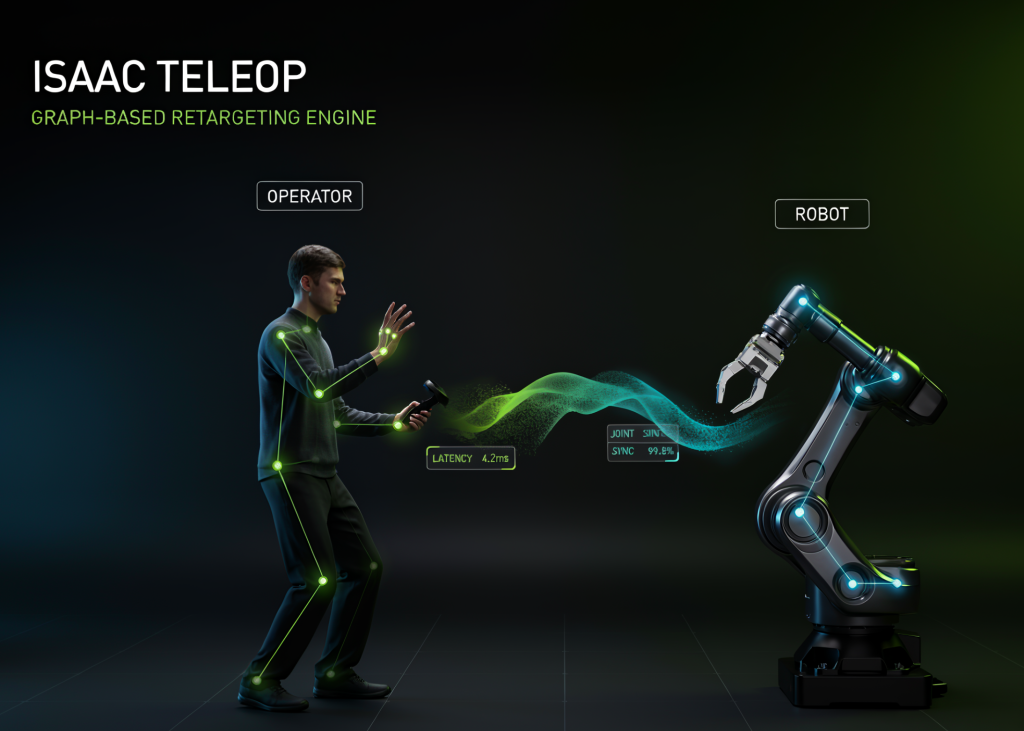
MarkTechPost’s IsaacTeleop walkthrough is a Colab tutorial with no headset: NumPy-built inputs, a graph retargeter, and the plumbing that turns XR hands into robot actions.
Why it matters
Asif Razzaq’s MarkTechPost tutorial works through the retargeting engine at the core of NVIDIA IsaacTeleop — the framework that converts XR hand tracking and motion-controller input into commands for simulated and real robots. Instead of plugging in a headset, the piece builds every input in NumPy so each step runs on a plain Colab CPU.
The package splits into device I/O that wraps OpenXR and CloudXR, a schema of FlatBuffer message types, and a pure-Python retargeting engine. The tutorial installs isaacteleop with the retargeters-lite extra from PyPI, then builds type contracts, synthetic hand and controller data, custom retargeters, gripper and SE(3) paths, and a full graph that emits one action vector per step.
This is not a product launch headline. It’s NVIDIA documenting the middle layer between human motion and robot command so developers can inspect and tune it without a lab full of headsets.
From the desk
We’re for tutorials that demystify teleoperation instead of treating XR robotics as magic. Retargeting — mapping human joints and controller poses onto robot morphologies — is where demos usually hide the hard engineering. Making that engine runnable in NumPy on Colab means more people can break it on purpose and learn what the graph is doing.
Useful AI in physical systems needs exactly this kind of inspectable middleware. If the only way to understand IsaacTeleop is a sealed binary and a $3,000 headset, the community that finds bugs and builds better retargeters stays small. Open Python graphs widen that circle.
The downside if teleop stacks scale without care is safety-shaped: a mistuned retargeter or a bad world-frame transform doesn’t just mis-draw a chart — it moves a real arm. Graph composability and live-tunable parameters help iteration; they also make it easier to ship a parameter set that works in sim and fails on hardware. Pause/kill state machines in the tutorial are not decorative.
I’m watching whether NVIDIA keeps the retargeting engine this open as IsaacTeleop products mature, or whether the publishable path stays a lite Colab story while production paths harden behind partner NDAs.
Context
IsaacTeleop sits inside NVIDIA’s broader Isaac robotics stack. The MarkTechPost piece is explicitly a developer walkthrough dated October 3, 2026, not a benchmark race.
Who feels it
- Robotics developers
- A CPU-friendly way to learn and modify the retargeting graph before buying XR hardware.
- Lab researchers
- Synthetic NumPy inputs make unit-testing teleop pipelines cheaper than headset-in-the-loop every time.
- Safety reviewers
- More visibility into how human motion becomes robot commands — and more responsibility to validate transforms before hardware.
What to watch
- Whether retargeters-lite stays feature-complete enough for real robot bring-up
- Community forks that add new morphologies or safety filters to the graph
- Shipments of IsaacTeleop demos that cite this engine in production write-ups
Companies: NVIDIA