Korea Advances Physical AI Across Industries With NVIDIA
Nov 8, 2026, 9:00 PM · NVIDIA Blog
The most useful number in NVIDIA's Korea physical-AI roundup isn't about robots at all; it's a Samsung chip simulation that dropped from about 18 hours to 41 seconds.
Why it matters
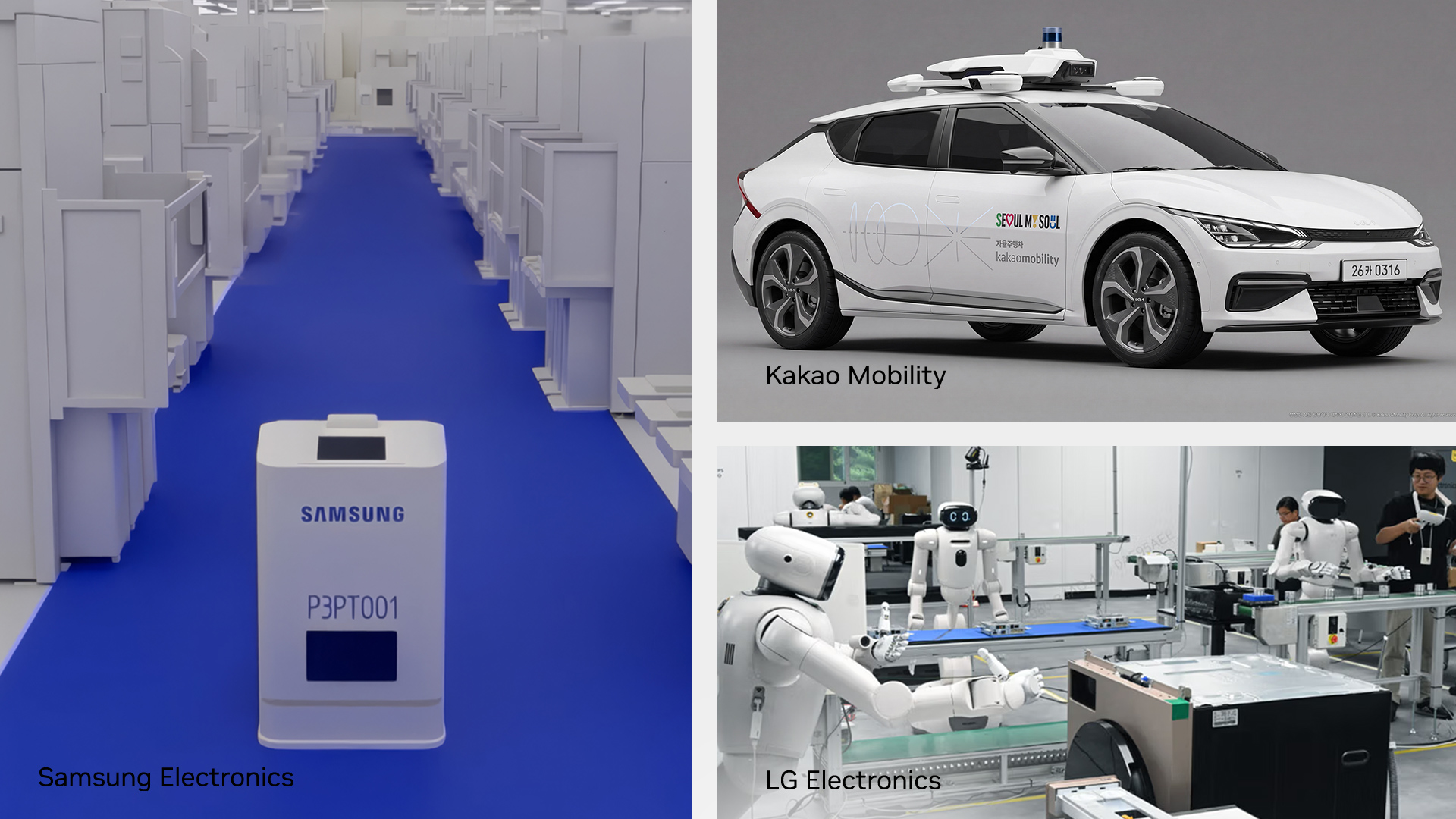
Korea's industrial giants are moving AI out of demos and into engineering and production. NVIDIA highlighted three tracks: Samsung using GPU solvers and AI physics in semiconductor design, Kakao Mobility building toward level 4 autonomous driving on NVIDIA's vehicle platform, and LG Electronics training its CLOiD robot inside a real factory.
Each one is a bet that simulation plus AI can shorten the loop between design, testing and deployment. If those loops shrink, product cycles in chips, cars and factories shrink too.
From the desk
Samsung's results are the strongest evidence here. Selected quantum chemistry runs on its sMOL platform finished up to five times faster end to end with cuEST. In one thermal and mechanical case using PhysicsNeMo, combining AI-predicted material properties with a coarser grid and GPU acceleration cut a roughly 18-hour, 32-core CPU job to 41 seconds, about a 1,600x speedup. That's the kind of gain that changes how many design options engineers can afford to try.
We'd add one caveat. Part of that speedup comes from using a coarser grid and AI-estimated properties, not just faster hardware. That's a legitimate technique, but it trades some fidelity for speed, and the hard question is when the approximation is trusted enough to sign off a chip. I'm watching for validation data, not just stopwatch numbers.
Kakao Mobility's plan is earlier stage. It intends to use NVIDIA Hyperion with DRIVE AGX Thor and the Halos safety stack, starting on Kia purpose-built vehicles and drawing on its operating experience in Seoul's Gangnam district. Level 4 is where public-safety stakes get real; the word that matters in this announcement is "plans." We'll judge it on safety disclosures and permitted service areas.
LG's CLOiD work is the clearest picture of where factory robotics is going: a data flywheel that collects real-world data, augments it with Cosmos, trains GR00T models, runs on Jetson AGX Thor and evaluates in simulation. Repeatable training loops are good engineering. Scaled across factories, they also mean fewer manual roles on the line, and we'd like to see the companies talk as plainly about workforce plans as they do about workflows.
Context
These announcements came alongside other NVIDIA news with Korean partners the same weekend. NVIDIA also floated its Agent Toolkit as a possible way to link Samsung's simulation tools so engineering agents could run analyses and compare designs, though that is described as a future direction rather than a deployed system.
Who feels it
- Semiconductor engineers
- GPU-accelerated and AI-assisted simulation could let teams explore far more design variants, provided results are validated against fine-grid baselines.
- Riders and city regulators
- Kakao Mobility's level 4 effort in Korea will need transparent safety evidence before public service.
- Manufacturing workers
- LG's repeatable robot-training loop points toward more automated dexterous tasks on factory floors.
What to watch
- Samsung publishing accuracy comparisons for its AI-physics speedups
- Kakao Mobility test permits, safety reports and first Kia purpose-built vehicle trials
- LG moving CLOiD from demonstration to sustained production use
- Whether engineering agents actually connect these simulation tools in practice
Companies: NVIDIA