AI · Oct 28, 2026
RTX Spark laptops get open speech models and a dial for background agentsLambda puts co-packaged optics into a 10,000-GPU cluster, a first big field test for Nvidia Photonics
· Updated · Signal Desk newsroom
Analysis of reporting by NVIDIA Blog. How we work
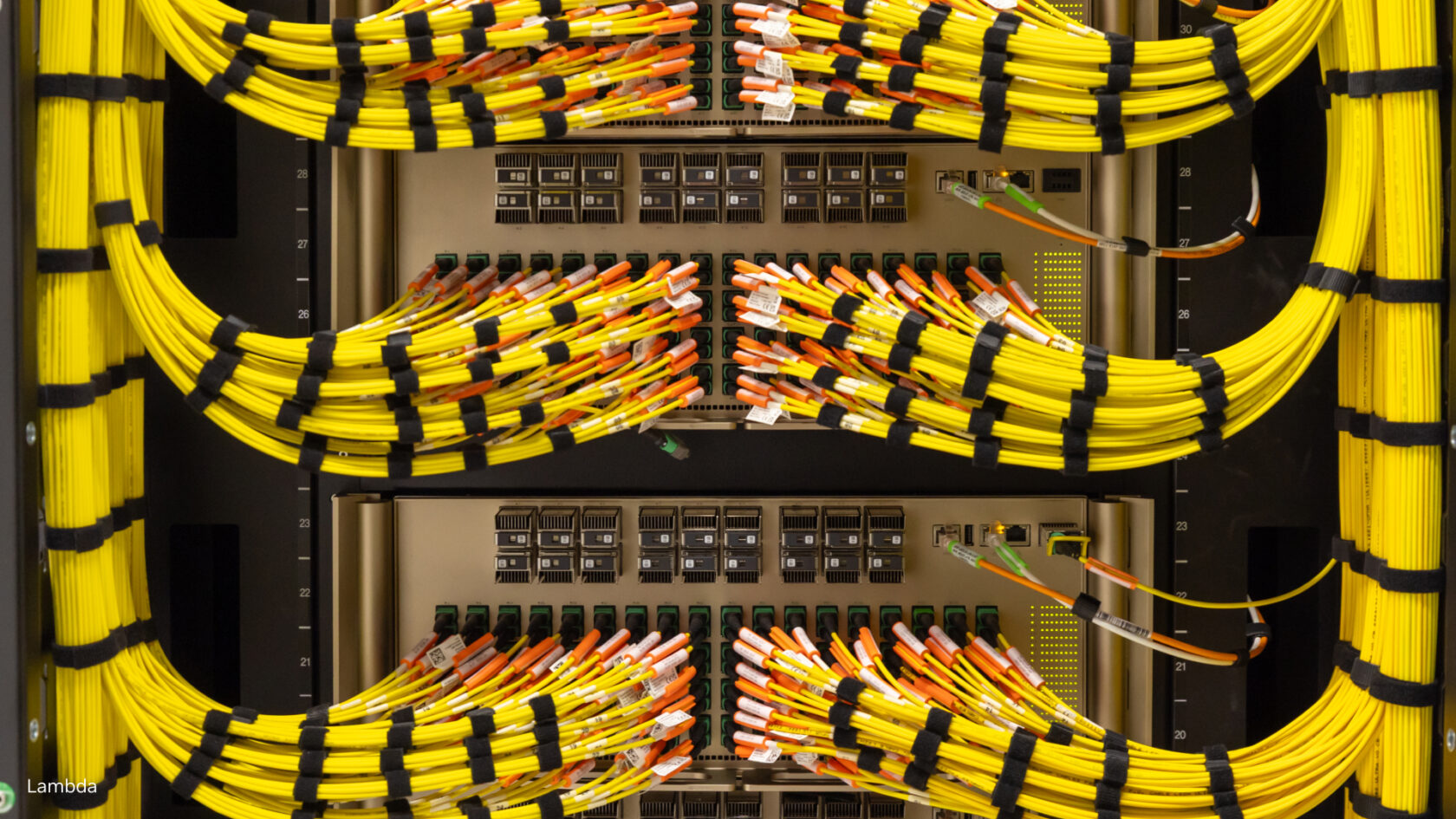
Lambda reports cooler optics, slightly lower latency and the same throughput after wiring GB300 NVL72 racks with Nvidia’s co-packaged optical switches. The bigger promise, fewer link failures stalling training jobs, still needs long-run data.
Key takeaways
- Lambda is using Nvidia Photonics co-packaged optics switches to connect GB300 NVL72 racks totaling more than 10,000 GPUs.
- In Lambda’s tests, latency fell about 4% at rack scale and up to about 10% at pod scale, with throughput matching conventional pluggable optics.
- Median optics temperature was 36°C versus 51°C for pluggables, with more stable signal integrity.
- Nvidia claims up to 5x better power efficiency, up to 15x higher reliability and 4x fewer lasers than pluggable optics.
- Each 144-port, 800Gb/s switch has 18 field-replaceable external light sources, so a failed laser doesn’t mean swapping a whole module.
Why the network is the weak link
In a large training run, thousands of GPUs move in lockstep. If one network link drops, the whole job can stall. That makes the optical links between racks one of the least glamorous and most expensive failure points in an AI data center. Lambda, a GPU cloud provider, is now running Nvidia Photonics co-packaged optics (CPO) switches to connect GB300 NVL72 racks with more than 10,000 GPUs, the kind of scale where small reliability gains turn into real money.
Co-packaged optics move the conversion between electrical and optical signals off removable transceivers and onto the switch package itself. The electrical path shrinks from inches to millimeters, which cuts signal loss and removes the retimer chips that pluggable modules need. Nvidia’s claims for the approach are large: up to 5x better power efficiency, up to 15x higher reliability, and 4x fewer lasers, meaning fewer parts that can fail.
What Lambda actually measured
Lambda’s reported numbers are more modest than Nvidia’s headline multiples, which makes them more believable. Network latency fell about 4% at rack scale and up to about 10% at pod scale, while throughput matched conventional pluggable optics across rack, scalable-unit and pod configurations. Liquid cooling kept median optics temperature at 36°C, compared with 51°C for pluggables, and Lambda reports more stable signal integrity. Cooler lasers generally last longer, so the temperature result may be the most important one, even if it’s the least flashy.
The serviceability design is smart. Each 144-port, 800Gb/s switch has 18 removable external light sources that technicians can replace in the field. With pluggables, a failed laser means swapping the whole module. Lambda’s president of cloud services, Dave Ward, frames the deployment as a step toward next-generation infrastructure, and it does look like the first large customer proof point for CPO in Nvidia’s Ethernet lineup.
The missing number
The post promises longer mean time between interruptions, but it doesn’t give Lambda’s actual MTBI figures, only Nvidia’s up-to-15x reliability claim. That’s the number operators will want, because interruptions, not raw latency, are what eat training budgets. We’d also want to know how the external light sources hold up after a year in production. Power savings matter too: as Nvidia argues in its megawatts-to-tokens framing, every watt in the network is a watt not available for compute. Lambda doesn’t quantify its power savings here either. This is a credible early deployment with vendor-scale claims; the long-run data will decide whether CPO becomes standard.
Who it affects
- GPU cloud operators
- A path to fewer link failures and cooler optics at scale, if reliability claims hold.
- Optical transceiver makers
- Co-packaged optics threaten the pluggable module business that dominates data-center networking today.
- AI labs renting compute
- Fewer stalled training jobs would mean lower effective cost per run.
- Data-center technicians
- Field-replaceable light sources change maintenance from module swaps to laser swaps.
What to watch
- Lambda’s actual MTBI and power data after months in production.
- Failure rates of the external light sources over time.
- Other cloud providers adopting Nvidia Photonics at similar scale.
- Pricing of CPO switches relative to pluggable-based networks.
FAQ
What are co-packaged optics?
Optical engines placed on the same package as the switch chip, replacing removable pluggable transceivers and shortening electrical paths.
What did Lambda report?
About 4% lower latency at rack scale, up to about 10% at pod scale, equal throughput, and optics running at a median 36°C versus 51°C for pluggables.
Why does reliability matter so much?
In large training jobs, one interrupted link can stall thousands of GPUs, wasting time and compute.
Companies: NVIDIA
More on NVIDIA
AI · Nov 5, 2026
NVIDIA’s four open Cosmos 3 Nano models let robot and driving teams simulate worlds that reactAI · Nov 16, 2026
Rubin HPC is Nvidia’s bet that science agents will be bottlenecked by simulation, not reasoningAI · Nov 9, 2026
Nvidia’s Korean startup bets span interconnect, open models, robot hands and document AIAI · Nov 8, 2026
Nvidia’s Dynamo recipes speed four Korean open models to production, tuned for B200s