AI · Nov 5, 2026
NVIDIA’s four open Cosmos 3 Nano models let robot and driving teams simulate worlds that reactNvidia bets on smooth-space text diffusion with 14 open Sigma checkpoints
· Updated · Signal Desk newsroom
Analysis of reporting by MarkTechPost. How we work
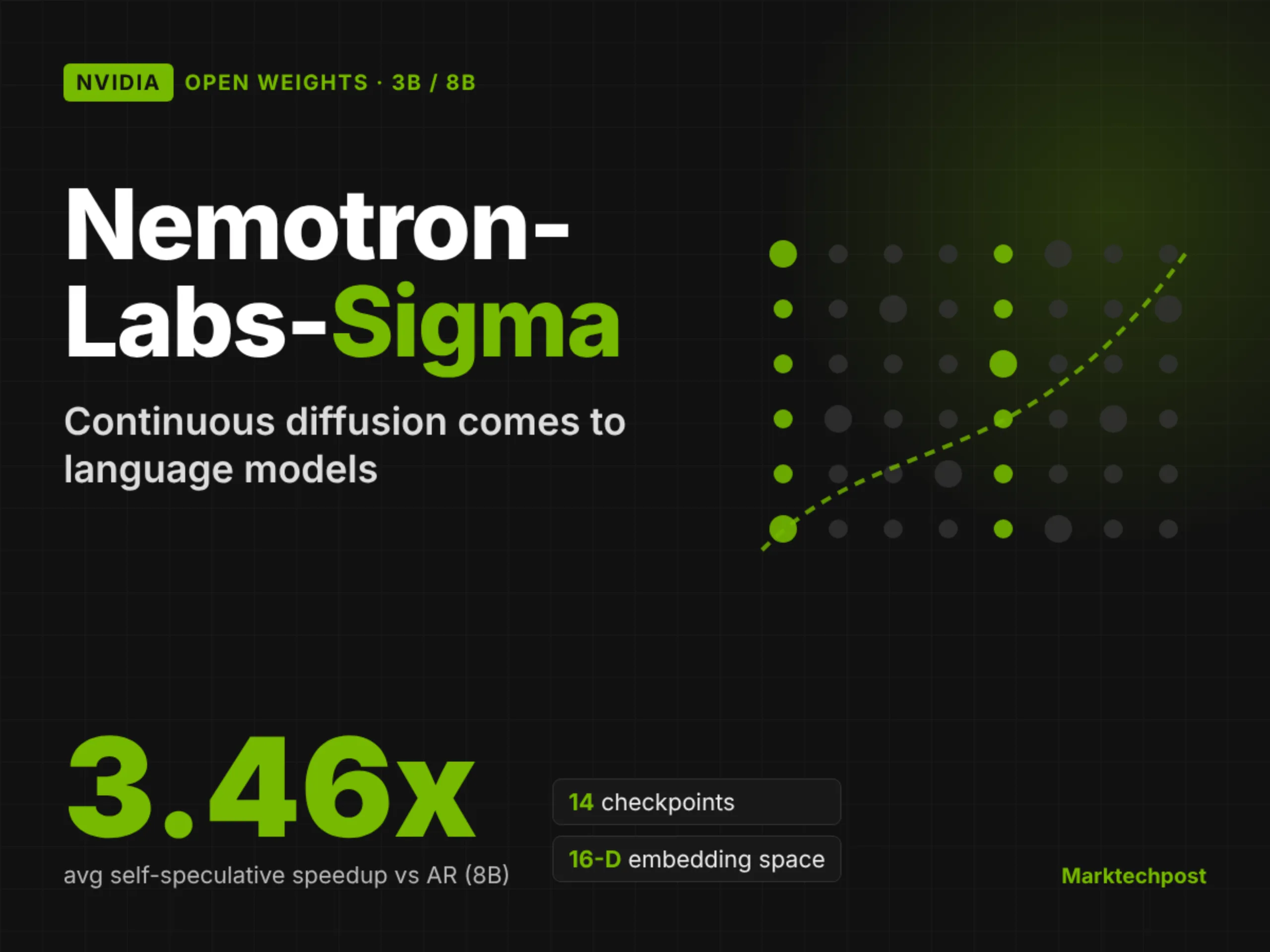
Nemotron-Labs-Sigma generates text by denoising in a learned 16-dimensional space rather than hopping between tokens. The speed numbers are real enough to matter, but the reasoning ceiling and short context keep it a research bet for now.
Key takeaways
- Sigma ships as 14 open checkpoints at 3B and 8B: base, instruct, four few-step distilled variants per size, and self-speculative models.
- Instead of discrete tokens, Sigma denoises text inside a learned 16-D embedding space, which Nvidia says makes few-step distillation and steering practical.
- On Nvidia's own six-task suite the 8B base averages 71.16, edging NLD-8B at 70.22 and Qwen3-8B in autoregressive mode at 68.91.
- The self-speculative 8B runs 3.46x faster than autoregressive decoding on average on one GB200, with peaks of 4.20x, while matching greedy output exactly.
- Weak spots are plain: 17.00 on AIME25, a 4,096-token base context, GPU-only inference and no quantized builds listed.
A different way to write a sentence
Almost every chatbot people use writes one token at a time, left to right. Diffusion language models try to draft a whole block at once and refine it, the way image generators sharpen noise into a picture. Most earlier attempts, such as LLaDA and Dream, still work on discrete tokens, jumping between word choices. Nvidia's new Nemotron-Labs-Sigma family takes the other road: each token becomes a point in a learned 16-dimensional embedding space, training adds Gaussian noise to those points, and the model learns to remove it. The geometry of that space is learned together with the denoiser.
That sounds like an academic distinction, and partly it is. The practical claim, per MarkTechPost's write-up of the paper, is that smooth trajectories degrade gracefully when you cut the number of denoising steps, and they distill well into fast samplers. Discrete diffusion, by contrast, is hard to steer because it leaps between states. If that holds up outside Nvidia's lab, it is the most interesting thing about the release, more than any single benchmark row.
What actually shipped
The collection is unusually complete for a research drop. At both 3B and 8B there is a base model, an instruct model, distilled versions that run in 2, 4, 8 or 16 function evaluations, and a self-speculative variant. Generation is blockwise, 64 tokens by default, with each finished block committed to a KV cache. The backbone is a conventional Ministral-style decoder-only Transformer, warm-started from about 1 trillion autoregressive tokens before roughly 0.3 trillion tokens of diffusion training. In other words, Sigma is not built from scratch; it is an autoregressive model taught a second way to write.
Everything sits on Hugging Face under the NVIDIA Nemotron Open Model License, and the model cards say the checkpoints are ready for commercial use. That license is Nvidia's own, not Apache or MIT, which matters for teams with strict legal review. Running it needs a CUDA GPU in bfloat16, from Ampere through Blackwell. There is no CPU path, no quantized variant listed and no hosted API, and on one H100 the base model produces about 120 to 140 tokens per second. It fits a pattern in Nvidia's open releases: smaller, deployable models such as the Nemotron 3.5 Bolt E4B that quietly assume Nvidia silicon.
The speed story is the real pitch
The headline numbers are about decoding speed, not raw quality. The 8-step distilled 8B keeps a 70.34 average on the six-task suite, close to the 256-step teacher at 71.16, while decoding each 32-token block in eight denoiser calls plus one readout. The self-speculative checkpoints go further: a diffusion head drafts a 32-token block and the model's own autoregressive head verifies it, so output exactly matches greedy autoregressive decoding. On one GB200 with SGLang, Nvidia reports 3.46x average speedup for the 8B spec model, versus 3.04x for NLD-8B, with peaks of 4.20x at 8B and 3.18x at 3B.
That exact-match property is the clever part. Speed tricks that change outputs are a hard sell for production teams; a drafter whose work is checked token for token is not. Our caution is that every number here comes from Nvidia's own evaluations, measured on Nvidia's top-end hardware with a serving stack tuned for it. Independent reproductions on more modest GPUs would tell us much more.
Where it falls short
Sigma is not a reasoning model, and the numbers say so. The instruct 8B reaches 91.96 on GSM8K and 82.50 on HumanEval, but just 23.33 on AIME24 and 17.00 on AIME25, and its 10-task average of 59.14 sits slightly behind NLD-8B at 59.92. MBPP coding trails NLD-8B too. The base context window is 4,096 tokens, 8,192 for the instruct 8B, while Qwen3-8B's card lists 32,768. For long documents or agent loops, that is a hard wall today.
So the honest framing is a research platform with production-grade packaging. It is worth taking seriously because the speedups arrive without a quality cliff on everyday math and code. It is not yet a replacement for a mainstream 8B chat model, and teams should treat it as something to benchmark on their own workloads, not something to swap in. More of the family's arc sits in our Nvidia coverage.
Who feels it
- Inference engineers
- A drafter that keeps greedy-exact output is a low-risk way to test diffusion speedups inside existing SGLang or vLLM setups.
- Researchers
- Fourteen open checkpoints at multiple step counts make continuous diffusion much easier to study and compare.
- Product teams
- Short context and weak hard-reasoning scores limit Sigma to narrow, latency-sensitive tasks for now.
- Rival chip vendors
- GPU-only, bfloat16-only packaging keeps the speed story inside Nvidia's ecosystem.
What to watch
- Independent benchmarks of the distilled and spec checkpoints on hardware below GB200 and H100.
- Whether longer-context or quantized Sigma variants follow.
- Adoption of continuous diffusion by labs outside Nvidia, which would show the approach generalizes.
- How the self-speculative design compares against standard speculative decoding with a small draft model.
FAQ
What is Nemotron-Labs-Sigma?
An open family of 14 continuous diffusion language model checkpoints from Nvidia at 3B and 8B scale, including base, instruct, few-step distilled and self-speculative versions.
How is continuous diffusion different from discrete diffusion?
Sigma denoises text in a learned 16-D embedding space along smooth paths, while models like LLaDA and Dream jump between discrete token states, which Nvidia says are harder to steer and distill.
How fast is Sigma?
Nvidia reports the self-speculative 8B decodes 3.46x faster than autoregressive decoding on average on one GB200, peaking at 4.20x, with output matching greedy decoding.
Can I run Sigma on a CPU?
No. The model cards require a CUDA GPU in bfloat16 (Ampere, Lovelace, Hopper or Blackwell), and no quantized variants are listed.
Companies: NVIDIA
More on NVIDIA
AI · Nov 16, 2026
Rubin HPC is Nvidia’s bet that science agents will be bottlenecked by simulation, not reasoningAI · Nov 9, 2026
Nvidia’s Korean startup bets span interconnect, open models, robot hands and document AIAI · Nov 8, 2026
Nvidia’s Dynamo recipes speed four Korean open models to production, tuned for B200sAI · Nov 5, 2026
Nvidia profiles Chris Alexiuk, the YouTube teacher making the case that open AI means weights, data and recipes