AI · Sep 22, 2026
Accelerating a ROS 2 Node with an AI Agent and NVIDIA Isaac ROSNVIDIA Isaac ROS 5.0 Advances Agentic, Open Source Robotics Development
Sep 22, 2026, 5:00 AM · NVIDIA Blog
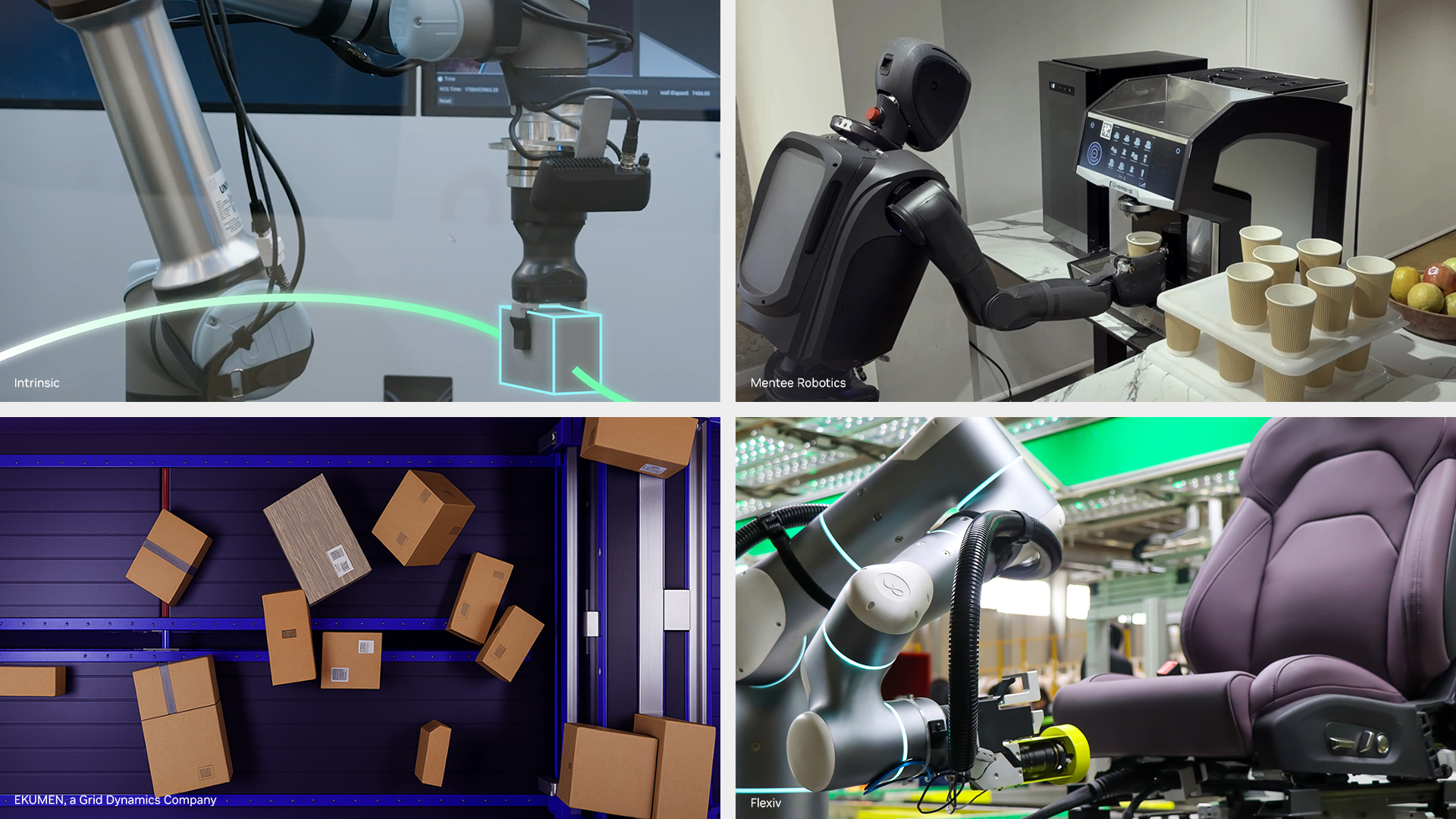
Isaac ROS 5.0 ships at ROSCon with a clear thesis: AI agents help build robots, and Jetson runs what they build — open source, GPU-accelerated, free.
Why it matters
NVIDIA released Isaac ROS 5.0 at ROSCon in Toronto — GPU-accelerated packages on the ROS open framework, now aimed at nearly 1.3 million ROS users and at AI coding agents that can drive robotics workflows.
The release adds ROS Lyrical and Ubuntu 24.04 support, agent-ready skills for setup and manipulation, and Jetson coverage from Orin Nano to Thor. Physical AI is shifting from demos to deployable graphs; this is NVIDIA trying to own the open middle layer.
From the desk
We’re constructive on this direction. Robotics doesn’t have a ChatGPT-scale data firehose. What it does have is a huge open toolchain — ROS — and a brutal gap between a working node on a laptop and a reliable behavior on a robot. Putting AI agents into that loop for migration, fine-tuning, and pick-and-place skills is useful if the agents stay subordinate to verifiable robot behavior.
Concrete pieces stand out. NVIDIA worked with the Open Source Robotics Alliance on a standard data-handling interface in ROS Lyrical so software can accelerate across hardware, with CUDA as the working GPU example. FoundationStereo fine-tuning as an agent skill, FoundationPose inference claimed up to 5.5x faster, and pick-and-place as a standalone agent-ready skill are the productization moves. Ecosystem partners — RealSense’s AgenticROS with Nemotron and NemoClaw, Intrinsic’s Open Machine Tending with FoundationPose, Seeed, Magna, Flexiv, Ekumen, Universal Robots, ROBOTIS, FieldAI, Mentee — are the distribution proof.
Our concern is familiar: agentic robotics development that skips hardware-in-the-loop validation will ship confident nonsense into factories. Magna pairing Isaac ROS with Isaac Sim HIL testing is the pattern we want copied. Useful AI here means faster iteration plus compulsory sim and on-robot checks — not vibe-coded inverse kinematics.
I’m watching adoption of the Lyrical buffer interfaces, how often agents actually fine-tune perception to a user’s cameras without a researcher in the loop, and whether Jetson Thor becomes the default edge brain for these stacks. Free and open source is the right posture. Trust still has to be earned on the factory floor.
Context
NVIDIA Blog by Katie Washabaugh, September 22, 2026, coinciding with ROSCon Toronto. Partner examples and performance claims (including FoundationPose speedup) are NVIDIA’s.
Who feels it
- ROS developers
- Path to ROS Lyrical / Ubuntu 24.04 with NVIDIA acceleration and agent-oriented skills without leaving familiar open tools.
- Industrial robotics teams
- Reference apps like Intrinsic’s machine tending and UR’s AI Accelerator SDK aim to cut fixture-heavy integration.
- Humanoid and mobile robot startups
- Shared Isaac ROS + Jetson Orin/Thor software path for perception and learned behaviors on-device.
- AI agent tool builders
- Agent-ready docs and skills create a robotics niche for coding agents beyond generic repos.
What to watch
- Uptake of ROS Lyrical data-interface contributions beyond NVIDIA’s CUDA example.
- Independent benchmarks of FoundationPose and FoundationStereo agent fine-tuning claims.
- How many partner demos move from Sim to sustained production cells.
- Jetson Thor design wins announced against Isaac ROS 5.0 as the software story.
Companies: NVIDIA