NVIDIA Open-Sources OSMO: One YAML Orchestrates Physical AI Training, Simulation, and Robot Testing
Sep 14, 2026, 1:04 AM · MarkTechPost
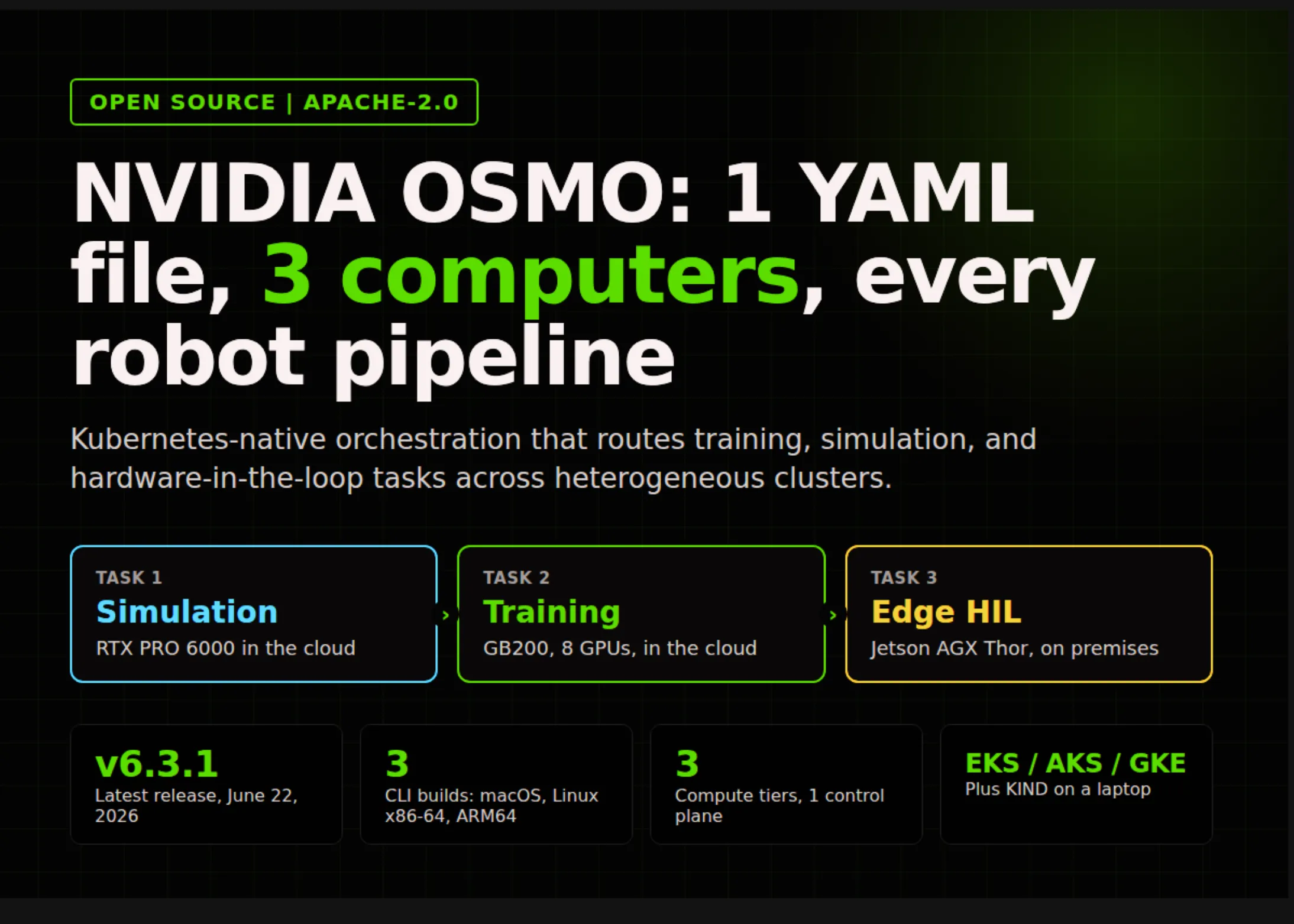
NVIDIA open-sources OSMO, a Kubernetes-native orchestrator that runs robot training, Isaac Sim, and Jetson hardware tests from one YAML across heterogeneous clusters.
Why it matters
Physical AI isn’t one compute problem—it’s three. Policies train on data-center GPUs, get simulated on RTX workstations, then face hardware-in-the-loop validation on Jetson-class edge boxes. Each tier usually means its own cluster, scheduler, and glue scripts.
OSMO is NVIDIA’s open-source answer: describe the whole pipeline in a single YAML, register backends as Kubernetes clusters, and let the control plane route tasks by platform name—gb200, rtx-pro-6000, jetson-agx-thor—without rewriting infrastructure code for every handoff.
From the desk
We’re treating this as infrastructure that can make useful robotics AI less fragile—if teams actually adopt it.
The fragmentation tax in robot learning is real. Training on one stack, simulating on another, and testing on a third is how custom scripts multiply and experiments rot. A portable workflow that runs from a laptop KIND cluster up through EKS, AKS, GKE, on-prem, or air-gapped setups is the adult version of “it works on my GPU.” Apache-2.0 licensing, Helm charts on NGC, and a local quickstart lower the excuse barrier.
Capabilities that matter in practice: KAI Scheduler by default, NVLink-aware multi-GPU placement, per-group timeouts so a stuck sim doesn’t murder sibling training jobs, interactive VS Code/Jupyter/SSH on remote nodes, and RBAC plus OAuth2 that finally look like production security. Content-addressable datasets with claimed storage savings are attractive—though the dataset CLI is already deprecated toward workflow-managed outputs, so migration planning isn’t optional.
We’re for tools that let researchers spend time on policies, not YAML archaeology across three clouds. The downside if this becomes the only path is NVIDIA-shaped lock-in dressed as open source: platforms, schedulers, and Isaac ecosystem gravity that make “portable” mean portable inside NVIDIA’s world. Agent integrations with Claude Code, Codex, and Cursor are clever; they also mean coding agents can submit and debug pipelines—power that needs the same approval discipline as any other privileged automation.
I’m watching whether non-NVIDIA shops run OSMO seriously, and whether the dataset deprecation stranding anyone mid-flight.
Context
MarkTechPost’s write-up cites battle-testing on GR00T, Isaac Lab, Isaac Sim, and Isaac ROS, with Azure and Nebius integrations noted. Latest release called out is 6.3.1 (June 2026). The canonical example chains Isaac Sim on RTX, PyTorch training on GB200 with eight GPUs, then ROS evaluation on Jetson AGX Thor.
Who feels it
- Robotics and physical-AI teams
- One workflow language across train/sim/edge can cut glue work—and force clearer platform tagging instead of ad-hoc cluster scripts.
- ML platform engineers
- Kubernetes-native design fits existing cluster ops, but KAI, identity wiring, and storage choices still need real ownership.
- NVIDIA ecosystem partners
- Deeper Isaac/GR00T coupling strengthens the Physical AI stack story around open orchestration.
- Security and compliance
- RBAC, OAuth2, TLS at the gateway, and cloud workload identity are table stakes; agent-submitted pipelines raise new abuse and audit questions.
What to watch
- Adoption outside NVIDIA-centric Isaac shops.
- Smoothness of the dataset CLI sunset into workflow-managed outputs by 6.4.
- Whether coding-agent integrations ship with hardened approval defaults.
- Evidence of multi-cloud and air-gapped production use beyond demos.
Companies: NVIDIA