AI · Nov 5, 2026
NVIDIA’s four open Cosmos 3 Nano models let robot and driving teams simulate worlds that reactAlpamayo 2 Edge's spec sheet shows an in-car reasoning driver that only NVIDIA has graded so far
· Updated · Signal Desk newsroom
Analysis of reporting by MarkTechPost. How we work
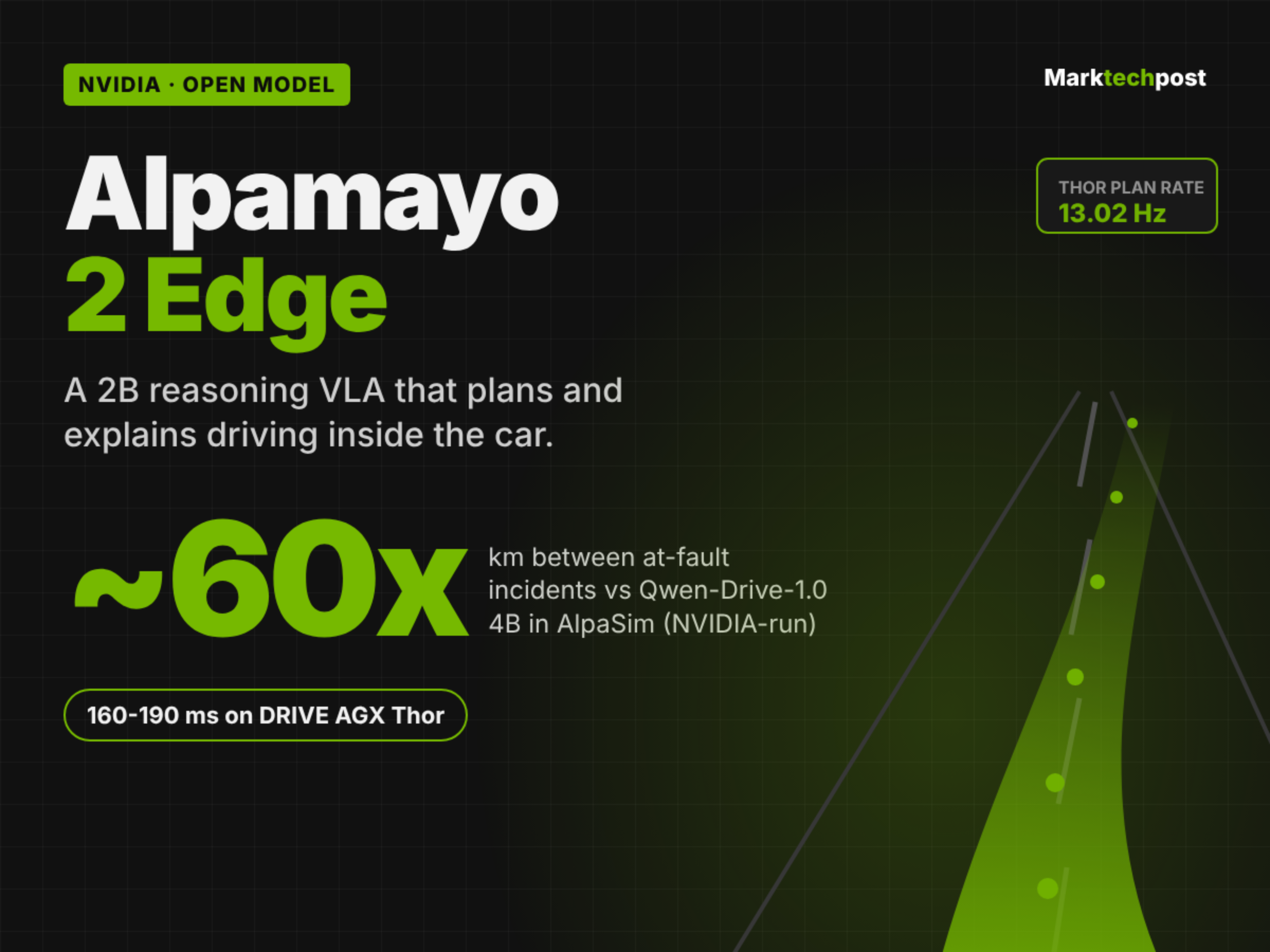
Now that the weights and model card are out, the small self-explaining driving model looks strong on safety-style metrics, middling on reasoning questions, and dependent on one tuned NVIDIA toolchain to hit real-time speed.
Key takeaways
- Alpamayo 2 Edge is marketed as a 2B model: a 2.45B backbone (1.96B language model plus a 0.41B SigLIP2 vision encoder) with a 0.2B diffusion action expert. Hugging Face metadata lists it as 3B.
- It reads six cameras, a navigation instruction and 20 past ego poses, and outputs 64 waypoints covering 6.4 seconds, plus a Chain-of-Causation reasoning trace when a scene calls for one.
- NVIDIA reports 160 to 190 ms pixel-to-trajectory latency on DRIVE AGX Thor, but only through an FP8 plus TensorRT Edge-LLM recipe; plain BF16 PyTorch plans at 0.76 Hz versus 13.02 Hz optimized.
- In NVIDIA's own AlpaSim runs it covers 15.15 km per at-fault incident versus 0.25 km for Alibaba's Qwen-Drive-1.0 4B, roughly 60 times better. On LingoQA it scores 75.2, behind Alpamayo 2 Super's 79.2.
- Weights ship under OpenMDW-1.1 and code under Apache 2.0, fine-tuning is supported, and the only GPU validated so far is the H100.
From announcement to artifact
When NVIDIA first described Alpamayo 2 Edge, the story was the idea: a compact driving model that plans a path and, when it decides it needs to, writes down why. We covered that pitch earlier this month in our look at fitting reasoning models into onboard compute, and it also turned up as one line in NVIDIA's European open-model rollout. What MarkTechPost has now pulled together is the model card, the benchmark tables and the deployment recipe. That is the stage where a launch either holds up or starts to wobble.
Mostly it holds up. The architecture is modest and clear. A Nemotron-based backbone of about 2.45 billion parameters pairs a 1.96B language model with a 0.41B SigLIP2 image encoder. A small 0.2B diffusion action expert on top predicts acceleration and curvature, and a simple unicycle model turns those into 64 waypoints covering the next 6.4 seconds. Inputs are surround video from six cameras (22 frames per observation, weighted toward the two front cameras), a navigation instruction and 20 past ego poses. One small wrinkle: NVIDIA calls it a 2B model while the Hugging Face metadata says 3B. That's a labeling gap, not a scandal, but in automotive work exact numbers are supposed to be boring and consistent.
The speed claim comes with a toolchain attached
The headline latency, 160 to 190 milliseconds from pixels to trajectory, is real, but it depends on a specific path. The weights ship in BF16 for PyTorch, and that way the model plans at 0.76 Hz in NVIDIA's simulator. That's less than one plan per second, far too slow for a moving car. The usable version runs at 13.02 Hz, and getting there takes NVIDIA's recipe: an FP8 calibration pass, a drafter model for speculative decoding, ONNX export and TensorRT engines built with Edge-LLM plugins, on DRIVE AGX Thor-X with pinned versions of DRIVE OS, CUDA and TensorRT. The speed spread depends on how much the model chooses to reason. A full explanation costs more time than a routine-driving placeholder token.
We don't see that as a trick. Production automotive software has always been tuned tightly to its silicon. But it does change what 'open' means here. The weights are open and fine-tunable, under OpenMDW-1.1, with code under Apache 2.0. The real-time product is open only in the sense that anyone can follow NVIDIA's steps on NVIDIA's car computer. One partner, Embedl, says it reached 10 Hz on AGX Thor in under 48 hours, which is a useful sign the recipe can be reproduced outside NVIDIA. It is also a sign that the work is optimizing for Thor, not for chips in general. The card lists no hosted API, no GGUF build and no validated GPU besides the H100.
Strong on driving, average on explaining
The benchmarks deserve a close reading because they cut in two directions. On closed-loop driving in AlpaSim, NVIDIA's simulator, Edge averages 15.15 km between at-fault incidents across 875 scenarios. Alibaba's 4B Qwen-Drive-1.0 manages 0.25 km in the same test. Open-loop trajectory error is 0.52 to 0.53 m against 1.68 m. That's a big gap for a model half the size. But NVIDIA ran both systems, in NVIDIA's simulator, and the comparison table itself warns that AlpaSim results are reported in different units across sources, with Qwen's own card using a different at-fault score. Until someone outside NVIDIA reruns the comparison, the 60x figure is a vendor result, and that is how it should be cited.
The reasoning numbers are more modest. LingoQA comes in at 75.2, behind both Alpamayo 2 Super at 79.2 and Qwen-Drive-1.0, and the nuReasoning numeric score is 48.67. MarkTechPost's summary sounds about right: strong closed-loop driving for its size, mid-pack at answering questions about a scene. That's worth noticing because explanation is the reason this model family exists. A small model that drives well but explains less well than its bigger teacher brings back the question we raised in November: whether its explanations describe what the model actually did or just sound right.
The training recipe makes that question sharper. Edge was distilled from about 3.7 million Chain-of-Causation traces auto-labeled by Alpamayo 2 Super, across roughly 115,000 hours of multi-camera video, and then refined with closed-loop reinforcement learning in AlpaSim. Reasoning quality is scored by AlpaJudge, a human-calibrated judge that filters data and provides RL rewards. NVIDIA says using it as a reward improved reasoning quality by 10.2% on the judge's own scale and 11.4% when humans rated it. The human number is the one that matters more. A model trained to satisfy its own judge is always going to score well on that judge.
Why this still matters
For all the caveats, this is the right kind of release. A self-explaining planner with open weights, a published deployment recipe and honest weak spots on the card gives automakers, researchers and safety reviewers something concrete to test rather than a demo video. The adaptive-reasoning design, which skips the explanation during routine driving, makes the cost workable. It also means the model chooses when it owes anyone an explanation, and that choice should be audited as carefully as the trajectories. The next useful step isn't another NVIDIA chart. It's an independent group running Edge in closed loop and on hardware NVIDIA didn't pick.
Who it affects
- Automakers and AV stacks
- A fine-tunable reasoning planner sized for Thor lowers the barrier to trying explainable planning, but real-time performance ties them to NVIDIA's FP8 and TensorRT pipeline.
- Researchers
- Open weights and inference code make it possible to probe whether reasoning traces match behavior, which a closed model wouldn't allow.
- Rival model makers
- Alibaba's Qwen-Drive team now faces a vendor-run comparison it may want to answer with its own numbers.
- Safety reviewers
- Written reasoning gives auditors something to inspect, as long as they also check the scenes where the model chose not to explain itself.
What to watch
- Independent closed-loop reruns of the Edge versus Qwen-Drive-1.0 comparison outside NVIDIA's own setup.
- Validation on GPUs beyond the H100 and on in-car platforms other than DRIVE AGX Thor.
- Whether NVIDIA fixes the 2B versus 3B labeling gap on Hugging Face.
- Data on how often the model's skip-reasoning tokens show up in scenes that later turn hazardous.
- More partner results like Embedl's 10 Hz port, and whether they reach NVIDIA's 13 Hz figure.
FAQ
What is Alpamayo 2 Edge?
An open NVIDIA vision-language-action model for autonomous driving that turns six-camera video into a 6.4-second trajectory and can write a reasoning trace explaining its plan. It's designed to run inside the vehicle on DRIVE AGX Thor.
Is it really 2 billion parameters?
NVIDIA markets it as 2B. The card describes a 2.45B backbone plus a 0.2B action expert, and Hugging Face metadata labels it 3B.
How fast is it?
NVIDIA reports 160 to 190 ms pixel-to-trajectory latency, or about 13 plans per second, on Thor using its FP8 and TensorRT Edge-LLM recipe. The stock BF16 PyTorch version runs at under one plan per second.
Is the 60x safety advantage over Qwen-Drive reliable?
It comes from NVIDIA's own runs in its AlpaSim simulator. It's a meaningful signal, but it hasn't been independently reproduced yet.
Can developers use and modify it?
Yes. Weights are under OpenMDW-1.1, code under Apache 2.0, and the model supports fine-tuning. BF16 inference needs a GPU with at least 16 GB of memory.
Companies: NVIDIA
More on NVIDIA
AI · Nov 16, 2026
Rubin HPC is Nvidia’s bet that science agents will be bottlenecked by simulation, not reasoningAI · Nov 9, 2026
Nvidia’s Korean startup bets span interconnect, open models, robot hands and document AIAI · Nov 8, 2026
Nvidia’s Dynamo recipes speed four Korean open models to production, tuned for B200sAI · Nov 5, 2026
Nvidia profiles Chris Alexiuk, the YouTube teacher making the case that open AI means weights, data and recipes