NVIDIA Unveils Minerva to Bring End-to-End Observability for AI Factories
Oct 22, 2026, 8:00 AM · NVIDIA Blog
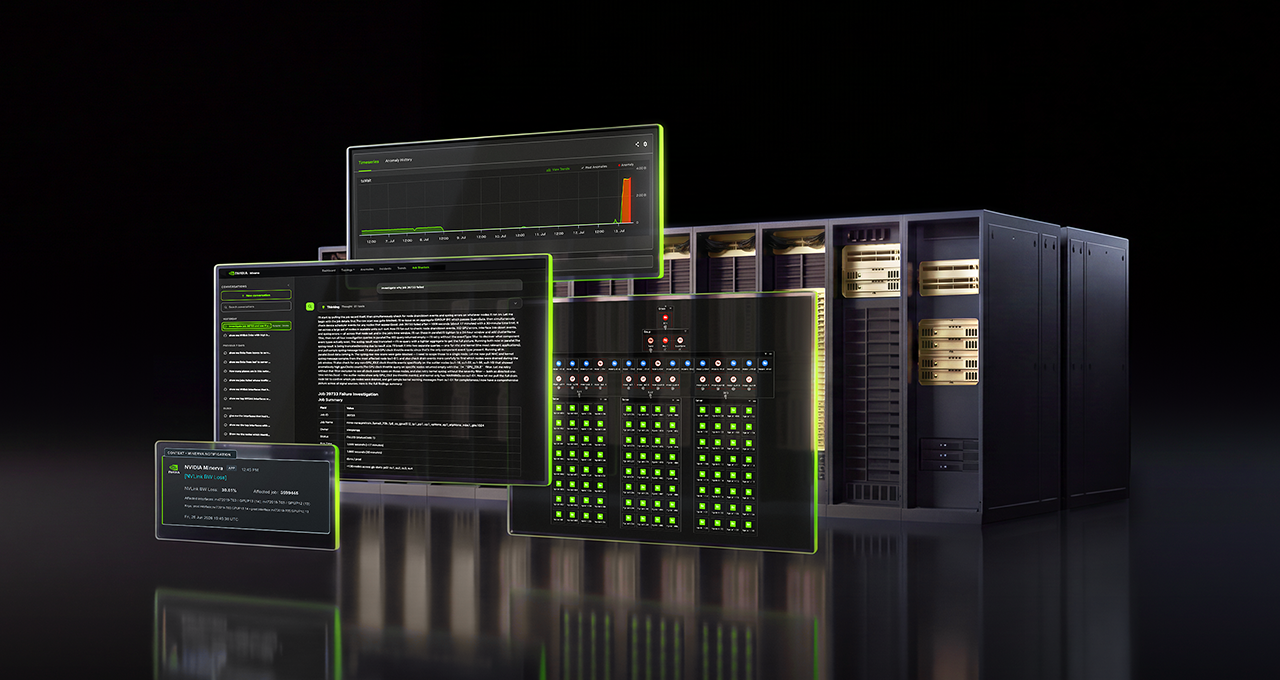
NVIDIA's new Minerva platform treats a GPU cluster's wasted hours as the problem worth solving, and it wants to own the operator's view of the entire AI factory.
Why it matters
NVIDIA launched Minerva, an AIOps platform that pulls together telemetry from GPUs, networking, storage, schedulers and workloads, then uses machine learning to spot anomalies, predict failures and group alert storms into single incidents with a likely root cause. It comes with a built-in AI assistant and can connect to outside agentic tools and automation.
At the scale of hundreds of thousands of GPUs, one overheating chip or a slowing NVMe drive can drag down a whole training job. Minerva is aimed at what NVIDIA calls AI factory yield: GPU hours, goodput, uptime and tokens produced.
From the desk
This is a sensible product for a real problem. When a training run spans enormous clusters, idle or degraded hardware is expensive and the signals are spread across teams that rarely share a view. A knowledge graph that maps jobs to the specific GPUs, SuperNICs, switches and cables they run on, so a slow job can be traced to the component causing it, is the kind of tooling operators have wanted. Fewer alerts, more meaningful ones, is a good goal.
We'd note what is and isn't in evidence. The launch claims longer time between interruptions, faster repair and less alert noise, but the announcement doesn't publish figures for any of those. IREN's CTO is quoted describing a shift toward proactive maintenance, and Aolani, Bitdeer AI, IBM, Jio, Lambda, Quake AI and Tesla plan to deploy it, with Dell, Lenovo and Supermicro offering it. That is strong adoption intent, not yet measured results.
The strategic read is the bigger one. NVIDIA already sells the chips, the networking and much of the software stack. Owning the operations layer as well tightens its grip on how AI data centers are run, and makes it harder for operators to mix in other vendors' hardware without losing visibility. That's good for integration, less good for competition.
The agentic piece also deserves care. Letting an AI assistant recommend fixes is useful. Wiring it to infrastructure APIs to apply them automatically can speed recovery, or spread a bad change quickly across a cluster. NVIDIA says teams can keep a person in the loop, and I'd expect most will, at least at first.
Context
Minerva was announced alongside NVIDIA's European announcements around GTC Berlin. Traditional monitoring splits the data center into separate views for networking, compute, site reliability and machine learning teams; Minerva's pitch is a single correlated view using supervised and unsupervised machine learning over billions of data points per hour.
Who feels it
- AI infrastructure operators
- A unified view across hardware and jobs could cut troubleshooting time and lift GPU utilization, if the claimed gains hold up.
- Cloud and neocloud providers
- Early adopters like IREN and Lambda signal that GPU yield is becoming a competitive metric worth paying to optimize.
- Competing hardware and monitoring vendors
- NVIDIA's move into AIOps raises the bar for observability tools and deepens lock-in around its own stack.
What to watch
- Published, measured improvements in uptime or repair time from early deployments
- How well Minerva handles non-NVIDIA components in mixed clusters
- How many operators enable automated remediation versus human-approved fixes
- Pricing and packaging through Dell, Lenovo and Supermicro
Companies: NVIDIA