OCP Summit 2026: Powering AI with Open Innovations in Scale-Up, Scale-Out, and Scale-Across Networks
Oct 12, 2026, 2:19 PM · Meta Engineering
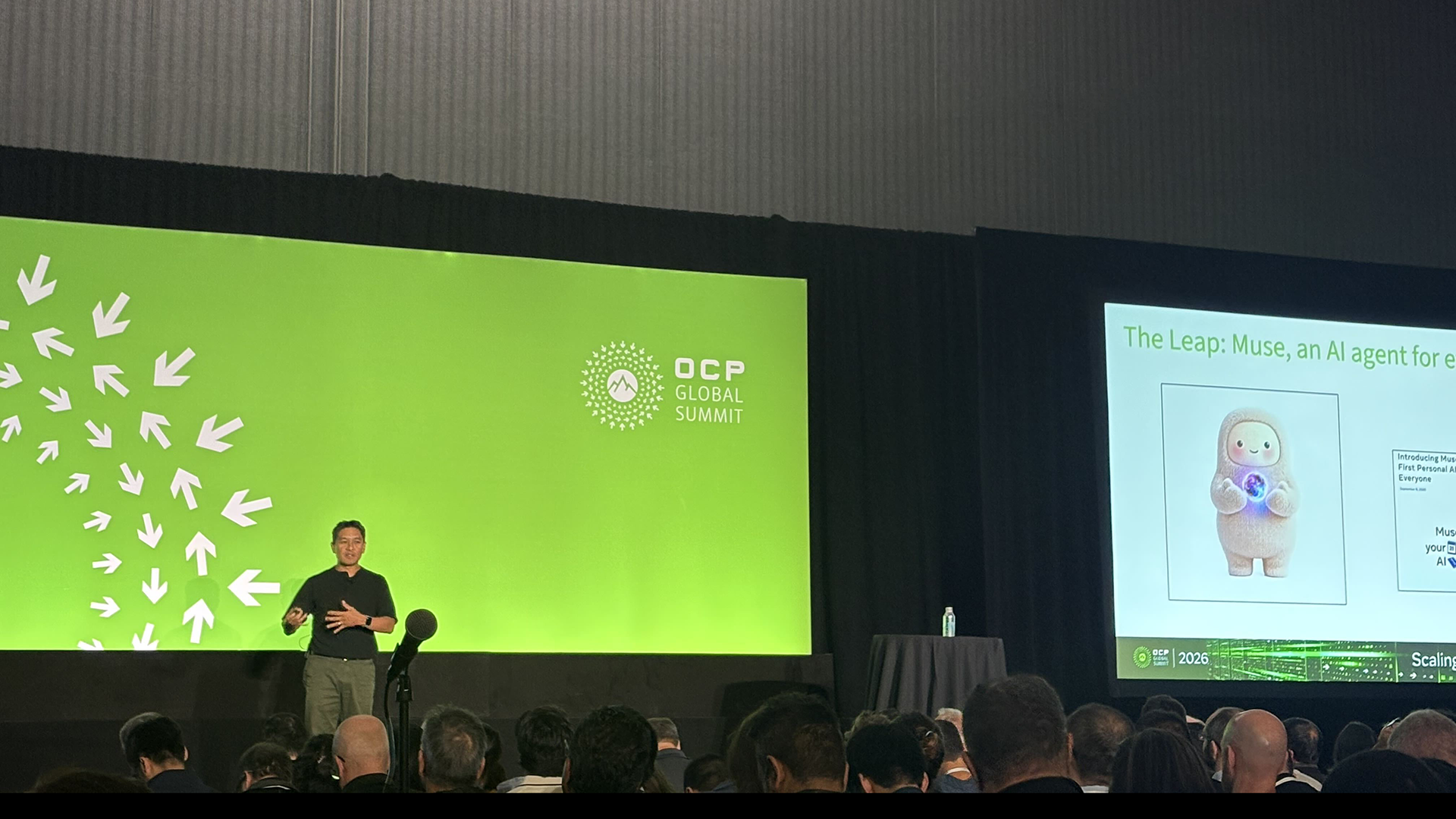
Meta is putting liquid-cooled 102.4T switches, a multiplane fabric, and open Ethernet scale-up designs on the OCP table — the plumbing that has to keep pace with Muse-scale models.
Why it matters
At the 2026 Open Compute Project Global Summit, Meta is publishing the next wave of open networking designs meant for gigawatt-scale AI clusters. The package includes IcePack, its first liquid-cooled network rack; IceCube switch blades at 102.4 Tbps; Flattened Planar Fabric, a multiplane scale-out design; Ethernet-based scale-up gear for its own accelerators; a new Open Switch Platform Architecture initiative with Microsoft and Alibaba; and open-source MetaRoCE transport.
This is the unglamorous half of the AI race. Models like Muse Wonder only matter if the fabric between accelerators can move traffic without melting, stalling, or locking operators into one proprietary interconnect. Meta is arguing that those networks should be open Ethernet standards rather than closed fabrics — and it is tying the work explicitly to training and serving its own Muse models and personal agent.
From the desk
We read this as Meta doing what it has always done best at OCP: turning its production pain into shared blueprints. IcePack and IceCube are not marketing slides. A liquid-cooled network rack with 128×800G non-blocking capacity, shipping on both Broadcom Tomahawk6C and NVIDIA Spectrum-6 silicon, and running Meta’s open FBOSS stack, is a concrete bid to double bandwidth over the prior 51.2T generation while staying inside denser power and cooling envelopes.
Flattened Planar Fabric is the architectural bet that interests us most. Each GPU hangs eight independent links into eight planes. The topology flattens from a three-tier Clos to two, load balancing moves into the NIC, and hosts help steer around failed planes. Meta says it built this with NVIDIA Spectrum-X multiplane work and is pushing the pattern into shared cloud partner deployments. That matters because Meta admits it cannot build campuses fast enough: leased halls and public cloud GPUs have to behave like one cluster. Heterogeneous fabrics, shallow buffers, and provider-specific RDMA are exactly where distributed training dies quietly. Standardizing the validation suite and congestion classes is less exciting than a model launch, and more useful.
Scale-across is the honest admission that one region is no longer enough. Backend aggregation as a petabit-scale Ethernet super-spine, connecting Prometheus and eventually Hyperion-class capacity across buildings and outdoor structures, is how Meta turns many fabrics into one training job. Measuring real cable length for buffer headroom, damping routing churn, and keeping collectives from crossing the expensive layer more than they must — that is the kind of systems work that decides whether a multi-site job finishes or thrashs.
On scale-up, Tahan is the political statement. An Ethernet-based switch for MTIA 300 accelerators, reusing the same lossless RoCE path as scale-out, and a preview of 72 accelerators per rack on 102.4T silicon headed toward ESUN, is Meta saying proprietary in-rack fabrics do not get a free pass forever. ESUN 1.0 already exists with a long vendor list; 1.1 is close. OSPA with Microsoft and Alibaba aims at the still-proprietary switch platform layer beneath SAI. MetaRoCE going open-source completes the pitch: transport, not just boxes.
Useful AI needs this kind of open plumbing. We are for it. The downside is familiar. Open specs that match Meta’s production path still favor whoever can afford IcePack-class density and BAG-scale regions. Faster, more standardized fabrics accelerate total electricity and water demand even when efficiency per bit improves. And “open” only counts when other operators ship to these specs without Meta engineers in the loop. I’m watching whether FBOSS self-onboarding and OSPA actually shorten vendor bring-up from months to something sane — that is the real adoption test.
Context
Meta co-founded OCP in 2011 and has used the summit for years to publish AI networking designs. Last year’s ESUN effort pushed Ethernet into the scale-up domain traditionally dominated by proprietary links. This year’s post explicitly frames the networking work as infrastructure for Muse Wonder, Muse Spark, and the Muse agent.
Who feels it
- Silicon and switch vendors
- Dual-ASIC IceCube blades, OSPA, and FBOSS self-onboarding lower the cost of shipping hyperscale-compatible gear — if vendors actually use the open path.
- Cloud providers and colos
- FPF learnings and shared validation suites are aimed at making leased and public-cloud GPUs look like Meta’s on-prem fabric.
- Competing accelerator makers
- Ethernet scale-up via ESUN and Tahan pressures proprietary in-rack interconnects, while still leaving GPU-side implementation flexible.
- Operators building multi-site clusters
- BAG, measured buffer headroom, and SRv6 regional backbones are a playbook for training jobs that outgrow a single building.
What to watch
- Whether non-Meta operators deploy IcePack/IceCube or FPF-style multiplane fabrics in production
- Adoption of MetaRoCE outside Meta’s own clusters
- ESUN 1.1 shipping and whether the 72-accelerator rack lands on an ESUN data plane
- How quickly OSPA v1.0 moves from submitted spec to multi-vendor hardware
Companies: Meta