AI · Nov 9, 2026
OpenAI’s Control Room puts a fail-closed kill switch inside the inference engineGLM-5.4 buys depth by reusing its own layers, but Z.ai hasn't yet shown the flagship clears the bar it claims
· Updated · Signal Desk newsroom
Analysis of reporting by MarkTechPost. How we work
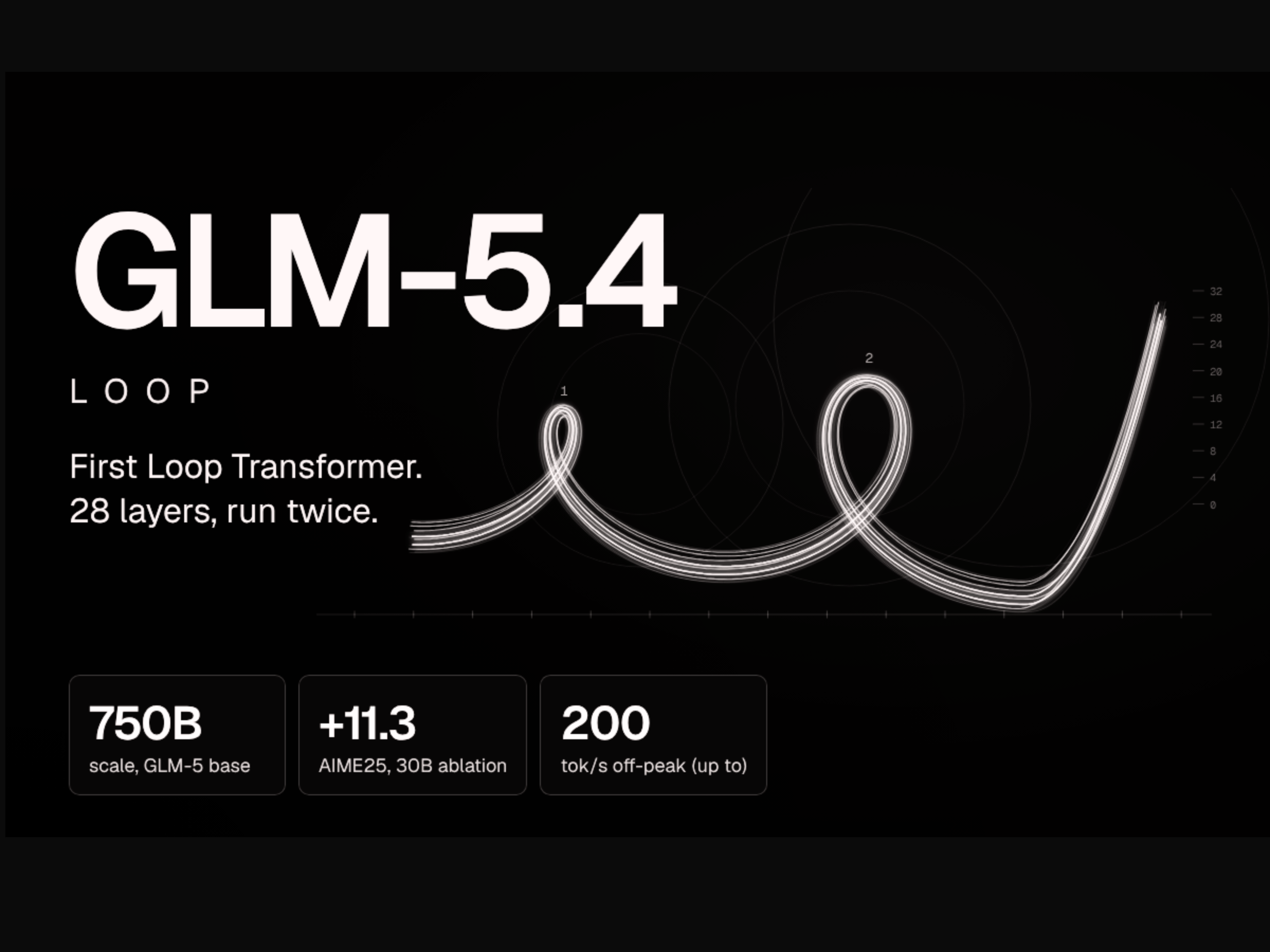
Z.ai's looped 750B model runs a block of 28 layers twice instead of adding more weights. The architecture is clever and the small-scale evidence is solid. The headline comparison to 2T-3T models is still an assertion.
Key takeaways
- GLM-5.4 is Z.ai's first flagship built as a Loop Transformer: 28 weight-shared layers from the GLM-5 base run for two iterations per pass, at 750B scale.
- It was adapted from the pre-trained GLM-5 base through continued training rather than trained from scratch.
- Z.ai claims intelligence comparable to 2T-3T parameter models but has published no benchmark table for the 750B model.
- In a 30B ablation using about 10% more training compute, looping lifted AIME25 from 19.17 to 30.42 and GPQA-Diamond from 47.58 to 56.26, while answers mostly got shorter.
- Access is through Z.ai's GLM Coding Plan, ZCode and Z.ai Chat. An API is coming and weights are planned after safety hardening.
Depth without more weights
Most of this year's open-model race has been about adding parameters, usually through mixture-of-experts designs that keep a large total size but activate only part of it per token. Z.ai's GLM-5.4 takes a different route. Instead of stacking more distinct layers, it runs a block of 28 shared layers from its GLM-5 base twice on each pass. The second trip through the same weights refines what the first trip built. MarkTechPost's summary of Z.ai's technical post describes it as the company's first flagship on this Loop Transformer design, at a 750B scale.
The idea of reusing layers isn't new in research, but making it work at flagship scale is a real engineering result. It's also the kind of bet that makes sense for a lab that can't simply outspend the biggest players on parameters and memory. If depth can come from looping, a smaller set of weights can, in principle, think harder.
The engineering is the convincing part
Z.ai describes three changes that keep the design practical, and they're the most credible part of the release. Overwriting hidden states on each loop made activation norms blow up, so GLM-5.4 adds per-token gates for each iteration. The first pass makes small updates to build context, and the second opens up to refine, with harder tokens getting bigger first-pass updates. The second loop also reuses the sparse key-value cache selected in the first pass and keeps only a local sliding window of its own, so the extra loop costs one window of cache rather than a full second copy. And it reuses the first loop's sparse attention indices, which Z.ai says adds no indexing overhead with near-identical results.
That attention to memory is what separates a paper idea from something you can serve at 1M context. Z.ai says the cost increase over GLM-5.3 stays under control at that length. We'd add one caution the release doesn't dwell on: running 28 layers twice still means more computation per token in that block, even if the cache stays lean. The reported speeds, up to 200 tokens per second off-peak and 70 to 80 at peak, are Z.ai's own figures on its own fused kernels. Anyone hosting the weights later will want to see what that costs on their hardware.
Good evidence, wrong model
Here's the gap. Z.ai has not published benchmark scores for the 750B GLM-5.4. The evidence it does offer comes from a 30B model sharing the same architecture, trained with and without looping at roughly 10% more compute for the looped version. Those results are encouraging: an 11.3-point jump on AIME25, 8.7 on GPQA-Diamond, 7.3 on the AA-LCR long-context test, and smaller gains on MMLU-Pro and IFBench. Better still, answers got shorter on most tasks, by nearly 15% on MMLU-Pro, which supports Z.ai's argument that some reasoning moves into the loop itself instead of into written-out tokens. Shorter answers for better accuracy is an efficiency result worth caring about.
But a 30B ablation is not a flagship benchmark, and the claim that GLM-5.4 matches 2T-3T parameter models has nothing at full scale behind it yet. Z.ai also flags a failure mode it calls marathon thinking, where the model gets stuck in long reasoning loops. Instruction-following showed the smallest gain of the five tests. For a product pitched at coding agents, which live and die on following instructions precisely, that's the number we'd want to see at 750B before believing the parity claim. The flashy demos, a self-narrated music video, a robotic arm modeled in FreeCAD, a full game and a shader-driven 3D scene, are vendor showcases, not measurements.
Open weights, later
GLM-5.4 launches inside Z.ai's own products: the GLM Coding Plan, the ZCode desktop agent and Z.ai Chat, with an API promised and weights planned after safety hardening. That sequence is becoming a pattern. Mistral released its trillion-parameter Large 4 behind a guardrailed endpoint with weights to follow after testing, and StepFun's Step 5 Preview promised open weights on a timeline. Releasing in hosted form first gives a lab time to find abuse cases, and it also lets the lab earn subscription revenue before competitors can serve the same model cheaper.
Neither motive is a problem on its own. But 'open weights planned' is a promise, not a release, and until the weights and a full benchmark table arrive, GLM-5.4 is a closed model with an interesting architecture paper attached. The research value is already real: if looping a pre-trained base delivers double-digit reasoning gains for about a tenth more compute, other labs will try it. Whether GLM-5.4 itself earns a place among the top open models depends on numbers Z.ai hasn't shown yet.
Who it affects
- Model researchers
- Evidence that looping an existing base model adds reasoning ability cheaply gives other labs a recipe to test without full pre-training runs.
- Developers on coding plans
- They can try GLM-5.4 now through Z.ai's tools at listed monthly prices, but without published flagship scores to compare against rivals.
- Self-hosters
- Hardware requirements and real serving costs remain unknown until weights ship.
- Rival open-model labs
- A looped design that matches much larger models would pressure the parameter-scaling approach, if Z.ai can prove it at full scale.
What to watch
- A full benchmark table for the 750B GLM-5.4, especially instruction-following and agentic coding results.
- The public API launch and per-token pricing.
- A date and license for the open weights after Z.ai's safety work.
- Independent measurements of the marathon thinking issue and serving cost at 1M context.
- Whether other labs publish looped variants of their own existing base models.
FAQ
What is a Loop Transformer?
A model that runs some of its layers more than once per pass. GLM-5.4 runs a block of 28 shared layers from GLM-5 twice to add depth without adding weights.
How big is GLM-5.4?
Z.ai describes it as 750B-scale. Active parameters and an official context window have not been disclosed, though the technical post discusses deployment at 1M context.
Has Z.ai proven it matches 2T-3T parameter models?
Not yet. Its published evidence is a 30B ablation. Z.ai has not released benchmark scores for the 750B model.
Where can developers use it?
Through Z.ai's GLM Coding Plan, the ZCode desktop app and Z.ai Chat. An API is coming and weights are planned after safety hardening.
More on AI
AI · Nov 11, 2026
OpenAI’s $2 million for children’s AI safety research matters for one promise: publishing bad newsAI · Nov 19, 2026
Perplexity opens its in-house model switchboard to developers, refusal routing includedAI · Nov 24, 2026
A general-purpose model reaches into biology's toolbox, and sometimes grabs the right toolAI · Nov 17, 2026
OpenAI says its models now shave area off production chips, including AMD’s next flagships