AI · Nov 9, 2026
OpenAI’s Control Room puts a fail-closed kill switch inside the inference engineThe personal-agent market's real dividing line is who holds the memory file
· Updated · Signal Desk newsroom
Analysis of reporting by MarkTechPost. How we work
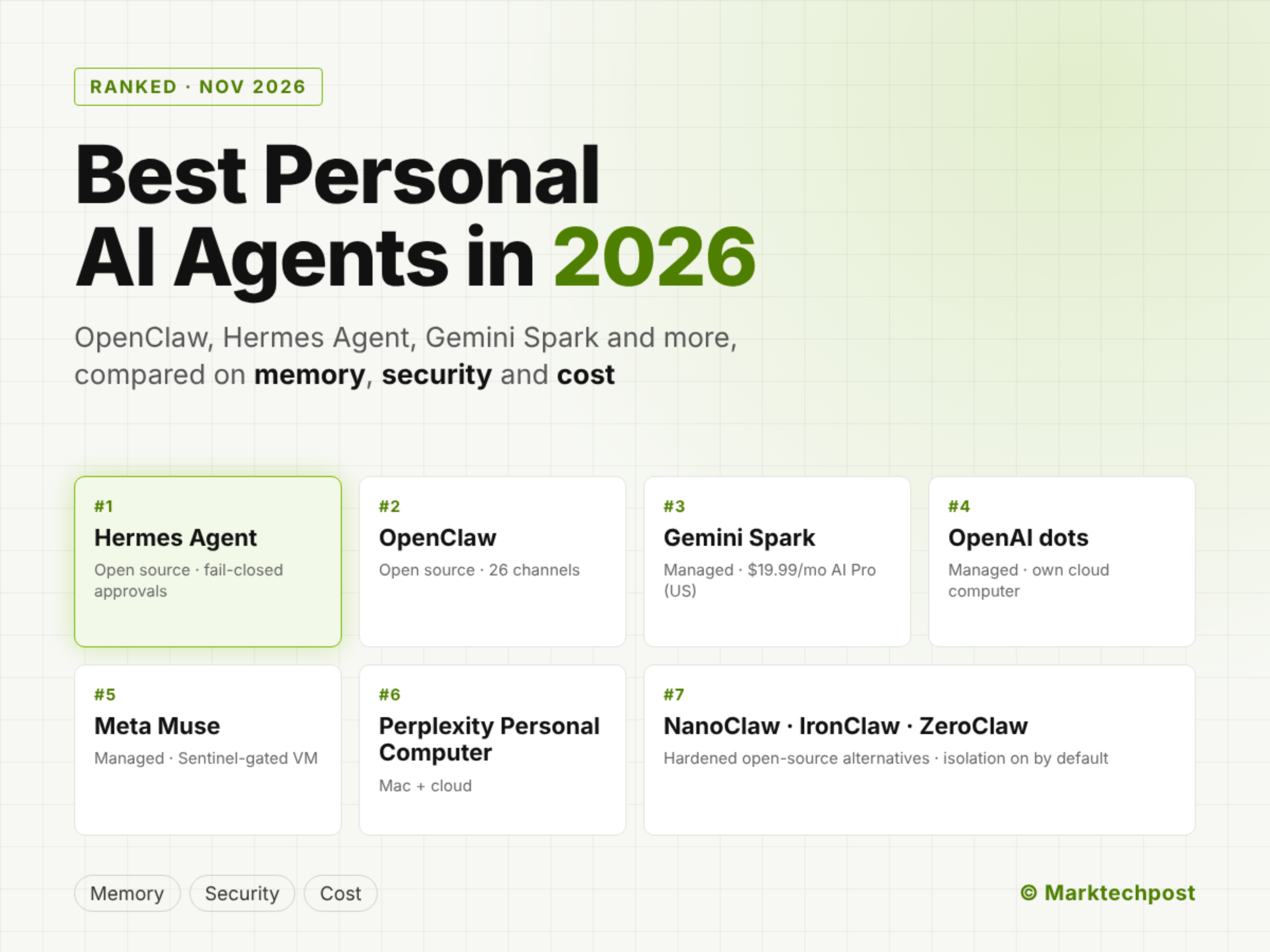
A new ranking of six personal agents scores memory, security and cost. Read closely, it shows the category splitting on ownership: files on your disk versus notes on a vendor's cloud.
Key takeaways
- MarkTechPost ranked Hermes Agent first, then OpenClaw, Gemini Spark, OpenAI dots, Meta Muse and Perplexity Personal Computer, scoring memory, security and cost for an individual user.
- Hermes and OpenClaw keep memory as editable Markdown files on the user's machine; dots and Muse keep vendor-held notes; Spark treats the Google account itself as memory.
- OpenClaw still defaults to full host access, and its ClawHub skills registry has been hit hard: Koi Security found 341 malicious entries among 2,857 skills audited, and Antiy CERT later counted 1,184.
- Spark is now included in Google's $20 US AI Pro plan, Muse has a free tier, and dots sits inside OpenAI's top consumer and business plans, though reports differ on the exact entry plan.
- Always-on agents spend tokens even when idle, through heartbeat checks, scheduled jobs and proactive research, which can exceed chat usage on a frontier API.
A buyer's guide that doubles as a map
Rankings of AI products usually age in weeks. This one, from MarkTechPost, is worth reading for a different reason. By scoring six personal agents on memory, security and cost rather than raw capability, it draws a clean map of where the category has landed a year after OpenClaw started life as a weekend project called Clawdbot in November 2025. Google, OpenAI, Meta and Perplexity all ship their own versions now. The open-source projects that started it are still at the top of the list.
The headline result is that Hermes Agent, from Nous Research, comes first and OpenClaw second, ahead of every managed product from a big platform. That's a fair call for the audience the ranking names: individual users, many of them technical. But the more durable finding sits in the memory column. Strip away the brand names and the market splits into two camps, and the split is about ownership, not intelligence.
Memory is the new lock-in
Hermes and OpenClaw store what the agent knows about its user as plain Markdown files on the user's own disk. OpenClaw's design spreads it across files such as SOUL.md for the persona and USER.md for what the agent knows about its owner. Hermes adds SQLite session search and writes its own reusable skills from completed tasks. Either way, the memory can be opened, edited, diffed, backed up and carried to a different model or a new machine.
The managed agents work differently. OpenAI's dots keep their own notes alongside ChatGPT memory. Meta's Muse learns preferences and will forget things on request. Google's Spark has no separate memory store at all, according to the ranking; it reads context from the Google apps a user connects. In each case the user can ask, but cannot open the store.
That matters more than any single feature. An agent that has spent six months learning how someone handles email, travel and money is worth far more than a fresh one, and that accumulated context is exactly what keeps a customer from switching. Search engines and social networks learned this with data. Personal agents are learning it with memory. The open-source camp is betting that people will eventually want that file in their own hands. The platforms are betting convenience wins first. Both bets are rational. Only one leaves the user free to leave.
The security record still belongs to OpenClaw
None of this makes self-hosting the safe default. OpenClaw is the cautionary tale. Out of the box it gives the agent full access to the host machine; its sandbox, which runs sessions in locked-down Docker containers with no network egress, has to be switched on. The ranking lists a one-click remote-code-execution flaw, CVE-2026-25253, that let a malicious web page steal auth tokens before it was patched. The bigger wound was the skills registry. Koi Security found 341 malicious skills among 2,857 it audited, most from a single campaign now tracked as ClawHavoc, and Antiy CERT later counted 1,184 as the registry grew. OpenClaw now scans uploads with VirusTotal and re-scans daily. That helps. It does not change the basic fact that a skill is code running with the agent's permissions.
Hermes earns its top slot partly because it fails closed: an unanswered approval prompt is denied after 300 seconds. Its own security file is admirably blunt that the denylist is not a sandbox and that operating-system isolation is the one boundary that actually holds. That honesty is a feature. Meanwhile the managed products have their own problems. The ranking praises Muse's separate Sentinel agent, which must approve any internet access, as a real architectural answer to prompt injection. Yet days earlier we covered a Reuters report that Muse was surfacing other people's messages, orders and account balances in internal testing. A clever isolation diagram is not the same as a clean record.
Where the money actually goes
Price is converging fast at the bottom. Spark launched on Google's $99.99 Ultra plan and moved into the $20 US AI Pro plan in July. Muse is free to start. The self-hosted agents are free software. The catch is buried in the cost section: always-on agents burn tokens while idle, through heartbeat checks, scheduled jobs and proactive research, and on a frontier model that background load can exceed a person's actual chat usage. A flat subscription hides that bill inside the vendor's margin. A self-hosted agent puts it on the user's API invoice.
That puts the subscription players in an awkward spot as agents get more proactive. The more useful the agent is between conversations, the more it costs to run, and somebody eats that cost. Expect usage limits and tiering to tighten before prices fall further.
It's worth setting this ranking beside WIRED's day-long test, which we wrote up in October and in which OpenAI's dots came out on top with Muse close behind for free. The two lists disagree because they ask different questions. WIRED asked which agent got everyday tasks done. MarkTechPost asked which agent a careful person should trust with an inbox and credentials. For most people, the second question is the one that ages better.
Who it affects
- Everyday users
- Spark and Muse are the easiest on-ramps, but memory and actions stay inside one company's cloud.
- Developers
- Hermes and OpenClaw offer portable, editable memory, provided they run inside a container or dedicated machine.
- Security teams
- Agent skills registries are a fresh supply-chain risk; the ClawHub numbers show how fast one can be poisoned.
- Platform vendors
- Proactive background work raises compute costs that flat subscriptions have to absorb.
What to watch
- Whether Meta ships the Muse Confidential VM, encrypted with a key only the user holds.
- Whether OpenClaw makes its sandbox the default rather than opt-in.
- Any move by Google, OpenAI or Meta to let users export agent memory in a readable format.
- Usage caps on managed agents as proactive research drives up background compute.
FAQ
Which personal AI agent ranked first?
MarkTechPost ranked Nous Research's open-source Hermes Agent first for individual users, citing its memory system and fail-closed approval defaults. OpenClaw came second and Google's Gemini Spark third.
What is the difference between self-hosted and managed agents?
Self-hosted agents such as Hermes and OpenClaw run on the user's own machine or server with any model. Managed agents such as Spark, dots and Muse run on the vendor's cloud machines and come bundled with a subscription.
Is OpenClaw safe?
It can be hardened, but by default it gives the agent full access to the host machine. Its sandbox must be turned on, and its skills registry has had hundreds of malicious entries, so unvetted skills should be treated as untrusted code.
Why do idle agents cost money?
Always-on agents call the model for heartbeat checks, scheduled jobs and proactive research even when nobody is chatting. On a frontier model, that background usage can exceed normal chat usage.
Companies: OpenAI, Google, Meta
More on OpenAI
AI · Nov 11, 2026
OpenAI’s $2 million for children’s AI safety research matters for one promise: publishing bad newsAI · Nov 19, 2026
Perplexity opens its in-house model switchboard to developers, refusal routing includedAI · Nov 24, 2026
A general-purpose model reaches into biology's toolbox, and sometimes grabs the right toolAI · Nov 17, 2026
OpenAI says its models now shave area off production chips, including AMD’s next flagships