AI · Nov 19, 2026
Apple wants to build the Mac agent it is warning users aboutMeta now lets agents carry most ad-model upgrades across its fleet, and claims $45 million in compute savings
· Updated · Signal Desk newsroom
Analysis of reporting by Meta Engineering. How we work
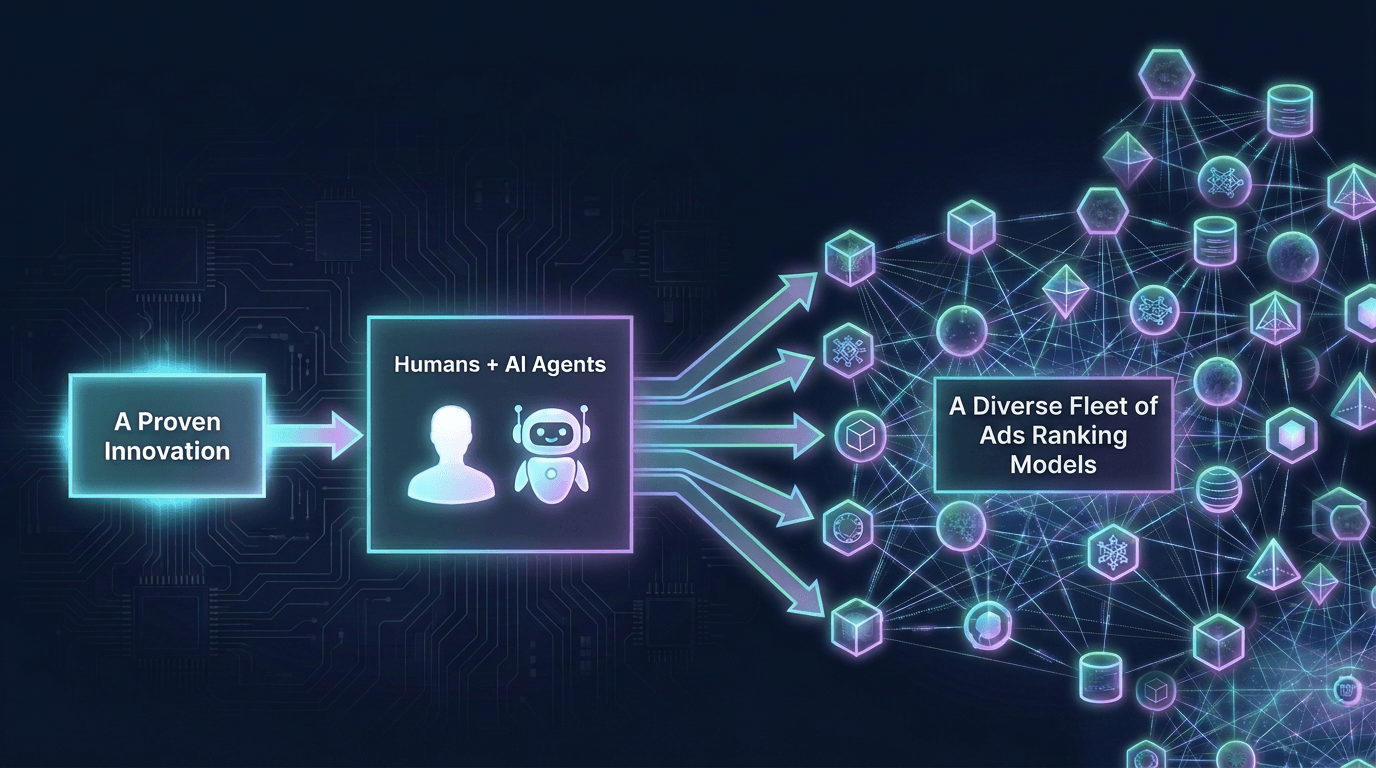
Meta Engineering says AI agents handle over 60% of ‘technique propagation’ across its ads ranking models, with 3x engineer productivity and a median 4x cut in training compute. The gains are internal and self-measured, but the pattern is instructive.
Key takeaways
- Since March 2026, Meta estimates agents handle over 60% of technique propagation across its ads ranking models.
- Meta reports 3x engineering productivity, a median 4x training-compute reduction on select combinations, and an estimated $45M+ in compute savings by year-end.
- Agents work across discovery, generalization and adoption, drawing on a shared knowledge base of prior runs.
- Highest-revenue models still get bespoke adaptation, with agents learning from engineers and humans approving what ships.
- Meta aims to cut the time for a technique to reach every applicable model from over a year to three months.
The unglamorous bottleneck
Most AI news is about inventing better models. Meta’s post is about a duller and more expensive problem: once a team proves an improvement on one ads ranking model, getting it onto all the others. Meta runs a large fleet of ranking models, each with its own architecture, data and serving limits, so a technique that works on one rarely copies cleanly to the next. And techniques have a shelf life; a gain proven today may be superseded within a couple of development cycles. Meta says it can currently take over a year for a proven technique to reach every applicable model.
Meta’s first answer was standardization. Its template-driven model ecosystem let a technique validated once at the template level flow to every model built from that template, and Meta says it shipped more than 5,000 technique-model combinations over two years while cutting per-model engineering time by 92%. What templates couldn’t automate were the judgment calls: which technique is worth trying where, how wide a search to run, why a model isn’t improving. That is the gap Meta now hands to agents.
How the agents divide the work
Meta describes three stages. In discovery, agents track which techniques have been proven, estimate how well each would transfer, and produce ranked candidate lists for engineers to review. In generalization, they help build and test templates and, for the highest-revenue models, learn from engineers’ adaptation choices before proposing changes for the remaining models. In adoption, they launch multi-day training runs, monitor convergence, diagnose failures and assemble proposals, while ranking hundreds of concurrent jobs by revenue importance, technique potential and deadline, and reclaiming capacity from stalled runs.
The compute savings come mostly from search discipline. Drawing on millions of prior training runs, agents start from configurations likely to work, narrow the hyperparameter space each round, and kill unpromising experiments early. Meta reports a median 4x reduction in training compute across select technique-model combinations. That fits a broader theme in recent Meta engineering posts about squeezing more from finite hardware, such as Intelligent Delivery.
What to believe
The headline numbers are self-reported and comparative against Meta’s own pre-agent baseline: over 60% of propagation handled by agents, 3x more adaptations per engineer, and an estimated $45 million-plus in compute savings by year-end. The “select combinations” qualifier on the 4x figure matters, and the $45 million is a projection. Still, the evaluation design is more rigorous than most agent case studies. Agent-propagated techniques face the same tests as human ones: better offline normalized entropy, no regressions on cost guardrails, and a statistically significant online A/B win before shipping. Meta also tracks recall at discovery, on the logic that a model missed early never gets a second chance.
The bigger takeaway is organizational. Meta says it is making agent-driven propagation the primary mode, targeting 5x higher throughput, and plans to “agentify” the whole ranking model lifecycle. For advertisers, that likely means improvements arrive faster across more ad surfaces. For engineers, it means their job shifts toward approving plans and handling the highest-stakes models, a pattern we see across agent deployments.
Who feels it
- Meta ML engineers
- Each engineer oversees about 3x more adaptations, with work shifting to review and prioritization.
- Advertisers
- Ranking improvements may reach more ad surfaces sooner if the three-month target is met.
- Other large ML teams
- A concrete template: standardize first, then use agents for judgment calls, with stage-level metrics.
- Meta’s compute budget
- Projected $45M+ savings this year, a small but real dent in AI training costs.
What to watch
- Progress toward Meta’s goal of three months from proven technique to full-fleet adoption.
- Whether agents begin handling the highest-revenue models with less human direction.
- Results from the “self-evolving” learning Meta says agents will use to refine their own strategies.
- Any reported failures or rollbacks from agent-propagated changes in production.
FAQ
What is technique propagation?
Meta’s term for adapting a proven model improvement, like a new architecture layer or training optimization, to the rest of its diverse ads ranking models.
How much do agents handle?
Meta estimates agents handle over 60% of technique propagation since they began driving execution in March 2026.
What savings does Meta report?
3x engineering productivity, a median 4x training-compute reduction on select combinations, and an estimated $45M+ in compute savings by year-end, all measured internally.
Do humans still approve changes?
Yes. Engineers review key decisions and approve what ships, and changes must win online A/B tests.
Companies: Meta
More on Meta
AI · Nov 13, 2026
A week with Claude Duet: good at catching what falls between apps, shaky on tone and urgencyAI · Nov 10, 2026
Anthropic moves beyond coders with Claude Meetings, Sheets and WhiteboardsAI · Nov 9, 2026
Meta’s Muse Ember prices agent grunt work at 10 cents per million tokensAI · Nov 6, 2026
Meta’s Muse Spaces turn the chatbot into a project board that keeps updating itself