AI · Nov 18, 2026
Meta now lets agents carry most ad-model upgrades across its fleet, and claims $45 million in compute savingsMeta’s quiet ads breakthrough is standardization, not a new model
· Updated · Signal Desk newsroom
Analysis of reporting by Meta Engineering. How we work
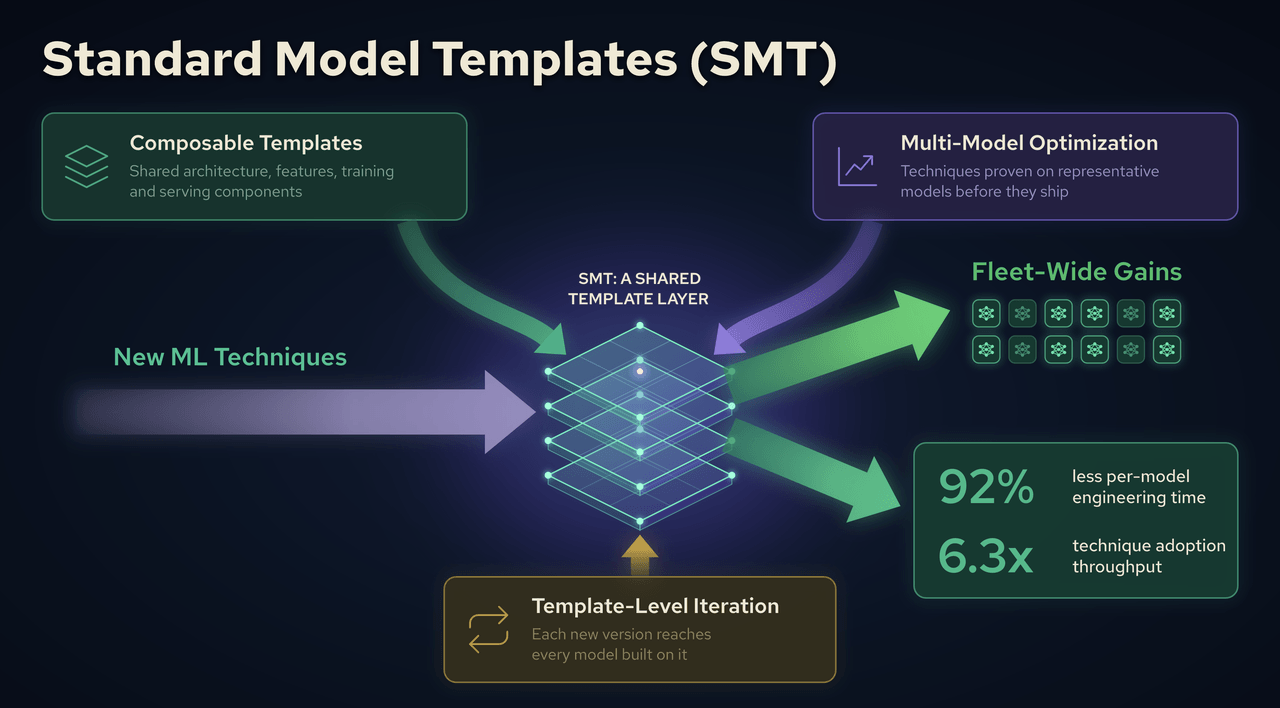
Meta says collapsing its ads-ranking fleet onto a small set of standard templates cut per-model engineering time 92% and gave its agents a bounded space to work in. The lesson travels well beyond ads.
Key takeaways
- Meta’s Standard Model Templates group many production ads models around a few reusable designs for ranking and retrieval.
- Over two years, Meta reports a 92% cut in per-model engineering time and more than 5,000 technique-model combinations shipped.
- It cites 0.63% average offline quality gains at neutral serving capacity and 0.86% cumulative online lift across 70% of models by count.
- Multi-model optimization weighs regression rates as heavily as average gains; 80 techniques shipped this way.
- Meta argues templates are what make agentic model building practical, by giving agents a bounded search space and a quality floor.
The problem Meta says it solved
Meta’s ads systems run a large fleet of production models serving billions of daily requests, and its engineers describe a problem every big ML shop eventually hits. Inventing a better technique is no longer the hard part; getting it onto every model it applies to is. A new architecture lands on one model and takes years to reach the rest. A platform migration works for one family and breaks on the long tail. Engineering effort grows linearly with the number of models.
Meta’s answer was to reduce variety rather than automate around it. Standard Model Templates are opinionated, minimal setups built from shared components for feature selection, feature interaction, model parallelism, training configuration and hardware-aware serving. Models are grouped around a small number of templates, and ideas are tested on representative models then pushed to the groups that use them.
What the numbers say, and don’t
The reported results are substantial for a mature system: a 92% reduction in per-model engineering time over two years, more than 5,000 technique-model combinations shipped, 0.63% average offline quality improvement at neutral serving capacity, and 0.86% cumulative online lift covering 70% of models by count. Meta also says 80 new techniques shipped through its multi-model optimization process, which considers regression rates alongside average gains before integrating a change.
These are Meta’s own figures, published alongside a paper, and the blog does not translate the online lift into revenue or advertiser outcomes. Sub-1% gains sound small, but on a system this size they are typically the whole game. The claim we find most interesting is qualitative: that diverse optimization goals did not require diverse model designs nearly as often as teams assumed. That runs against the instinct of most product teams, who want their own model for their own objective. It also fits the direction of Meta’s GEM foundation model, which consolidated per-surface optimizations into one central model.
Why agents need guardrails like this
The most transferable argument is about agents. Meta says free-form agentic model building fails because the search space is too open: agents waste effort on unproductive regions and propose changes that are hard to explain or ship. Templates give them a structured start, a bounded space and a quality floor. In Meta’s setup, agents build and improve templates, run experiments across representative models, diagnose failures and handle migrations, work described in its companion post on agents scaling ML techniques across ads ranking.
That is a sober counterweight to the idea that agents will simply figure everything out. The trade-off is lock-in to the templates themselves. Meta acknowledges that a template system accommodating every edge case will recreate the fragmentation it was meant to fix, and that its workflows still need to become more reliable and explainable. For the advertisers and users on the other end, a more efficient ranking machine is still an ads-optimization machine; the efficiency claim says nothing about what it is optimized to do.
Who it matters to
- ML platform teams
- A documented case that standardizing model design can beat per-model tuning at fleet scale.
- Agent researchers
- Evidence that bounded, structured spaces make agentic optimization more practical.
- Advertisers
- Small fleet-wide ranking gains compound across Meta’s products, though Meta doesn’t quantify advertiser impact here.
What to watch
- Peer review and outside replication of the template-driven approach from Meta’s paper.
- Whether Meta extends templates beyond ads ranking and retrieval.
- Progress toward the end-to-end agentic workflows Meta lists as next steps.
FAQ
What are Standard Model Templates?
A curated set of reusable model designs built from shared components, around which Meta groups its ads-ranking models.
What results does Meta report?
A 92% cut in per-model engineering time, 5,000+ technique-model combinations shipped, 0.63% average offline gains and 0.86% cumulative online lift across 70% of models.
How do agents fit in?
Meta uses agents to build and improve templates, run experiments, diagnose failures and migrate models, with templates bounding the search space.
Companies: Meta
More on Meta
AI · Nov 19, 2026
Apple wants to build the Mac agent it is warning users aboutAI · Nov 13, 2026
A week with Claude Duet: good at catching what falls between apps, shaky on tone and urgencyAI · Nov 10, 2026
Anthropic moves beyond coders with Claude Meetings, Sheets and WhiteboardsAI · Nov 9, 2026
Meta’s Muse Ember prices agent grunt work at 10 cents per million tokens