Mistral AI Releases Mistral Large 4 (Le Chonk): A 1.05T Parameter Multimodal MoE Model
Oct 6, 2026, 10:30 AM · MarkTechPost
Look past the trillion-parameter headline: Le Chonk's sharpest claim is that it will do defensive security work closed models refuse, and that claim carries both promise and risk.
Why it matters
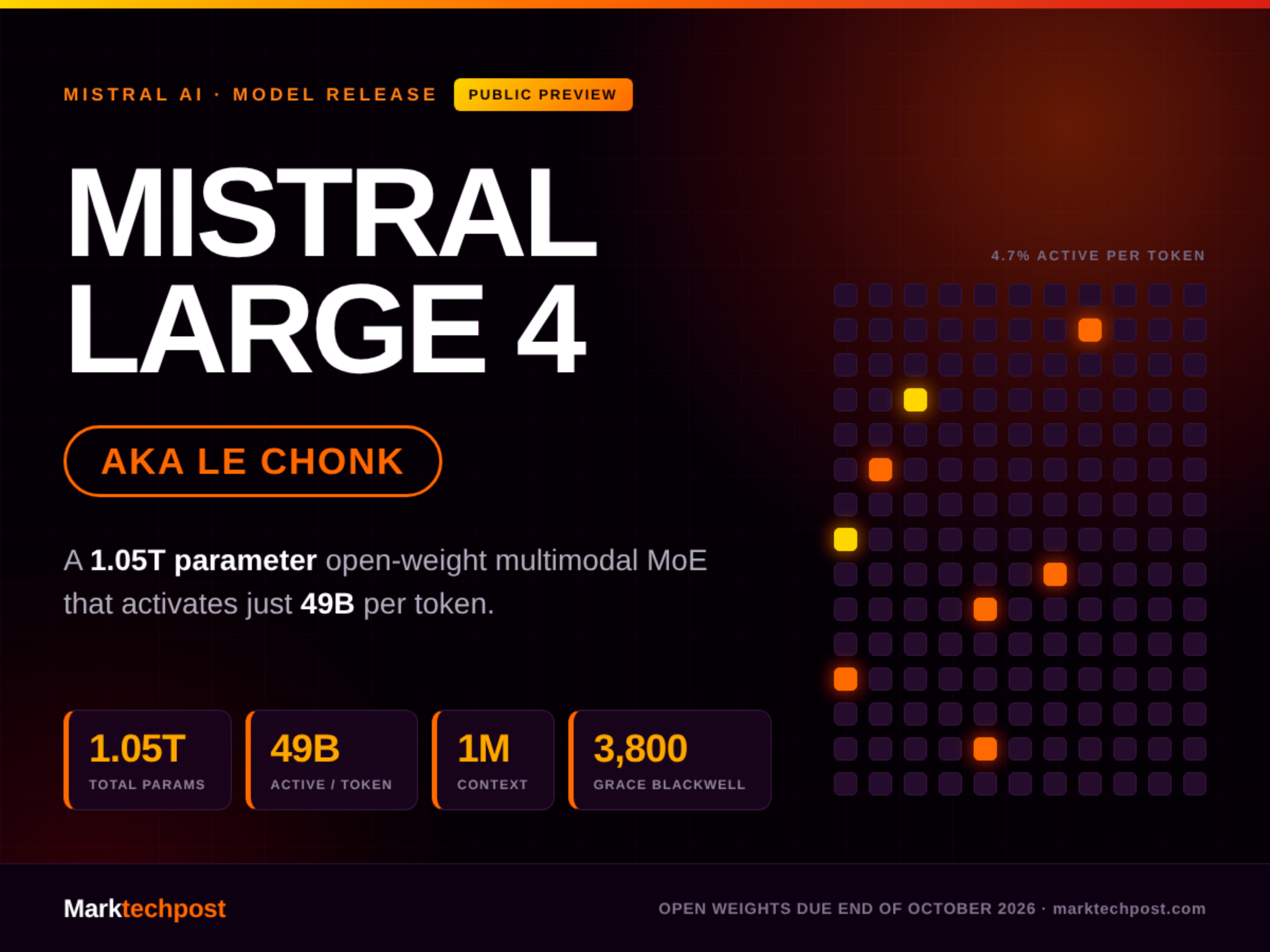
Mistral released Mistral Large 4, nicknamed Le Chonk, as a public preview. Per its documentation it is a mixture-of-experts model with 1.05 trillion total parameters, 49 billion active per token, a 1 million token context window, and native image input, trained from scratch on 3,800 NVIDIA Grace Blackwell GPUs in Mistral's own European data centers. The API is live at $1.36 per million input tokens and $4.18 per million output tokens, with cached input at $0.14. The weights are due by the end of October, so self-hosting is not possible yet.
The standout numbers are in cybersecurity: Mistral reports 93 percent on Cybench and 82 percent on CyberGym-E2E, and says several closed frontier models score near zero on the latter because they refuse the task outright.
From the desk
We've covered Le Chonk's politics and the sovereignty pitch. This source points us to something more practical: refusal as a competitive variable. Reproducing a vulnerability to prove it is real is ordinary defensive work, and if closed models turn that work away, security teams have a legitimate reason to look elsewhere. We think a model that helps defenders do their jobs is a real public good, and we're glad someone is measuring the cost of over-refusal instead of treating it as free.
The other side is just as real. A model strong at finding and reproducing exploits, with downloadable weights coming soon, is strong for anyone who downloads it. Once the weights ship, the guardrails Mistral controls at the API layer stop being the only line. Mistral reports safety scores too, resisting 93.3 percent of attacks on Lakera's B3 benchmark and scoring 1.691 of 2.0 on KORABench. Those are useful signals, but they describe the model under test, not what a determined fine-tuner can make of it.
We'd also slow down on the coding numbers. Mistral says its agentic coding results were evaluated privately before the test harness was public, so nobody can reproduce them yet. The more trustworthy signal is the blind human evaluation run with Surge AI, which put the preview second of five models at 3.74 out of 5, ahead of GLM-5.3 and Kimi K3 and behind Claude Opus 5. That is strong, not dominant.
Our read: the economics are the quiet story. With only about 4.7 percent of weights active per token, Le Chonk serves at mid-tier prices, and cheap cached input makes long-context agent loops much more affordable. For security teams frustrated by refusals, that combination will be hard to ignore. Whether the open-weight release makes the internet safer or noisier depends on who picks it up first.
Context
Mistral has not yet published the expert count, routing details or layer layout, which it says arrive with the weights, and the license is not yet announced. Training data spanned more than 160 languages, including every official EU language. The preview API supports function calling, structured outputs, document Q&A, batching and agent endpoints.
Who feels it
- Security teams
- A capable option for vulnerability reproduction and defensive work that closed models may refuse.
- Developers building agents
- A 1M context window with $0.14 cached input changes the cost math for long-running agent loops.
- Self-hosters
- Must wait for end-of-October weights and an unannounced license, and the full 1.05T parameters still have to fit in memory.
- Closed-model providers
- Pressure to justify refusals on legitimate security tasks as open alternatives advertise doing them.
What to watch
- Whether the weights ship on schedule and under what license
- Independent reproduction of the coding and CyberGym-E2E results once harnesses are public
- How closed labs respond to the claim that their refusals cost defenders
- Early reports of the open weights being fine-tuned to strip safety behavior
Companies: NVIDIA