NVIDIA Brings Real-Time AI to Broadcast, Sports and Global Streaming at IBC
Sep 9, 2026, 9:00 AM · NVIDIA Blog
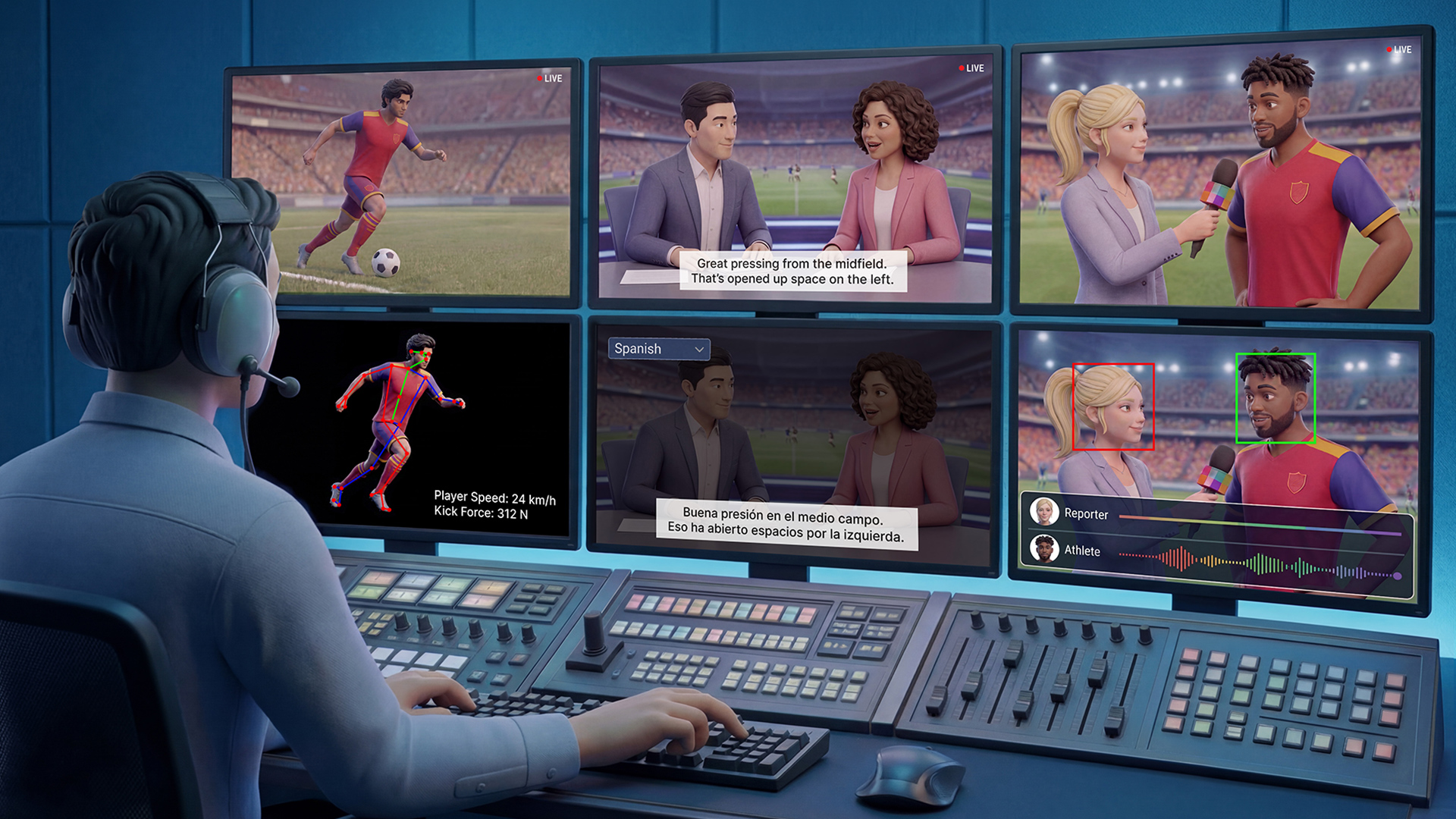
At IBC 2026, NVIDIA is packaging authenticity detectors, frame generation, and sports-specific fine-tuning into one media stack—pushing live production toward software-defined AI without pretending the trust problem is solved.
Why it matters
NVIDIA used the run-up to IBC in Amsterdam (Sept. 11–14, 2026) to expand NVIDIA AI for Media: SDKs, NIM microservices, playbooks, and blueprints aimed at live broadcast, sports, news, and streaming. The headline pieces are a Synthetic Video Detector for authenticity scoring, Video Frame Generation for smoother slow-mo, Video Super Resolution and TrueHDR for enhancement, LipSync and Active Speaker Detection for localization, plus Holoscan for Media with a Media Exchange Layer for software-defined live apps.
Partners are already wiring this into production systems—Dalet and TwelveLabs and Wowza for synthetic-media checks, Ross Video for AI-assisted sports replay, Vizrt for body-pose-driven virtual studios, NDI for lip-synced multilingual streams. Sports Intelligence Playbooks lean on the same theme: fine-tune open models on proprietary league footage so multimodal AI understands a sport's rules and moments.
That is not a niche demo week. It is NVIDIA trying to make GPU-accelerated AI the default substrate of live media infrastructure, from authenticity gates to replay and global localization.
From the desk
We're watching a familiar NVIDIA pattern: ship the building blocks, seed partner integrations, and let the industry reorganize around accelerated compute. The useful part is concrete. Synthetic Video Detector claims 99.3% accuracy on text-to-video and 97.7% on image-to-video, with Dalet, TwelveLabs, and Wowza putting scores into editorial and compliance workflows—including live feeds that can run on-prem or air-gapped. In a year when synthetic footage is a newsroom daily hazard, a detector that editors can actually open inside existing tools is progress worth taking seriously.
Frame generation is the other crowd-pleaser. Ross Video is integrating VFG into Rio Replay for roughly 6x slow-motion, with work toward 8x, so replay teams get smoother motion without every camera running ultra-high frame rates. Pair that with Body Pose from a single camera, VSR, and TrueHDR in one effects pipeline and you get a coherent story: enhance what you already shot, don't always recapture.
I'm less impressed by the sports playbook numbers until outsiders replicate them. Early testing says multiple-choice accuracy on unseen footage jumped from about 53% to 94%, and open-ended from about 5.7% to 66%, after fine-tuning on proprietary sports data. That is a strong pitch for rights holders who already own the film and annotations—and a reminder that general models still miss sport-specific context. The downside if this scales: leagues that can afford private multimodal stacks pull further ahead, and officiating or safety claims built on pose and moment detection will need independent audit, not just partner demos.
Localization is the sleeper. LipSync plus Active Speaker Detection inside Holoscan for Media, with NDI and vendors like CAMB.AI and Chyron in the mix, points to multilingual live from a shared stream. That can expand reach and cut duplicate production cost. It can also normalize face and voice rewriting in news and sports without audiences knowing what was translated versus performed. Our read is pro-useful: authenticity tooling and smoother live workflows earn the benefit of the doubt when they stay in human review loops. The trajectory to watch is whether detectors and localization become mandatory infrastructure—or marketing stickers on the same GPU bill.
Context
IBC remains the annual gathering point for broadcast and streaming tech; NVIDIA's AI for Media bundle and Holoscan reference architecture are pitched as the open exchange layer so AI functions, traditional media apps, and multi-vendor tools share the same accelerated fabric.
Who feels it
- Broadcasters and sports rights holders
- Authenticity scoring, AI replay, and playbook-tuned sports models become purchasable capabilities—favoring organizations that already own proprietary video and can fine-tune privately.
- Newsrooms and compliance teams
- Frame-level synthetic signals inside Dalet/TwelveLabs/Wowza workflows help, but probability scores are not verdicts; editorial judgment stays the last mile.
- Global audiences
- Smoother slow-mo and real-time lip-synced localization can improve access; they also blur the line between original performance and generative rewrite.
What to watch
- Whether SVD accuracy claims hold up in newsroom A/B use beyond NVIDIA's reported text-to-video and image-to-video figures.
- Ross Video's 6x-to-8x AI slow-mo shipping into real sports productions this season.
- How many leagues adopt Sports Intelligence Playbooks versus sticking with closed analytics vendors.
Companies: NVIDIA