AI · Oct 28, 2026
RTX Spark laptops get open speech models and a dial for background agentsRTX Spark arrives as a mini PC, and Nvidia is selling it as an always-on home for AI agents
· Updated · Signal Desk newsroom
Analysis of reporting by NVIDIA Blog. How we work
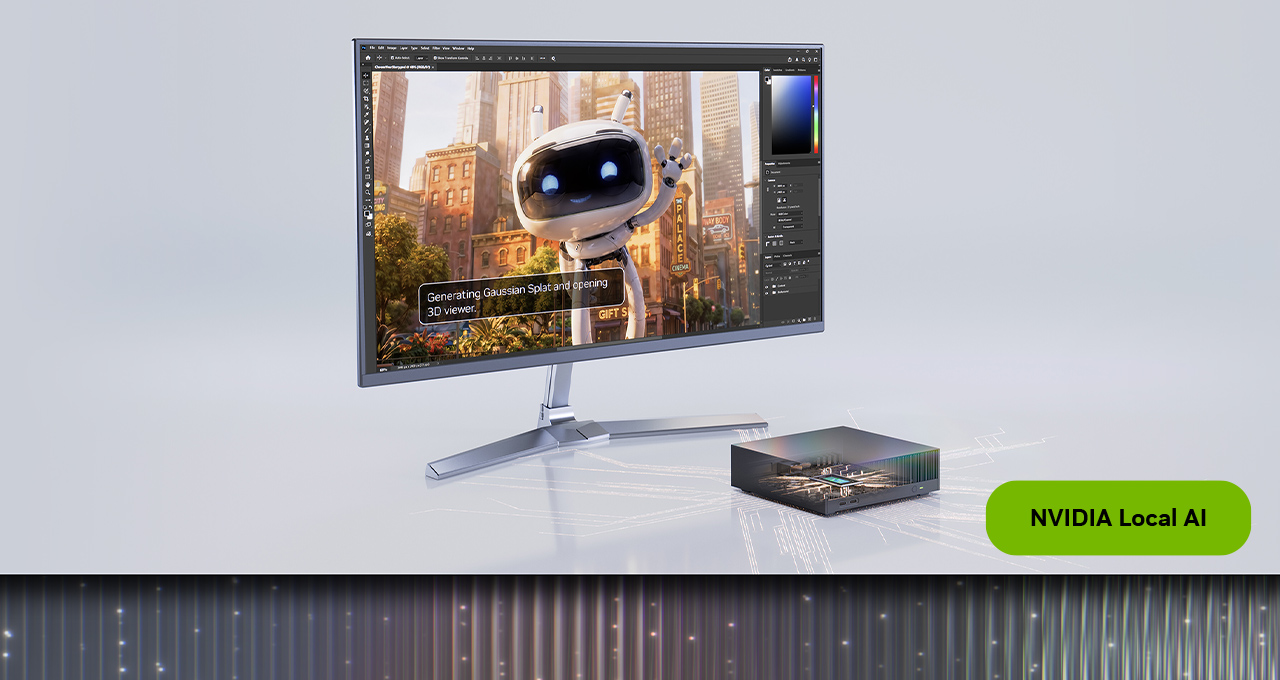
Compact RTX Spark desktops from ASUS, Dell and MSI are on sale, with Acer, GIGABYTE, HP and a Microsoft Surface dev box coming. Nvidia’s pitch is a dedicated Windows box for local agents; the software ecosystem is what will make or break it.
Key takeaways
- RTX Spark compact desktops from ASUS, Dell and MSI are available now; Acer, GIGABYTE, HP and a Microsoft Surface RTX Spark Dev Box are coming.
- Each pairs a 20-core Grace CPU with a Blackwell RTX GPU (6,144 CUDA cores) and up to 128GB unified memory, rated up to 1 petaflop of AI performance.
- Nvidia says the machines can run 120-billion-parameter models locally and keep agents running 24/7.
- NVIDIA Switchyard in Hermes routes agent tasks between local and cloud models to manage costs.
- Adobe, Blender and ComfyUI updates add native Arm and RTX-accelerated workflows; Nvidia did not list desktop pricing in this post.
The desktop half of the Spark launch
When Nvidia and Microsoft launched RTX Spark in October, laptops came first and compact desktops were promised for November. They are here. ASUS, Dell and MSI are selling them now, with mini PCs from Acer, GIGABYTE and HP and a Microsoft Surface RTX Spark Dev Box on the way. The spec sheet matches the laptops: a 20-core Grace CPU, a Blackwell RTX GPU with 6,144 CUDA cores, up to 128GB of unified memory, and up to 1 petaflop of AI performance, plus 10-gigabit Ethernet for moving big models and media.
Nvidia’s framing is the interesting part. It is not pitching these as faster PCs; it is pitching them as a place for agents to live. A dedicated desktop can keep scheduled tasks and agents running while a laptop travels. ASUS’s ProArt GR1X mini PC is described as built to run personal agents around the clock.
Why local-first is the argument
The economic case is that running supported models locally keeps code and files on the machine and avoids per-token cloud charges for those tasks. Nvidia says 128GB is enough to run 120-billion-parameter models locally. The more realistic architecture, though, is hybrid. NVIDIA Switchyard, now in Hermes Agent, routes everyday tasks to on-device models and sends harder reasoning to cloud models. That is an honest admission that local hardware won’t match frontier cloud models for everything, and a sensible way to cap bills.
This builds on the software slate Nvidia rolled out around the laptop launch, which we covered in the RTX Spark app ecosystem piece, and on Microsoft’s Windows work to make agent installs nearly frictionless.
Creative software is catching up
A big risk for any Arm-based Windows PC is emulation. This update chips away at it. Adobe is expanding native Windows on Arm and RTX acceleration: Premiere gains TensorRT-RTX acceleration for features like Enhance Speech and Auto Reframe, with Adobe and Nvidia claiming over 50% faster turnaround on everyday H.264 deliverables; Photoshop speeds up its Remove Tool and gets native Camera Raw; Illustrator and InDesign get native Arm builds, with Illustrator up to 30% faster than emulated; Substance 3D Painter runs natively in public beta. Blender 5.3 adds DLSS 4.5 Ray Reconstruction to the Cycles viewport, and ComfyUI chains frame generation and HDR conversion in one workflow.
Those are vendor figures, and creative pros will judge by their own projects. But the direction is right: the hardware only matters if the apps people already use run natively and fast.
Where we land
RTX Spark desktops are a coherent idea, a quiet always-on box for local models with a cloud escape hatch, and the 128GB memory ceiling is the feature that matters most for agent workloads. The open questions are price, which Nvidia’s post doesn’t list for the desktops, and whether Windows on Arm compatibility holds up for the long tail of professional tools. Developers already weighing a DGX Spark now have a Windows-first alternative from the same chip family.
Who it’s for
- Developers
- A Windows machine with CUDA, WSL and 128GB memory for local agents and fine-tuning via Unsloth or NemoClaw blueprints.
- Creators
- Native Adobe and Blender acceleration plus local ComfyUI generation without cloud fees.
- Small teams
- An always-on local agent host that keeps files on-premises, with hybrid routing for harder tasks.
- PC makers
- A new category alongside laptops, with Acer, GIGABYTE, HP and Microsoft joining soon.
What to watch
- Desktop pricing and how it compares with RTX Spark laptops and DGX Spark.
- Availability dates for Acer, GIGABYTE, HP and the Surface RTX Spark Dev Box.
- Real-world tests of 120-billion-parameter models and sustained 24/7 agent workloads.
- Native Arm support for more professional apps beyond Adobe and Blender.
FAQ
Who sells RTX Spark desktops?
ASUS, Dell and MSI now; Acer, GIGABYTE, HP and the Microsoft Surface RTX Spark Dev Box are coming soon.
What are the specs?
A 20-core Grace CPU, a Blackwell RTX GPU with 6,144 CUDA cores, up to 128GB unified memory, up to 1 petaflop of AI performance and 10GbE.
Can it replace cloud AI?
Partly. Nvidia says it can run 120B-parameter models locally, and Switchyard routes harder reasoning to cloud models.
How much does it cost?
Nvidia’s announcement doesn’t list desktop prices; RTX Spark laptops started at $2,399 in October.
Companies: NVIDIA
More on NVIDIA
AI · Nov 5, 2026
NVIDIA’s four open Cosmos 3 Nano models let robot and driving teams simulate worlds that reactAI · Nov 16, 2026
Rubin HPC is Nvidia’s bet that science agents will be bottlenecked by simulation, not reasoningAI · Nov 9, 2026
Nvidia’s Korean startup bets span interconnect, open models, robot hands and document AIAI · Nov 8, 2026
Nvidia’s Dynamo recipes speed four Korean open models to production, tuned for B200s