AI · Nov 9, 2026
OpenAI’s Control Room puts a fail-closed kill switch inside the inference engineOpenAI and Cisco build a kernel-level stopgap for the days between finding a bug and patching it
· Updated · Signal Desk newsroom
Analysis of reporting by OpenAI. How we work
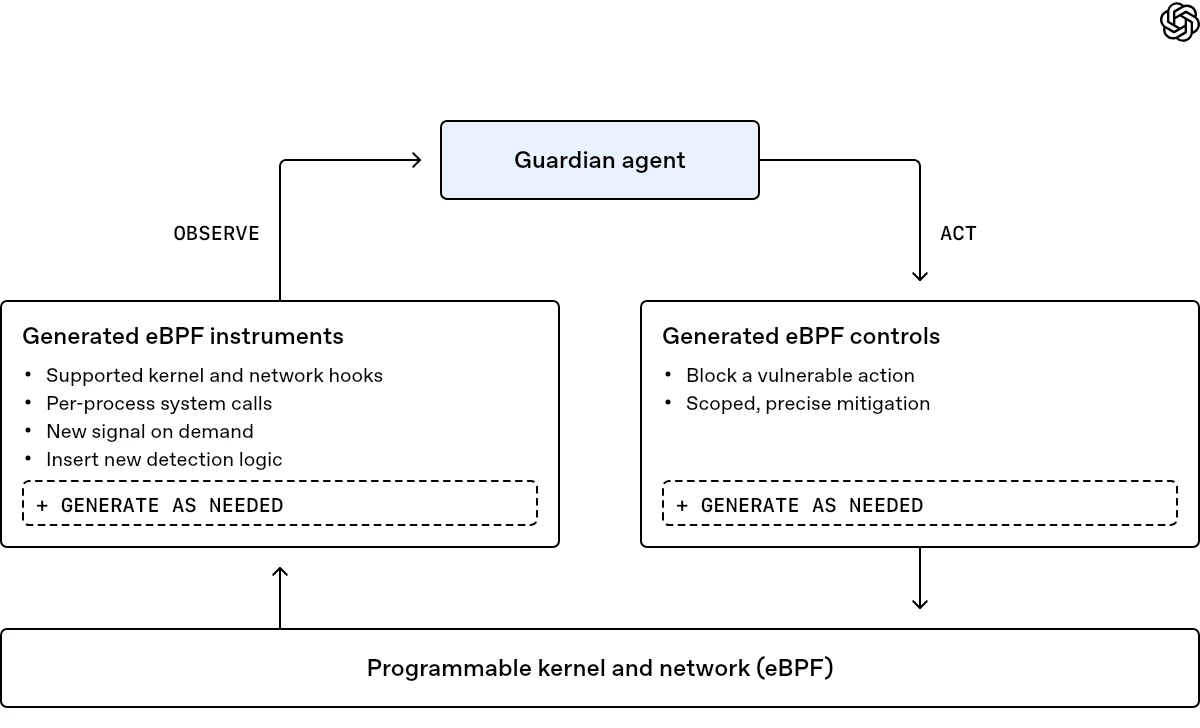
Shirudo lets operators drop signed, tested eBPF shields onto running Linux services while fixes roll out. It's a smart answer to a gap AI itself is widening, and it puts AI-written code inside the kernel.
Key takeaways
- Shirudo is an open-source Linux runtime from OpenAI and Cisco that applies temporary protections, called shields, to running systems without restarts.
- Shields are eBPF programs. They are cryptographically signed, checked by Linux's eBPF verifier before loading, and their loading and removal can be recorded through a TPM.
- In a controlled test, a Codex-generated shield added an input check to Java's Base64 decoder and blocked a Java4Shell exploit attempt on a running Elasticsearch service.
- Operators can watch how a shield would affect applications before enforcing it, and humans approve what gets deployed.
- The code is BSD 2-Clause, with BPF programs dual-licensed BSD and GPL. A technical webinar is set for December 15.
The problem is the waiting room
Security teams have a vocabulary problem with patching. A fix exists, so the vulnerability is considered handled, but the vulnerable service is still running for days or weeks while the patch is tested and rolled out. OpenAI and Cisco's new open-source project, Shirudo, is aimed squarely at that waiting room. It lets operators attach a narrow, temporary protection to a live Linux system that blocks the specific behavior an exploit needs, without taking the service down or restarting it.
OpenAI makes the case plainly in its announcement: an exploit and a legitimate request often go through the same Linux operation, so blocking that operation wholesale can knock the service offline. Shirudo's shields are supposed to be precise enough to stop the bad call and let the good ones through. Whether they are precise enough is something each operator can test before turning enforcement on, and that test-first design is the most important thing about the project.
Why AI makes this gap worse before it makes it better
There's an uncomfortable logic behind the launch. Frontier models are getting good at finding vulnerabilities. We've covered that shift through partnerships like Cloudflare's use of OpenAI models to flag and remediate flaws. Faster discovery is good news for defenders, but only if fixing keeps up. If a model can surface a hundred real bugs in an afternoon and an organization can roll out patches at its usual pace, the list of known-but-unpatched issues gets longer, not shorter. Attackers with similar models find the same bugs.
Shirudo is OpenAI acknowledging that discovery alone doesn't close the loop. Greg Brockman's quote says as much: finding a bug today doesn't mean every system can be patched tomorrow. A stopgap that can be written quickly, tested against real workloads and deployed live is the missing middle piece. Done well, it turns a model's speed at finding problems into something operators can actually use.
Putting machine-written code next to the kernel
The technical choice is eBPF, the Linux mechanism that lets small, sandboxed programs run at specific points inside the operating system. It's a mature technology with a strong safety story, since the kernel's verifier rejects programs that break its rules. OpenAI and Cisco layer more on top: shields are signed and verified before loading, kernel security controls restrict unauthorized changes, and a Trusted Platform Module keeps a verifiable record of which protections were loaded or removed. That last piece is underrated. Auditors and incident responders will want proof of exactly what was running on a host and when, and a hardware-backed log gives them something better than a config file.
Still, the verifier checks that a program is safe to run, not that it's correct. A shield can pass every kernel check and still block legitimate traffic, or miss a variant of the exploit it was written for. The Java4Shell example is instructive. Codex wrote a shield that added an input check to Java's Base64 decoder inside a running Elasticsearch process, and it rejected the malicious input. That's impressive, and it's also one controlled test of one bug. Generated shields will need the same skepticism as generated patches: observe first, enforce second, and keep a human signing off. The project's design says operators control what gets deployed. The risk is that, under pressure during a live incident, teams start approving shields faster than they understand them.
Open by design, and a quiet alliance shift
The licensing is genuinely open: BSD 2-Clause for the runtime, with the BPF programs dual-licensed under BSD and GPL, which matters because GPL compatibility is often a practical requirement for code that touches the kernel. The stated goal of shipping tested shields alongside vulnerability disclosures could change disclosure practice if it catches on. A shared library of shields means one team's work protects everyone running the same software, which is the strongest argument for doing this in public.
The partnership is worth noticing too. When Nvidia assembled its agent-safety coalition in September, OpenAI was conspicuously absent from the public list while Cisco was among the named partners. Now OpenAI and Cisco are building their own open project together, at the operating-system layer rather than the agent layer. It's too early to call that rivalry, but it suggests the defensive tooling around AI is splitting into camps organized by who owns which layer of the stack.
The other open question is scope. Shirudo is described as a first step toward infrastructure with automatically generated, least-privilege policies and verified recovery. That's a big ambition, and a stopgap tool can easily become a permanent crutch. If shields make it comfortable to defer patches indefinitely, the project will have solved the wrong problem. Its success should be measured by how fast real fixes land, not by how long systems can safely avoid them.
Who it affects
- Infrastructure operators
- A tested way to protect live Linux services during patch windows, provided they invest in observing shields before enforcing them.
- Security researchers
- A chance to publish shields alongside disclosures, which could become a new expectation for responsible reporting.
- Software vendors
- Pressure may grow if shields routinely appear before official patches, highlighting slow fix cycles.
- Compliance and audit teams
- TPM-backed records of what protections were loaded and removed give them stronger evidence than configuration snapshots.
What to watch
- Whether shields start appearing alongside major vulnerability disclosures, as the project hopes.
- Independent reports of false positives or bypasses against generated shields in real environments.
- Contributions from Linux distributions and eBPF maintainers beyond OpenAI and Cisco.
- What the December 15 technical webinar reveals about agent autonomy in writing and validating shields.
- Whether competing labs or the Nvidia-led coalition release overlapping kernel-level tooling.
FAQ
What is Shirudo?
An open-source Linux runtime from OpenAI and Cisco that applies temporary eBPF-based protections, called shields, to running systems while permanent patches are prepared.
Does it require restarting services?
No. Shields attach to running systems. In OpenAI's test, a shield protected a live Elasticsearch process without a restart.
Who writes the shields?
People or AI agents. OpenAI's example shield was generated with Codex, but operators approve what gets deployed and can observe a shield's effect before enforcing it.
How are shields kept safe?
They are cryptographically signed, checked by Linux's eBPF verifier and kernel security controls, and a TPM can record when protections are loaded or removed.
What license is it under?
BSD 2-Clause, with its BPF programs dual-licensed under BSD and GPL.
Companies: OpenAI
More on OpenAI
AI · Nov 11, 2026
OpenAI’s $2 million for children’s AI safety research matters for one promise: publishing bad newsAI · Nov 19, 2026
Perplexity opens its in-house model switchboard to developers, refusal routing includedAI · Nov 24, 2026
A general-purpose model reaches into biology's toolbox, and sometimes grabs the right toolAI · Nov 17, 2026
OpenAI says its models now shave area off production chips, including AMD’s next flagships