AI · Sep 30, 2026
The four rules in the White House AI commitment, and the missing fifth: penaltiesNvidia's case for AI factory financing rests on three words: productive, durable and fungible
· Updated · Signal Desk newsroom
Analysis of reporting by NVIDIA Blog. How we work
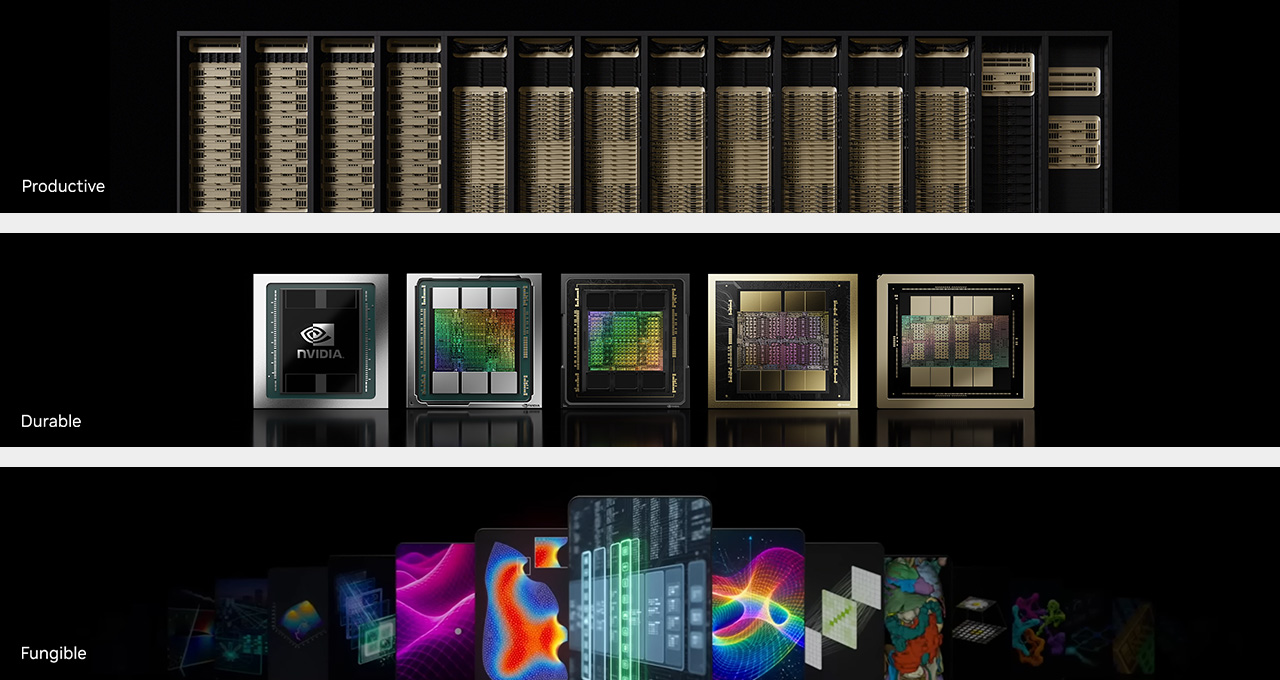
In a company blog post, Nvidia argues that AI factories get financed only when earning capacity, useful life and demand all clear the bar, and pitches its stack on throughput per megawatt, multi-year hardware value and workload flexibility. It cites SemiAnalysis AgentX data claiming large gains for Vera Rubin NVL72 over GB300.
Key takeaways
- Nvidia frames AI factory investment around earning capacity, useful life and demand.
- "Productive" means throughput per megawatt and cost per token.
- "Durable" means hardware that keeps earning years after it ships.
- "Fungible" means running training, inference and non-AI accelerated jobs.
- Nvidia cites SemiAnalysis AgentX data claiming over 30x throughput per megawatt for Vera Rubin versus GB300.
The argument
In a post on its blog, Nvidia argues that AI factories, large data centers built to produce AI output, are financed only when three conditions hold: they can earn enough, they last long enough and there is demand for what they produce. It maps those conditions to three qualities it attributes to its platform. Productive refers to throughput per megawatt and cost per token. Durable refers to hardware that continues to generate revenue for years after shipping. Fungible refers to the ability to switch among training, inference and non-AI accelerated computing as demand changes.
The framing is aimed at operators and financiers who must justify capital spending against power budgets and depreciation schedules, rather than at engineers comparing peak compute figures.
The numbers Nvidia cites
The post cites SemiAnalysis AgentX benchmark data claiming that Vera Rubin NVL72 delivers more than 30 times higher throughput per megawatt than GB300 NVL72, and up to 45 times lower cost per million tokens on DeepSeek V4 Pro. Nvidia attributes the gains to full-stack codesign across chips, networking and software, and to ongoing optimization in its CUDA-X libraries. These are vendor-promoted figures from a specific benchmark and workload, and earlier posts made related efficiency claims, including up to 30x more work per watt and tokens-per-watt advances at AI Infra Summit.
Nvidia also argues that cheaper tokens expand demand rather than shrink spending, a version of the Jevons paradox applied to AI. If that holds, efficiency gains translate into more usage and more infrastructure rather than smaller budgets.
How to weigh it
The productive-durable-fungible lens is a reasonable way to think about infrastructure risk, and it reflects real buyer concerns about whether older GPU generations keep earning or require early replacement. It also serves Nvidia's interest in persuading customers that its hardware holds value across product cycles. Independent replication of the Vera Rubin versus GB300 token-cost claims, and customer data on multi-year utilization of older systems, would make the case stronger.
Power is the other constraint. Measuring output per megawatt makes grid capacity a central planning issue, and utility interconnection timelines for announced campuses may limit how fast any of this scales. Related reading includes From Megawatts to Tokens. More in our Nvidia coverage and business coverage.
Who feels it
- AI factory operators
- Financing models built on tokens per megawatt, residual life and workload mix.
- Cloud buyers
- Questions about how older GPU generations keep earning.
- Energy policymakers
- Large AI plants make grid planning central.
What to watch
- Independent replication of Vera Rubin token-cost claims.
- Customer data on multi-year GPU utilization.
- Utility interconnection timelines for announced campuses.
FAQ
What does productive mean here?
Throughput per megawatt and cost per token.
What is the main performance claim?
Over 30x throughput per megawatt and up to 45x lower token cost for Vera Rubin versus GB300, per SemiAnalysis AgentX data Nvidia cites.
Is this independent analysis?
No. It is an Nvidia blog post citing third-party benchmark data.
Why does fungibility matter?
Hardware that can switch workloads keeps earning as demand shifts.
Companies: NVIDIA
More on NVIDIA
AI · Oct 7, 2026
Microsoft prices its first RTX Spark PCs; the agent sandbox coming to all Windows 11 users may matter moreAI · Sep 24, 2026
Nvidia, DeepMind and EMBL-EBI release predicted structures for protein complexes from 2,800-plus virusesAI · Oct 21, 2026
Europe’s banks are training their own AI on open weights, with Nvidia underneathAI · Oct 21, 2026
Nvidia turns Cosmos into a synthetic-data factory for robots’ rarest, riskiest moments