AI · Nov 16, 2026
Rubin HPC is Nvidia’s bet that science agents will be bottlenecked by simulation, not reasoningSakana squeezes research skills out of Nvidia's smallest Nemotron, and trades away memory to do it
· Updated · Signal Desk newsroom
Analysis of reporting by MarkTechPost. How we work
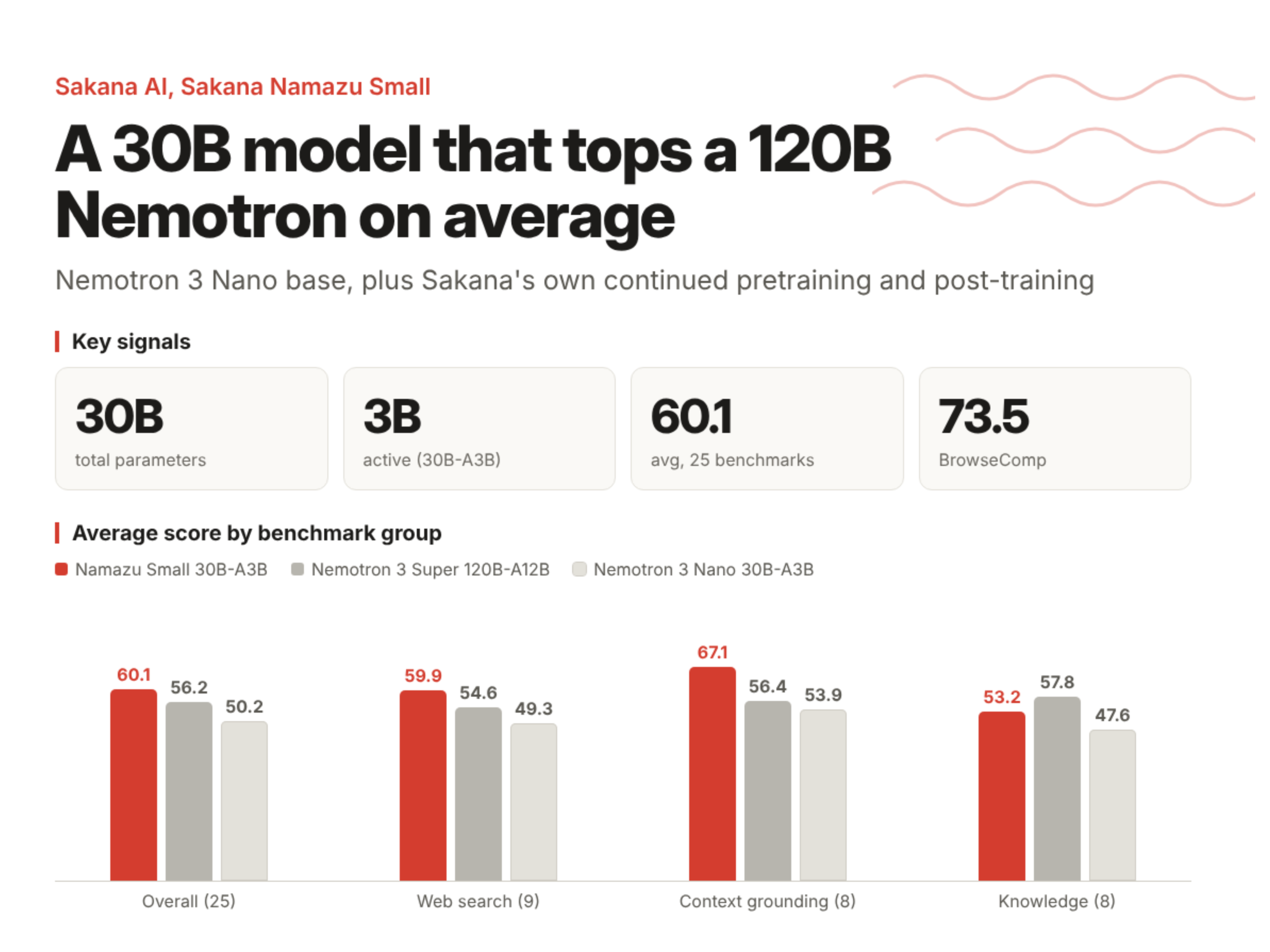
Namazu Small shows a 3B-active model can out-browse a 120B sibling on Sakana's own tests, but weak closed-book recall and unreleased weights keep it a promising lab result for now.
Key takeaways
- Sakana AI announced Namazu Small, a 30B-parameter reasoning model with 3B active parameters, built from the pretrained base of Nvidia's Nemotron 3 Nano, according to MarkTechPost.
- Sakana says it averages 60.1 across 25 benchmarks, ahead of Nemotron 3 Super (56.2) and Nemotron 3 Nano (50.2); all scores are self-reported.
- Web research is the standout: 73.5 on BrowseComp versus 36.1 for Super and 29.3 for Nano, and 84.3 on DeepSearchQA versus 65.4 for Super.
- Closed-book knowledge lags badly: 6.8 on SimpleQA Verified, below Nano's 9.1 and Super's 18.1, and Sakana concedes internal-knowledge tasks barely improved.
- Per benchmark it beats Super on 13 of 25 tests and Nano on 22 of 25.
- Weights are not released, and license, context length, hardware and pricing are undisclosed; on-prem details are due in December 2026.
A small model with a narrow, sharp edge
Sakana AI, the Japan-based lab, has a new entry in its Namazu line, and the headline number is designed to turn heads. According to MarkTechPost, Sakana Namazu Small is a 30-billion-parameter reasoning model that activates about 3 billion parameters per token, built on Nvidia's Nemotron 3 Nano. Sakana reports it averages 60.1 across a 25-benchmark suite, beating Nvidia's own Nemotron 3 Super, a 120B model with 12B active, which scored 56.2. The Nano it started from scored 50.2.
Taken at face value, a model with a quarter of the total parameters and a fraction of the active compute beating a bigger sibling is a strong result. But the interesting part isn't the average. It's the shape of the scores underneath it, which tell a clear story about what post-training can buy, and what it can't.
How Sakana built it
MarkTechPost reports Sakana did not start from Nvidia's finished, post-trained Nano. It took the pretrained base, then ran its own continued pretraining and post-training, layering new techniques on top of methods it developed for the original, larger Namazu. That bigger model is built on Kimi K2.6; Sakana uses the Namazu name for models it builds from open releases and finishes with its own training.
The underlying architecture comes along for the ride. Nemotron 3 Nano is a hybrid Mamba-Transformer mixture-of-experts design, which Nvidia lists at 30B total and 3B active parameters, with context up to 1 million tokens. Sakana has not disclosed Namazu Small's context length, so it isn't safe to assume it inherits the full window.
This is a good example of what open base models are for. We have tracked Nvidia's steady expansion of the Nemotron family, from the 120B multimodal Super VL to small local models, with a pitch that partners will post-train their own specialists. Sakana is doing exactly that, and arguably doing it better on some tasks than Nvidia's own post-training. That should please Nvidia more than embarrass it: every strong derivative is an advertisement for the base.
It reads well and searches well
The gains are concentrated where Sakana aimed them: web research, long-document question answering and following instructions grounded in context. MarkTechPost's breakdown shows Namazu Small at 59.9 on the nine web-search benchmarks versus 54.6 for Super, and 67.1 on the eight context-grounding and instruction-following tests versus 56.4 for Super.
Individual results are striking. BrowseComp, an agentic browsing test, comes in at 73.5, roughly double Super's 36.1. DeepSearchQA hits 84.3 against Super's 65.4. On grounded long-document work, LLM-jp LongBench rises to 86.0 from the Nano baseline's 67.0, and FaithEval reaches 78.3 versus 59.1 for Super. Citation-oriented tasks look solid too, with LongBench-Cite at 80.2 and ALCE at 60.2.
The pattern makes sense. These are skills about using information in front of the model: finding it, organizing it, citing it, staying faithful to it. A small active parameter count doesn't hold that back much if training teaches good procedure. For anyone building research agents or document assistants, that is the useful lesson.
It doesn't remember much on its own
Now the other side. On the eight knowledge benchmarks, Namazu Small averages 53.2, below Super's 57.8. SimpleQA Verified, which checks short factual recall, comes in at 6.8, lower than both Nano's 9.1 and Super's 18.1. Japanese SimpleQA is 8.0 versus Super's 24.9, and HealthBench drops to 40.6, under Nano's 47.5. Sakana itself acknowledges that tasks relying only on internal knowledge didn't improve much.
I find that candor useful, and the trade-off honest. A 3B-active model simply has less room to store facts, and research-style training doesn't add them. But it carries a real risk. A model that is great at reasoning over retrieved material and weak at recall must be deployed with retrieval, every time. Put it in a setting without search or documents, especially something like health questions, and the confident step-by-step reasoning style could dress up poor answers. The HealthBench dip is the number I'd want deployers to read twice.
It also complicates the headline. Beating Super on 13 of 25 tests is a split, not a sweep. The average win comes from very large leads in the browsing and grounding categories, which pulls the mean up. Against its own base, the improvement is broader, winning 22 of 25.
Self-reported, unreleased, and undisclosed
Every number here comes from Sakana, measured on Sakana's suite, MarkTechPost notes. That doesn't make them wrong, but until outside evaluators run the model, these are claims. And right now outsiders can't: the weights are not released, and the license, context length, hardware requirements and pricing are all undisclosed. Sakana says details on on-premises use are coming in December 2026 and describes the model as small enough to run in a customer's own environment.
That on-prem angle is the strategic tell. A 3B-active model on a base Nvidia designed for DGX Spark, H100 and B200 hardware is a natural fit for companies, particularly in Japan, that want research and document assistants without sending data to a cloud API. If Sakana delivers practical deployment terms, Namazu Small could be a meaningful option for sovereign or regulated workloads. If the terms stay vague, it remains an impressive chart. December will tell us which.
Who feels it
- Enterprise and on-prem buyers
- A compact model aimed at local deployment could handle research and long-document work, pending license, hardware and pricing details.
- Agent and RAG builders
- Strong browsing and grounded-QA scores suggest small models can anchor research agents, provided retrieval is always in the loop.
- Nvidia
- A partner beating Nvidia's own bigger model using the Nemotron base strengthens the case for its open-model strategy.
- Evaluators and researchers
- Self-reported results with no released weights leave independent verification as the open question.
What to watch
- Sakana's promised December 2026 on-prem details, including license, hardware and pricing.
- Whether weights are released so outside groups can reproduce the 25-benchmark results.
- Disclosure of Namazu Small's context length relative to the Nano base's 1M-token window.
- Independent tests of closed-book and health accuracy, where Sakana's own numbers are weakest.
- More partner models post-trained from Nemotron bases that beat Nvidia's own releases.
FAQ
What is Namazu Small built on?
The pretrained base of Nvidia's Nemotron 3 Nano, a hybrid Mamba-Transformer mixture-of-experts model, with Sakana's own continued pretraining and post-training, per MarkTechPost.
How big is it?
30 billion total parameters with about 3 billion active, labeled 30B-A3B.
Does it really beat Nemotron 3 Super?
On Sakana's 25-benchmark average, 60.1 to 56.2, and on 13 of 25 individual tests; the scores are self-reported.
Where is it weak?
Closed-book knowledge, such as SimpleQA Verified at 6.8 and HealthBench at 40.6.
Can I download it?
Not yet. Weights aren't released; Sakana says on-prem details are due in December 2026.
Companies: NVIDIA
More on NVIDIA
AI · Nov 9, 2026
Nvidia’s Korean startup bets span interconnect, open models, robot hands and document AIAI · Nov 8, 2026
Nvidia’s Dynamo recipes speed four Korean open models to production, tuned for B200sAI · Nov 6, 2026
Nvidia’s open Aerial and Sionna 6G tools pass a million downloads as labs report latency, receiver and power gainsAI · Nov 19, 2026
At Ignite, Nvidia and Microsoft pitch one stack from Vera Rubin racks to RTX Spark laptops