AI · Nov 18, 2026
Meta now lets agents carry most ad-model upgrades across its fleet, and claims $45 million in compute savingsFacebook's Your Algorithm shows how far Meta will explain its feed, and where the explanation stops
· Updated · Signal Desk newsroom
Analysis of reporting by MarkTechPost. How we work
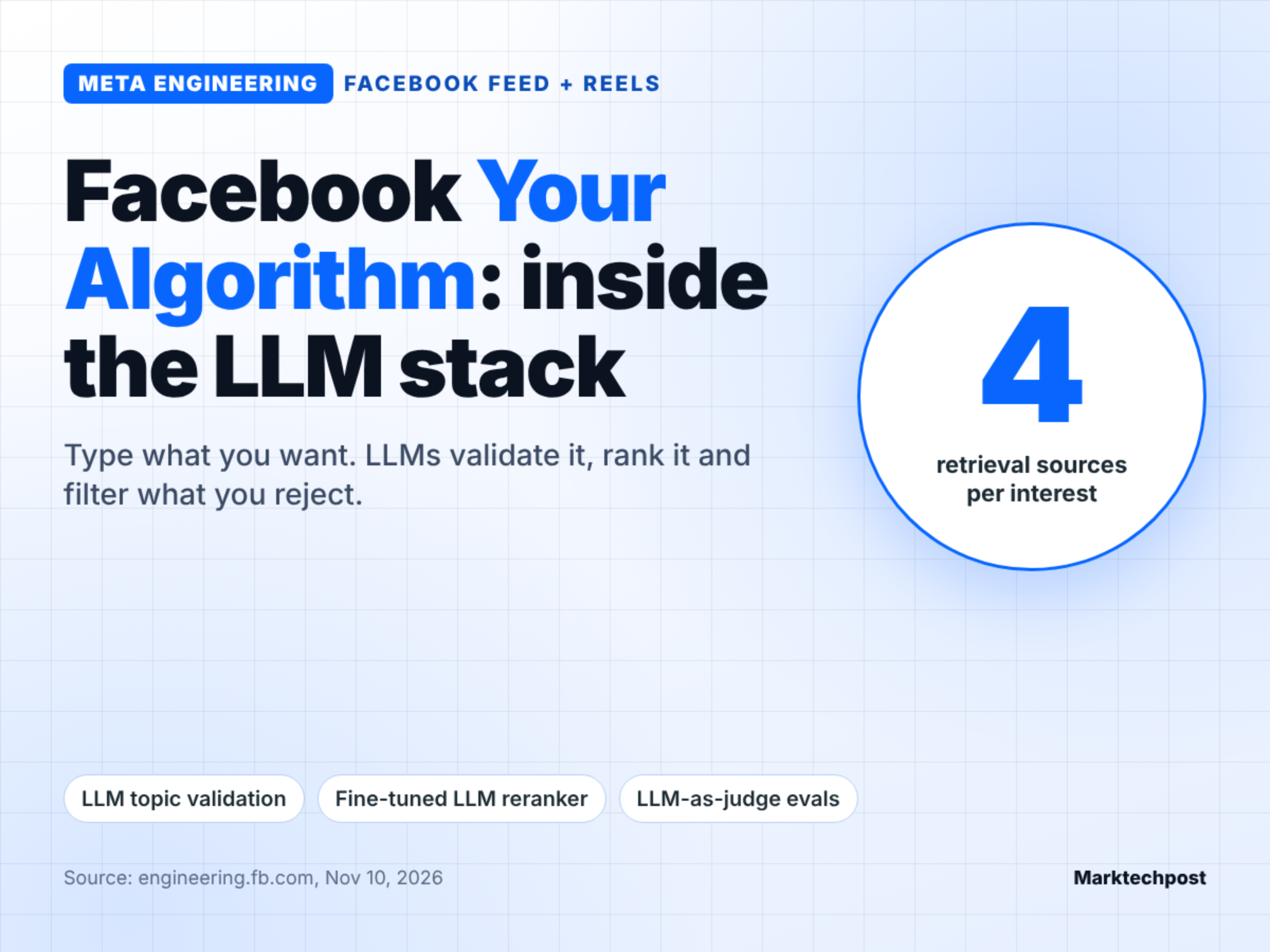
Meta's engineering write-up on Your Algorithm is the most detailed public look at LLMs steering a mainstream feed. It explains the machinery in unusual depth, yet offers no numbers to show whether typed preferences actually win.
Key takeaways
- Facebook's Your Algorithm, announced October 13, 2026, lets people tell Feed and Reels in plain language what they want more and less of, MarkTechPost reports from Meta's engineering post.
- LLMs run the whole lifecycle: turning activity into readable topics and a one-line summary, validating typed interests on a smaller model, and helping enforce exclusions.
- Each interest drives four retrieval sources, with daily caps, spacing and temporary extra weight for new interests to avoid flooding.
- Exclusions pass through embedding filters, demotion rules, a small fine-tuned LLM reranker that returns only items to remove, and on-device cache invalidation.
- Meta discloses no metrics and no model names, so its effectiveness claims can't be checked from the outside.
A rare look inside the box
For years, the standard complaint about social feeds has been that nobody outside the company can see how they work. Meta's engineering post on Facebook's Your Algorithm, summarized by MarkTechPost, is a meaningful exception. It lays out how a typed phrase like a hobby or a topic to avoid moves through the ranking system: an LLM cleans it up and checks it's a real topic, the system attaches an embedding and search keywords, and the preference lands in a shared store that both Feed and Reels read from.
That level of detail deserves credit. We first covered the launch in October in Facebook's plain-language controls for Feed and Reels, and then Meta's own engineering account in our breakdown of how a typed preference is meant to beat engagement. MarkTechPost's comparison adds something useful: among Facebook, Instagram, Threads, YouTube and TikTok, Facebook is the only one in its table that has published engineering details for its preference controls at all.
The clever part is what the model doesn't do
The most interesting design choice is the reranker. Rather than asking a large general-purpose model to judge every candidate post, Meta trained a small model to output only the items that should be removed. According to the write-up, that smaller fine-tuned model beat a general-purpose one on both speed and reliability. A short removal list is cheaper to produce than a score for every item.
This is the kind of applied AI we like to see. It treats the LLM as a narrow tool with a specific job instead of a magic oracle sitting on top of the stack. It also hints at where production AI is heading generally: smaller specialized models doing tightly scoped work inside larger systems, with the big models reserved for the messy language parts like understanding what someone meant when they typed a vague interest. The same pattern of careful, unglamorous engineering shows up in Meta's work like the TLX extensions for Triton GPU kernels.
Control without a scoreboard
Here's the gap. Meta's post describes the machinery but, as MarkTechPost notes, discloses zero metrics and no model names. We don't know how often an exclusion actually holds, how much a typed interest moves what people see, or how quickly the extra weight on a new interest fades back into normal engagement ranking. The design itself includes caps on how much each interest can contribute per day. That's sensible for avoiding a feed flooded by one topic. It also means the engagement model stays in charge, with stated preferences as a bounded adjustment.
That's the honest tension in any feature like this. Facebook's business runs on engagement, and a system that let people fully override it would cost money. Users deserve to know how much weight their words carry. A simple published figure, such as the share of excluded topics that still slip through, would turn a nice engineering story into something people could hold Meta to.
Stated preferences are also data
There's one more angle the engineering story doesn't cover. When people type what they're interested in, they hand Meta a cleaner signal of intent than any click. Meta is building agents across its apps, and this month put its Muse agent directly into Instagram DMs with shopping front and center. Nothing in the source says Your Algorithm preferences feed ads or Muse, and we're not claiming they do. But it's a fair question for Meta to answer in public: are typed preferences used only to rank the feed, or anywhere else?
We're broadly in favor of features that let people steer their own feeds in their own words. The quality filters, which let someone ask for less AI-generated or sexually suggestive content and route that to dedicated demotion signals, are exactly the kind of control that has been missing. Pair that with a few real numbers and a clear data-use promise, and Your Algorithm could become a template others follow.
Who it affects
- Facebook users
- They can steer Feed and Reels in plain language, though the effect of each preference is capped and unmeasured in public.
- Recommender engineers
- The post offers a rare blueprint for wiring explicit, LLM-parsed preferences into an engagement ranking stack, including a removal-only reranker.
- Creators
- Users can now exclude specific creators and topics directly, making audience preferences a more explicit factor in reach.
- Rival platforms
- YouTube, TikTok and others offer similar controls with far less disclosure, which raises the bar on transparency.
What to watch
- Whether Meta publishes any effectiveness metrics, such as how often exclusions hold.
- Disclosure of which regions get Facebook's Your Algorithm, which Meta has not specified.
- A clear statement on whether typed preferences are used for ads or agents.
- Whether competitors publish comparable engineering details for their own feed controls.
- How long the temporary boost on new interests lasts in practice.
FAQ
What is Facebook's Your Algorithm?
A preference page for Feed and Reels with a one-line summary of recent viewing, an Interested In list prefilled from past activity, and a Not Interested In list. Users can type, move or delete topics in plain language.
How does Meta keep excluded topics out?
According to Meta's engineering post as summarized by MarkTechPost, exclusions are enforced through embedding filters, demotion rules, a fine-tuned LLM reranker and on-device removal of cached items.
Does Meta say how well it works?
No. MarkTechPost notes that Meta disclosed no metrics or model names, so claims about effectiveness can't be independently verified.
Companies: Meta
More on Meta
AI · Nov 19, 2026
Apple wants to build the Mac agent it is warning users aboutAI · Nov 13, 2026
A week with Claude Duet: good at catching what falls between apps, shaky on tone and urgencyAI · Nov 10, 2026
Anthropic moves beyond coders with Claude Meetings, Sheets and WhiteboardsAI · Nov 9, 2026
Meta’s Muse Ember prices agent grunt work at 10 cents per million tokens